
City pigeons are easy to walk past without a second look. Look a little closer, and they start to surprise you.
These 52 facts are all checked against published sources: museum collections, official records, and peer-reviewed studies. The ten that tend to startle people most come first. Most of the list concerns the rock dove and the feral pigeons that live with us in towns and cities, though a few facts reach across the wider pigeon family.

The 10 most surprising facts
- 1
They can be trained to spot cancer on medical images
After training with food rewards, pigeons in a 2015 study learned to tell cancerous from benign breast tissue on microscope slides, including slides they had not seen before. Accuracy rose from chance to nearly 85% within about two weeks, and when four birds’ choices were pooled the group reached 99% on uncompressed images. They also learned to spot tiny calcium deposits on mammograms (84% on familiar images, 72% on new ones), but they could not apply that learning to the harder task of judging suspicious masses. This is evidence of how much pigeons can learn, not a proposal to replace doctors.
Sources: PLOS ONE (Levenson et al., 2015) (opens in new tab) and University of California (opens in new tab).
- 2
They can tell a Picasso from a Monet
Pigeons trained to tell Monet paintings from Picasso paintings kept the distinction when shown works they had never seen. They also treated other Impressionists as Monet-like and other Cubists as Picasso-like. Colour and sharp edges were not the only cues: the birds still did well on grey and slightly blurred images.
- 3
The dodo was a pigeon
The dodo belonged to the pigeon and dove family. DNA work led by researchers at the University of Oxford placed the dodo and the Rodrigues solitaire with the pigeons, and found that the Nicobar pigeon is their closest living relative.
Source: Oxford University Museum of Natural History (opens in new tab).
- 4
They once outperformed aircrew at spotting life-jackets
In US Coast Guard trials from the late 1970s, known as Project Sea Hunt, trained pigeons rode in a clear bubble under a helicopter and pecked a key when they saw a red, orange or yellow object on the water. They found test markers 90% of the time, compared with 38% for the human crew. The work stayed experimental and was not taken into everyday search and rescue.
Source: The Christian Science Monitor, 1981 (opens in new tab).
- 5
They can tell the letters of the alphabet apart
In a 1982 experiment, pigeons learned to tell each of the 26 letters of the English alphabet from the other 25. A later study found they could also learn to tell real four-letter English words from made-up strings of letters. That is visual pattern learning, not reading as a person reads a sentence.
Sources: Science (Blough, 1982) (opens in new tab) and PNAS (Scarf et al., 2016) (opens in new tab).
- 6
Cher Ami is still on display in Washington
Cher Ami, a US Army Signal Corps pigeon, is credited with carrying a message from the ‘Lost Battalion’ in the Argonne Forest on 4 October 1918, after American artillery had begun falling on the trapped men. Accounts describe a flight of about 25 miles in a little under half an hour, with the bird arriving badly wounded. France awarded the Croix de Guerre. DNA testing by the Smithsonian in 2021 showed that Cher Ami was male. His mounted skin is at the National Museum of American History. Pigeons served in both world wars.
Sources: Smithsonian National Museum of American History (opens in new tab) and National Museum of the United States Army (opens in new tab).
- 7
More pigeons have won the Dickin Medal than any other bird
The PDSA Dickin Medal, first awarded in 1943 and often called the animals’ Victoria Cross, has been given 75 times, plus one honorary medal. Thirty-two of those awards went to pigeons, more than to any other bird.
Source: PDSA Dickin Medal (opens in new tab).
- 8
One racing hen sold for €1.6 million
In November 2020 a Belgian racing pigeon hen called New Kim sold at auction for €1.6 million (about $1.9 million or £1.4 million), a world record listed by Guinness. The previous record was €1.25 million for a cock called Armando in 2019.
Sources: BBC News (opens in new tab) and Guinness World Records (opens in new tab).
- 9
A flock once seemed to darken the sky for a day
The passenger pigeon was once among the most numerous birds in North America. In 1813 John James Audubon described a flock that darkened the Kentucky sky all day, and estimated it might have contained as many as a billion birds. The last known bird, Martha, died at Cincinnati Zoo on 1 September 1914. She is now at the Smithsonian’s National Museum of Natural History.
- 10
Both parents make milk for their chicks
Both the male and the female feed their young on crop milk, a thick, cheese-like secretion from the lining of the crop. It is the chicks’ only food for the first days of life. Among birds, a similar secretion is also known in flamingos and emperor penguins.
Sources: Cornell Lab of Ornithology, All About Birds (opens in new tab) and BTO (opens in new tab).
Minds, senses and how they find their way
They can tell a live image of themselves from a recording
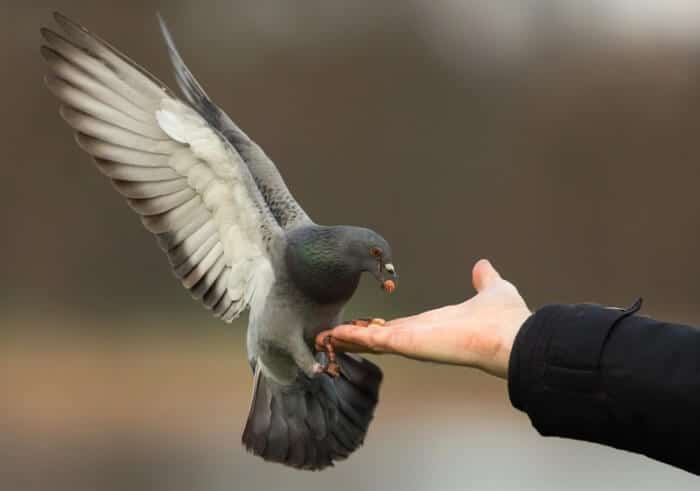
Trained pigeons in a 2008 study learned to peck at a live video of themselves more than at a pre-recorded film of the same bird. They still preferred a slightly delayed live picture to a new recording, though the effect faded as the delay grew. The birds were trained for the task, so this is not the same as the untrained mirror test used with some apes, and it is not a fair comparison with young children.
Source: Animal Cognition (Toda and Watanabe, 2008) (opens in new tab).
City pigeons remember who is friendly and who is not
In a Paris park study, feral pigeons quickly learned to tell a person who fed them from a person who chased them away. They kept avoiding the unfriendly person even after the two people swapped coats, which points to stable features such as face and body, not just clothing colour.
Source: Animal Cognition (Belguermi et al., 2011) (opens in new tab).
They can see ultraviolet light
Pigeons can discriminate patterns and wavelengths in the near ultraviolet, a part of the spectrum people cannot see. Their colour vision is broader than ours, which is worth remembering when we judge how a city street or a loft must look to them.
Source: Journal of Comparative Physiology (Emmerton and Delius, 1980) (opens in new tab).
They can hear sounds far below the human range
Homing pigeons can detect infrasound down to 0.05 hertz, at least 50 decibels more sensitive than people below 10 hertz. Distant storms and other large events produce energy in that range. That is a measured hearing ability, not proof that pigeons forecast the weather or sense volcanoes.
Source: Journal of Comparative Physiology (Kreithen and Quine, 1979) (opens in new tab).
The head bob is a way of seeing, not a nervous tic
When a pigeon walks, the head is held still in space, then thrust forward as the body catches up. The hold keeps the image on the retina steady. In a classic treadmill test, birds stopped the bob when the visual world around them was held still. So when you see pigeons bob their heads in the street, they are stabilising their view.
Some homing pigeons follow roads
GPS tracks of experienced homing pigeons around Rome showed that the birds often followed highways and a railway even when a straighter line would have been shorter. They usually left the road when it no longer led toward home, though some continued to a major junction. Road-following increased with practice, which fits a learned way to find their way home.
Sources: Current Biology (Lipp et al., 2004) (opens in new tab) and Scientific American (opens in new tab).
They drink with their heads down, like a straw
Most birds scoop water and tip the head back to swallow. Pigeons and doves can drink with the bill in the water, using it like a straw, and keep their heads down as they do so.
Source: Cornell Lab of Ornithology, All About Birds (opens in new tab).
Flight, size and city life

In still air they are unlikely to exceed about 60 mph
Guinness World Records says it is very doubtful that any pigeon exceeds about 96 km/h (60 mph) in level flight in windless conditions. Everyday race speeds are often lower than that. For more on how fast pigeons fly, including how race velocity is measured, see our speed guide.
The fastest recorded race had a strong tailwind behind it
The highest race speed listed by Guinness is 177.14 km/h (110.07 mph), from an East Anglian Federation race out of East Croydon on 8 May 1965. The 1,428 birds had a powerful south-south-west wind behind them. That figure is ground speed over the course, not a still-air flying speed.
The largest living pigeon can exceed 80 cm and 3.5 kg
The world’s largest wild pigeon is the Victoria crowned pigeon of New Guinea. Guinness records that it can exceed a length of 80 cm (about 2 ft 7 in) and a weight of 3.5 kg (7 lb 11 oz). At the other end of the family are small ground doves and fruit doves, some of them not much bigger than a sparrow.
The family includes 339 living species
The IOC World Bird List, version 15.2 (2026), recognises 339 living species of pigeons and doves, in 52 genera. The same list also includes extinct members of the family, among them the dodo and the passenger pigeon.
Source: IOC World Bird List (v15.2, 2026) (opens in new tab).
The pigeons in our streets are rock doves at heart
Feral pigeons are the free-living descendants of the domestic rock dove (Columba livia). Truly wild rock doves in the UK are now confined to remote northern coasts and islands, where they nest in sea caves and on cliff ledges.
Sources: BTO BirdFacts, Rock Dove (opens in new tab) and RSPCA (opens in new tab).
City ledges stand in for sea cliffs
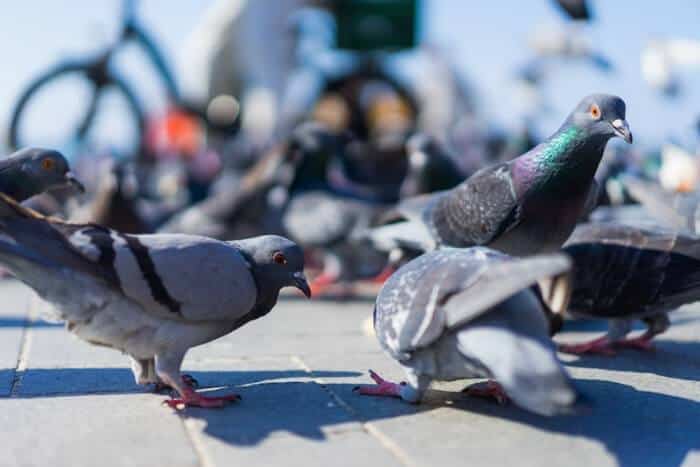
Rock pigeons nest on a nook, cranny or ledge, on cliffs or on buildings, often under an overhang. In towns they use ledges, rooftops and other cliff-like spots such as windowsills, bridges, stairwells and abandoned rooms, because those places resemble the cliffs their wild ancestors used.
Sources: Cornell Lab of Ornithology, All About Birds (opens in new tab) and BTO BirdFacts, Rock Dove (opens in new tab).
A messy nest can become a solid one
The female builds a flimsy platform of straw and sticks from material the male brings one piece at a time. Pigeons reuse the same nest for later broods and do not carry away the chicks’ droppings. Over time the mess hardens into a sturdier, pot-like mound.
Sources: Cornell Lab of Ornithology, All About Birds (opens in new tab) and RSPCA (opens in new tab).
The disease risk is real, but it is often overstated
Droppings can carry diseases such as psittacosis, histoplasmosis and cryptococcosis, usually when dried material is stirred into dust and breathed in. New York City’s health department says the risk is rare and highest for people with weakened immune systems. A routine wipe of a windowsill is not a serious risk for most people, but cleaning up droppings still calls for gloves, wetting the material, and a good wash afterwards. In England, fewer than 10 PCR-confirmed psittacosis cases are usually reported each year, from all bird sources, not pigeons alone.
Sources: New York City Department of Health (opens in new tab) and GOV.UK, UK Health Security Agency (opens in new tab).
They often gather in large flocks
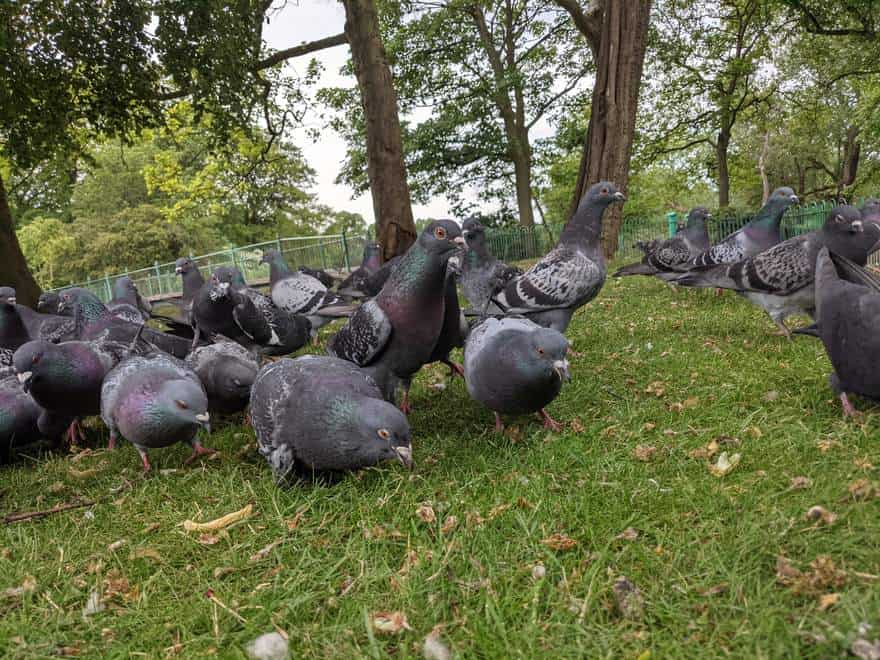
Rock pigeons may gather in large flocks in urban parks where people feed them, and they also feed on seeds, grain and food left behind in streets. The old claim that a typical group is 20 to 30 birds is too neat: flock size varies a great deal with food and roost sites.
Source: Cornell Lab of Ornithology, All About Birds (opens in new tab).
There are an estimated 140 million rock pigeons in the world
Partners in Flight, cited by the Cornell Lab of Ornithology, estimates a global breeding population of 140 million rock pigeons, with about 7% in the United States. The species is of low conservation concern, even though North American numbers fell by 46% between 1966 and 2015.
Source: Cornell Lab of Ornithology, All About Birds (opens in new tab).
In the UK a typical bird that reaches breeding age lives about three more years
BTO ringing data give a typical life expectancy of three years once a rock dove or feral pigeon has reached breeding age, which is usually at one year. The oldest bird on the UK ringing scheme, as of 2010, was 7 years, 8 months and 25 days. Many city birds die younger through collision, disease or poor food.
Sources: BTO BirdFacts, Rock Dove (opens in new tab) and RSPCA (opens in new tab).
Eggs, chicks and family life

The usual clutch is two white eggs
BTO records a typical clutch of two eggs (sometimes one). Cornell gives a range of one to three. The eggs are white, and both parents take turns to incubate them.
Sources: BTO BirdFacts, Rock Dove (opens in new tab) and Cornell Lab of Ornithology, All About Birds (opens in new tab).
The male sits by day, the female by night
The male incubates from mid-morning to late afternoon. The female takes late afternoon, overnight and through to mid-morning. Incubation usually lasts 16 to 19 days.
Sources: Cornell Lab of Ornithology, All About Birds (opens in new tab) and BTO BirdFacts, Rock Dove (opens in new tab).
Squabs leave the nest looking almost like adults
Cornell gives a nestling period of 25 to 32 days. By then the young are close to adult size, which is why people almost never see a baby pigeon on a pavement. The first feathers hide the yellow or white down they hatch with.
Source: Cornell Lab of Ornithology, All About Birds (opens in new tab).

A pair can raise several broods in a year
Cornell lists one to six broods a year. BTO gives a typical figure of five or more. In towns, pigeons may nest in any month, with a peak from late spring to early summer, and they often return to the same site.
Sources: Cornell Lab of Ornithology, All About Birds (opens in new tab), BTO BirdFacts, Rock Dove (opens in new tab) and RSPCA (opens in new tab).
Pairs share the work of nest, eggs and chicks
A male courts by bowing, cooing, inflating his throat and walking in a circle. The pair may preen one another, and the male may offer regurgitated food. Once a nest is started, both birds incubate, brood and feed the young. That is a lasting working partnership, though it is safer not to call every pair a lifelong match: birds can re-pair if a mate is lost, and the studies cited here describe how the pair shares the work rather than proving lifelong monogamy.
Source: Cornell Lab of Ornithology, All About Birds (opens in new tab).
Chicks are helpless at first and grow on crop milk
Newly hatched squabs are helpless, with only sparse yellow or white down. Both parents brood them and feed them crop milk, then gradually add softened seed. That early diet is one reason the young can grow so fast in the nest.
Sources: Cornell Lab of Ornithology, All About Birds (opens in new tab) and BTO (opens in new tab).
History, war and the post

Darwin used fancy pigeons to show what selection can do
Charles Darwin kept fancy pigeons and made them a central example in his work on variation. Victorian readers already knew how far breeders had taken pouters, tumblers and carriers from a common wild ancestor, the rock dove. He used that familiar variation to argue that selection, given time, can change a living form a great deal.
Reuters first beat the train with 45 pigeons
In 1850, just before he founded Reuters in London, Paul Julius Reuter used a fleet of 45 pigeons to carry news and stock prices between Brussels and Aachen in about two hours, six hours faster than the railway. The service filled a gap until the telegraph joined the two cities.
New Zealand ran one of the world’s first airmail services by pigeon
In 1896 a New Zealand Herald reporter on Great Barrier Island sent his story to Auckland with a pigeon named Ariel, which arrived in less than two hours. The Great Barrier Pigeongram Agency opened in 1897 and ran until 1908, when an undersea telegraph cable made it unnecessary. The idea followed the 1894 wreck of the SS Wairarapa off the island, in which 121 people died and the news took several days to reach the mainland. The unofficial stamps issued for the service are often described as the world’s earliest airmail stamps.
Source: Museum of New Zealand Te Papa Tongarewa (opens in new tab).
India’s last official police pigeon post ended in 2008
Odisha police began a carrier-pigeon service after the Second World War and once used it to reach places without a reliable telephone or wireless link, including during the 1982 floods. The state ended the official messenger service in March 2008. About 150 birds were kept on for ceremonial flights, which were still being flown a decade later.
Source: The Hindu (opens in new tab).
G.I. Joe arrived in time to stop a bombing run
On 18 October 1943, British troops took the Italian village of Calvi Vecchia earlier than planned. An Allied air attack on the village had already been scheduled. G.I. Joe, a US Army pigeon, flew 20 miles in 20 minutes with a message to call the raid off, reaching the airfield as the bombers were preparing to take off. The PDSA credits him with saving at least 100 Allied soldiers, and many civilians. He was the first non-British recipient of the Dickin Medal and lived to 18.
Source: PDSA, G.I. Joe (opens in new tab).
Gustav brought the first news from the Normandy beaches
Gustav (NPS.42.31066) received the Dickin Medal for delivering the first message from the Normandy beaches, sent from a ship off the beach-head, while serving with the RAF on 6 June 1944.
Source: PDSA Dickin Medal (opens in new tab).
Paddy made the best recorded time back from Normandy
Paddy (NPS.43.9451), an Irish-bred RAF pigeon, received the Dickin Medal on the same day as Gustav, for the best recorded time with a message from the Normandy operations in June 1944.
Source: PDSA Dickin Medal (opens in new tab).
Pigeons also helped to find ditched air crews
Winkie and White Vision were among the first pigeons to receive the Dickin Medal, on 2 December 1943. Both were honoured for delivering a message in difficult conditions and helping in the rescue of an air crew, Winkie in February 1942 and White Vision in October 1943. Other medal citations record flights from forced landings and from the sea.
Source: PDSA Dickin Medal (opens in new tab).
Some wartime pigeons covered 400 to 500 miles
PDSA citations include Mercury, honoured for a 480-mile flight from northern Denmark in July 1942; Princess, who flew about 500 miles, mostly over the sea, from a mission to Crete back to her loft at RAF Alexandria; and All Alone, who carried a message 400 miles in a day in August 1943. Those are among the longer documented wartime flights, and they sit with other records of how far a homing pigeon can fly.
Source: PDSA Dickin Medal (opens in new tab).

A royal loft bird also won a Dickin Medal
Royal Blue (NURP.40.GVIS.453) received the medal for being the first pigeon of the war to deliver a message from a forced-landed aircraft on the Continent, in October 1940, while serving with the RAF. The Royal Pigeon Racing Association records that birds from the Sandringham loft were used as carriers in both world wars, and names Royal Blue among them.
Sources: PDSA Dickin Medal (opens in new tab) and Royal Pigeon Racing Association (opens in new tab).
Species, conservation and culture
The pink pigeon was pulled back from nine wild birds
The Mauritius pink pigeon fell to a single wild population of 20 birds in the mid-1970s, then to 12 in 1986 and to an all-time low of nine in 1990. After decades of captive breeding, releases and forest work by the Mauritian Wildlife Foundation, Durrell and partners, BirdLife downlisted the species from Endangered to Vulnerable in 2018. It is a rare recovery in a family where other pigeons and doves are in much more trouble.
Sources: BirdLife International (opens in new tab) and Durrell Wildlife Conservation Trust (opens in new tab).
The British royal family has kept racing pigeons since 1886
In 1886 King Leopold II of the Belgians gave racing pigeons to the British royal family, and a loft was started on the Sandringham Estate. Queen Elizabeth II kept up the interest, visited the royal lofts and was patron of the Royal Pigeon Racing Association. In 2024 King Charles declined to take on that patronage.
Sources: Royal Pigeon Racing Association (opens in new tab) and The Guardian (opens in new tab).
Picasso named his daughter after the dove of peace
In 1949 Louis Aragon chose a Picasso lithograph of a pigeon as the poster for the Paris Peace Congress, and the image became a global emblem of peace. Picasso’s daughter was born on the eve of the congress, and he named her Paloma, the Spanish word for dove.
Sources: Musée Picasso Paris (opens in new tab) and Tate, Picasso: Peace and Freedom (opens in new tab).
Peregrines can stoop at around 200 mph
Peregrine falcons hunt pigeons and other medium-sized birds. The RSPB says they can reach speeds of around 200 miles per hour in a hunting stoop, which makes them the fastest animals on the planet in that dive. In cities, tall buildings give them the same kind of lookout that sea cliffs once did.
Source: RSPB (opens in new tab).
A conservation group is trying to restore passenger-pigeon traits
Revive & Restore’s Great Passenger Pigeon Comeback, begun in 2012, aims to write passenger-pigeon gene sequences from museum specimens into the genome of the band-tailed pigeon, the closest living North American relative. The group is clear that the historic species cannot be brought back as it was. Any birds would be a new population designed to look and function more like the lost flocks, and a first hatching is only a hope for the 2030s.
Source: Revive & Restore (opens in new tab).
Pigeon and dove are names in the same family
There is no strict scientific split between a pigeon and a dove. Both words are used, often by size or by custom, for birds in Columbidae. The Nicobar pigeon, the Victoria crowned pigeon and the familiar street pigeon all sit in that one family, alongside the turtle doves and the extinct dodo.
Sources: Oxford University Museum of Natural History (opens in new tab) and IOC World Bird List (v15.2, 2026) (opens in new tab).
UK feral and rock doves number in the hundreds of thousands of pairs
BTO gives a UK breeding population of 465,000 pairs (2016) for rock doves and feral pigeons combined, because the two forms are hard to separate in surveys. They are present in every month of the year and occupy most of Britain and Ireland except many upland areas. Wild-type rock doves are thought to be restricted to remote coasts of northern and western Scotland and parts of Ireland.
Almost every familiar pigeon starts from the same wild cliff bird
The rock dove is the ancestor of domestic breeds and of the feral pigeons in our streets. Darwin’s fancy pigeons, the wartime lofts, the racing clock and the flock on a station roof all start from that one wild cliff species. Truly wild flocks now survive only in a few remote coastal places, while their descendants live almost everywhere people do.
Sources: Christ’s College, Cambridge (opens in new tab) and BTO BirdFacts, Rock Dove (opens in new tab).
Want to put your pigeon knowledge to the test? Try our 12-question pigeon quiz.
Last updated 10 November 2026 · Facts