
To clean pigeon poop safely, soak the droppings first so they cannot turn into dust, lift them into a bag, then wash the surface with detergent and disinfect it. Gloves are enough for a small, fresh mess. Dried build-ups on balconies, ledges or in lofts need a fitted mask, and the largest jobs are best left to a specialist.
This page is general information, not medical advice. If you develop a fever, cough or breathlessness in the weeks after clearing droppings, see a GP and mention the contact with birds.
Is pigeon poop dangerous to clean?
For most people, cleaning up a small amount of pigeon poop is low risk. NYC Health (opens in new tab) says a routine clean of a windowsill does not pose a serious health risk to most people, and that diseases linked to pigeons are rare.
The risk rises when large amounts of dried droppings are disturbed, because the dust can carry fungal spores and bacteria that are then breathed in (WorkSafe Queensland (opens in new tab)). Three infections are linked to bird droppings:
- Histoplasmosis, a lung infection caused by the fungus Histoplasma, which grows in soil mixed with bird or bat droppings. Most people who breathe in the spores do not become ill. In the US it is found mainly in central and eastern states (CDC (opens in new tab)).
- Cryptococcosis, caused mostly by Cryptococcus neoformans, a fungus found in the environment worldwide. Most infections are in people with a weakened immune system (CDC (opens in new tab)).
- Psittacosis, a bacterial infection caught mainly by breathing in dust contaminated with infected birds’ droppings. Fewer than ten confirmed cases are usually reported each year in England (UK Health Security Agency (opens in new tab)).
If your immune system is weakened, for example by cancer treatment or HIV, do not clean droppings yourself (NYC Health (opens in new tab)). Keep children and pets away while you work. For what pigeons can and cannot pass on more generally, see do pigeons carry diseases?.
What you need
Gather everything before you start, so you are not walking droppings through the house halfway through the job.
- Disposable or washable rubber gloves.
- Old clothes that can go straight into the wash, or disposable overalls for a big job.
- Eye protection if you will be scraping or spraying at head height.
- For dried build-ups, a properly fitted particulate mask (FFP2 or FFP3, similar to N95), as WorkSafe Queensland (opens in new tab) recommends.
- A spray bottle or garden sprayer filled with water and a squeeze of washing-up liquid, which helps the water soak in and keeps dust down (University of Minnesota (opens in new tab)).
- A plastic scraper or old spatula, paper towels and a stiff brush.
- Two strong bin bags, a bucket, detergent and a disinfectant suited to the surface.
How to clean pigeon droppings, step by step
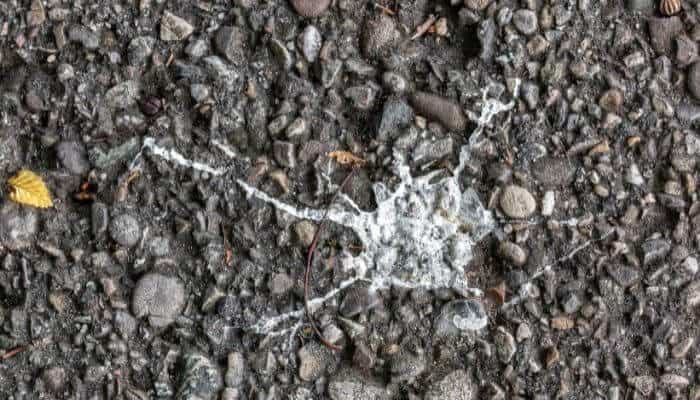
This is the wet method that public health guidance uses for droppings on hard outdoor surfaces. The table in the next section shows how to adjust it for each surface.
- Put on your gloves and other kit, and keep children and pets out of the area.
- Spray the droppings until they are soaked through. Do not sweep or scrape them while they are dry.
- Leave them to soften for about 10 minutes, spraying again if they start to dry (Southern Nevada Health District (opens in new tab)).
- Scrape or wipe them up and put them in a bin bag. Put that bag inside a second one, tie both and put them out with your household rubbish (NYC Health (opens in new tab)).
- Scrub the surface with detergent and water, then rinse. Disinfectants work poorly on dirty surfaces, so this cleaning step comes first (WorkSafe Queensland (opens in new tab)).
- Disinfect if the surface can take it. The Southern Nevada Health District (opens in new tab) uses 1 part household bleach to 9 parts water, kept wet for 10 minutes. Where bleach would cause damage, use a disinfectant labelled as safe for that surface and follow its contact time.
- Clean your tools, take off your gloves, and wash your hands and any exposed skin with soap and water.
Cleaning pigeon poop from different surfaces
The steps above suit paving and concrete. Other surfaces need gentler products, and several should never get bleach.
| Surface | Soften with | Bleach (1:9) | Pressure washer | Watch out for |
|---|---|---|---|---|
| Paving and concrete | Water and washing-up liquid | ✓ Yes, test first | ✓ Final rinse only | Runoff into beds |
| Balconies and sills | Water | ✓ Tiles and concrete | ✗ No | Drips on people below |
| Car paint | Water or car shampoo | ✗ No | ! Gentle rinse | Grit scratching paint |
| Wood | Water and detergent | ✗ Can blotch | ! Low setting | Tearing the surface |
| Metal | Water and detergent | ✗ Can corrode | ! Low setting | Scratching the coating |
| Windows | Water | ✓ Rinse well | ✗ Not needed | Ammonia glass cleaner |
| Clothes and fabric | Cold water | ! Only if the label allows | ✗ No | Heat setting the stain |
Paving, patios and concrete
Soak, lift and scrub as in the steps. A pressure washer is fine for the final rinse once the bulk has gone, but WorkSafe Queensland (opens in new tab) advises against blasting dried droppings, because it throws dust and spray into the air. On coloured or porous paving, try the bleach solution on a hidden corner first, as it can lighten the surface.
Cars

Lay a wet microfibre cloth or soaked kitchen roll over the dropping for a few minutes, then lift it off in one movement rather than rubbing, which drags grit across the paint. Finish with car shampoo and water. Do not use bleach, vinegar or household sprays on paintwork. Fresh droppings come off far more easily than ones baked on by the sun, so deal with them the same day if you can.
Balconies and window sills
These are usually small, fresh jobs. Spray the droppings, wipe them up with damp paper towels, bag them and wash the area with detergent. Avoid hosing a balcony down, which sends dirty water onto the windows and people below. If birds come back every day, cleaning will not keep up; our guide to keeping pigeons off a balcony covers netting and other fixes.
Metal railings, gutters and roofs

Scrape with plastic rather than metal so you do not scratch the paint or coating, then wash with detergent. Bleach can corrode metal, so use a disinfectant without chlorine if you want to disinfect.
Droppings are often said to eat into metal, but the evidence is thinner than that suggests. A review by Dirk Spennemann and Maggie Watson found only three of 95 studies had tested the effect of bird droppings on metals experimentally (APT Bulletin, 2018 (opens in new tab)). Their earlier work showed that pigeons fed on human food scraps produce more acidic droppings than seed-eating birds (Spennemann, Pike and Watson, 2017 (opens in new tab)). Clearing droppings promptly is still sensible, because wet deposits hold moisture and salts against the surface.
Wood decking and garden furniture

Soak and lift as usual, then scrub along the grain with a stiff brush and detergent. For a mark that stays, spray a mix of equal parts white vinegar and water, leave it for a few minutes, scrub and rinse. Skip bleach on wood, which can leave pale blotches, and keep a pressure washer on a low setting so it does not tear the surface.
Windows and glass
Soak, lift and wipe, then use your usual glass cleaner. If you disinfected with bleach first, rinse it off fully before using a glass cleaner, as many contain ammonia (Washington State Department of Health (opens in new tab)).
Clothes, bags and upholstery
Lift off what you can with a blunt edge, then rinse the fabric from the back under cold water. Rub in a little laundry detergent, leave it for 15 minutes and wash at the warmest temperature the care label allows. Check that the mark has gone before tumble drying, as heat can set a stain.
Diluted hydrogen peroxide can help on white fabric, but it can bleach colours, and it should not be mixed with vinegar (Transport Canada (opens in new tab)). For sofas and car seats, blot with a cloth dipped in water and a little detergent, then blot dry without soaking the padding. Droppings from birds that have eaten berries can stain for good.
Large build-ups, lofts and attics
A loft, attic, tower or air shaft that pigeons have used for years is a different job, and it is where the infection risk is highest. WorkSafe Queensland (opens in new tab) advises restricting access, sealing vents, keeping the material wet throughout, wearing a fitted respirator with coveralls and boot covers, and considering a specialist cleaning service. The health and safety team at the University of Minnesota (opens in new tab) adds that if nobody uses the space, leaving the material undisturbed may be the best option.
Check for active nests before you start. In Great Britain it is an offence to intentionally damage or destroy a wild bird’s nest while it is in use (Wildlife and Countryside Act 1981 (opens in new tab)), and feral pigeon nests can only be removed under the conditions of a general licence; our page on whether it is legal to shoot pigeons explains how those licences work. Once the birds are out, block the gaps they used, or the build-up will return.
Stopping the mess coming back
Cleaning only lasts if pigeons stop landing there. Stop any feeding nearby, block ledges and gaps, and wash the area regularly so droppings never build up (NYC Health (opens in new tab)). Our guide on how to keep pigeons away sets out the humane methods that work, and our review of the best pigeon deterrents compares spikes, nets, gels and other products. If you are curious about what the colour of a dropping says about a bird’s health, see our pigeon droppings guide.
Can you use pigeon droppings as fertiliser?
Yes, and people have done so for centuries. Pigeon droppings are rich in nitrogen, and many dovecote buildings and the pigeon towers of Egypt were built partly to collect them for the fields.
If you want to compost them, collect them with the same wet method and protection, compost them thoroughly, and do not put fresh droppings on food crops.
Frequently asked questions
Is it safe to clean pigeon poop without a mask?
For a small, fresh mess outdoors, gloves and washing your hands afterwards are usually enough, according to NYC Health. Wear a fitted FFP2 or FFP3 mask when you disturb dried droppings or a large build-up, especially indoors.
What kills germs in pigeon droppings?
Clean the surface first, then disinfect it. Public health guidance commonly uses 1 part household bleach to 9 parts water, kept wet for about 10 minutes, on surfaces that can take bleach. Vinegar helps with stains, but the guidance cited here does not use it as a disinfectant.
Can I pressure-wash pigeon poop?
Not while it is dry. Soak the droppings and lift the bulk first, because blasting dried droppings sprays dust and droplets into the air. A pressure washer is fine for a final rinse of paving.
How do I get pigeon poop off a car without damaging the paint?
Soften it under a wet cloth for a few minutes, lift it off without rubbing, then wash with car shampoo. Avoid bleach, vinegar and household sprays on paintwork.
What should I do if I feel ill after cleaning droppings?
See a GP or doctor and mention the contact with bird droppings. Histoplasmosis symptoms usually start 3 to 17 days after exposure, and psittacosis has an incubation period of 1 to 4 weeks, with flu-like symptoms such as fever, headache and cough.
Sources
Health and cleaning guidance on this page comes from these public health, workplace safety and research sources:
- NYC Health: Pigeon-related diseases and safe cleaning tips (opens in new tab)
- Southern Nevada Health District: Pigeon prevention and clean-up guidelines (opens in new tab)
- WorkSafe Queensland: Work with bird and bat droppings (opens in new tab)
- University of Minnesota Health, Safety and Risk Management: Bird and bat droppings (opens in new tab)
- US Centers for Disease Control and Prevention (CDC): About histoplasmosis (opens in new tab)
- CDC: About cryptococcosis (opens in new tab)
- UK Health Security Agency: Psittacosis (opens in new tab)
- Washington State Department of Health: Dangers of mixing bleach with cleaners (opens in new tab)
- Transport Canada (CANUTEC): Improper mixing of common household cleaning products (opens in new tab)
- Spennemann, Pike and Watson (2017). Effects of acid pigeon excreta on building conservation. International Journal of Building Pathology and Adaptation 35(1) (opens in new tab)
- Spennemann and Watson (2018). Experimental studies on the impact of bird excreta on architectural metals. APT Bulletin 49(1) (opens in new tab)
- Wildlife and Countryside Act 1981, section 1 (legislation.gov.uk) (opens in new tab)
Last updated 21 November 2026 · Keeping