
How fast do pigeons fly? In level flight with little wind, pigeons are unlikely to exceed about 60 mph (96 km/h), according to Guinness World Records. Everyday race velocities are often lower and climb when a strong tailwind pushes birds over the ground. What fanciers call velocity is ground speed from release point to loft, not airspeed.
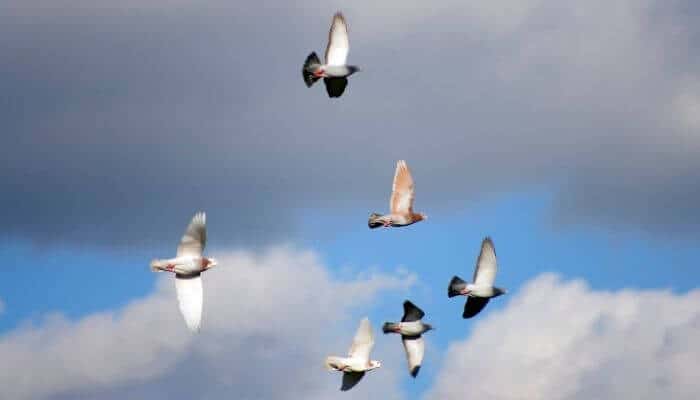
Typical speeds
Guinness states it is very doubtful that any pigeon exceeds about 96 km/h (60 mph) in level flight in windless conditions. Race speeds can look much higher because they include wind: the same source records 177.14 km/h (110.07 mph) for an East Anglian Federation race from East Croydon on 8 May 1965, when 1,428 birds had a strong south-south-west wind behind them.
Published race averages vary with route and weather. Notes collected in The Auk (1933) list multi-hour races averaging roughly 37-56 mph, with a short 200-mile example at 74.5 mph. A Wildlife Biology study of short Scottish races found control birds averaging about 46.5 km/h (about 29 mph) under those trial conditions. Use race comparisons from the same day; wind dominates the result.
How race velocity is measured
In UK and US pigeon racing, velocity is usually given in yards per minute (ypm): distance from the liberation point to the loft, divided by flying time in minutes. The highest velocity wins that race. Convert ypm to mph by multiplying by 60 then dividing by 1,760 (or use our pigeon velocity calculator).
Because the clock stops at the loft, birds that take a longer route or rest score a lower velocity even if they flew hard when airborne.
Yards per minute to mph
| Yards per minute | mph | km/h |
|---|---|---|
| 1,000 | 34.1 | 54.9 |
| 1,200 | 40.9 | 65.8 |
| 1,350 | 46.0 | 74.1 |
| 1,500 | 51.1 | 82.3 |
| 1,800 | 61.4 | 98.8 |
What changes the number
Wind is the largest effect on ground speed. A tailwind raises velocity; a headwind cuts it. Distance matters too: shorter races are often flown faster. Rain, poor visibility and fatigue slow birds or stop them. Condition and training also matter; see racing pigeon tips and how far a homing pigeon can fly.
- Tailwind: higher ground speed and higher race velocity.
- Headwind: lower ground speed for the same effort.
- Short races: often higher average velocity than long ones.
- Weather: rain and low cloud can delay or divert birds.
Ordinary town pigeons
Feral pigeons descend from the same rock dove as racing stock but are not selected for race speed. Solid published averages for casual city flight are scarce, so this page does not invent a single normal mph for street pigeons. They can sprint when flushed, then cruise more slowly between perches and feeding sites.
How fast do pigeons fly? FAQs
How fast can a pigeon fly?
In still air, about 60 mph is a cautious upper guide for level flight (Guinness). Race ground speeds vary widely with wind.
What is the fastest pigeon race speed recorded?
Guinness lists 177.14 km/h (110.07 mph) for a 1965 East Anglian Federation race flown with a strong tailwind.
How is pigeon race speed calculated?
Distance to the loft divided by flying time, usually as yards per minute (velocity).
Do all pigeons fly at racing speed?
No. Racing birds are bred and trained for it. Feral pigeons are the same species but not race-selected.
Is 100 mph a normal pigeon speed?
No. Figures near 100 mph or above are ground speeds with strong wind help, not a calm-air cruise.
Sources
Primary references used for this page:
- Guinness World Records – Fastest pigeon race (still-air note and 1965 record) (opens in new tab)
- Mullen 1933, The Auk – Speed of racing pigeons (historical race averages) (opens in new tab)
- Gagliardo / radio-tag race study – Wildlife Biology 13:238-244 (2007) control about 46.5 km/h (opens in new tab)
- Wildlife Biology PDF – Cost of carrying radio transmitters (race velocities) (opens in new tab)
Last updated 6 November 2026 · Racing