
The Cauchois is a large French form pigeon from the Pays de Caux, the chalk country of Upper Normandy. It is longer in wing and tail than compact utility breeds such as the Carneau, and it often wears a white half-moon of feathers, called a bavette in French, on the upper neck and breast.
The Société Nationale de Colombiculture (SNC), France’s national pigeon body, places it in the form group and lists 19 colour varieties, with or without that white bib. Like other domestic breeds, it descends from the rock pigeon (Columba livia). Today it is kept mainly for showing. In earlier centuries, pigeons from Caux were also table birds.
Cauchois pigeon at a glance
| Feature | Cauchois |
|---|---|
| Species | Domestic rock pigeon (Columba livia) |
| Origin | Pays de Caux, Normandy, France |
| Type | Form / utility pigeon (EE group 0000; breed no. 0008) |
| Weight | SNC: cocks 700-800 g, hens 650-700 g. NPA and German standards: 700-800 g |
| Wingspan (NPA only) | About 85-90 cm in cocks, 80-85 cm in hens |
| Ring | EE and German standard: 10 mm. UK NPA list: size E |
| Marks | White rump in every colour; white half-moon on the neck (rules differ, see below) |
| Varieties | 19 in the SNC summary |
| Breed clubs | Club Français du Cauchois (founded December 1949); German special club (1966) |
What a Cauchois looks like
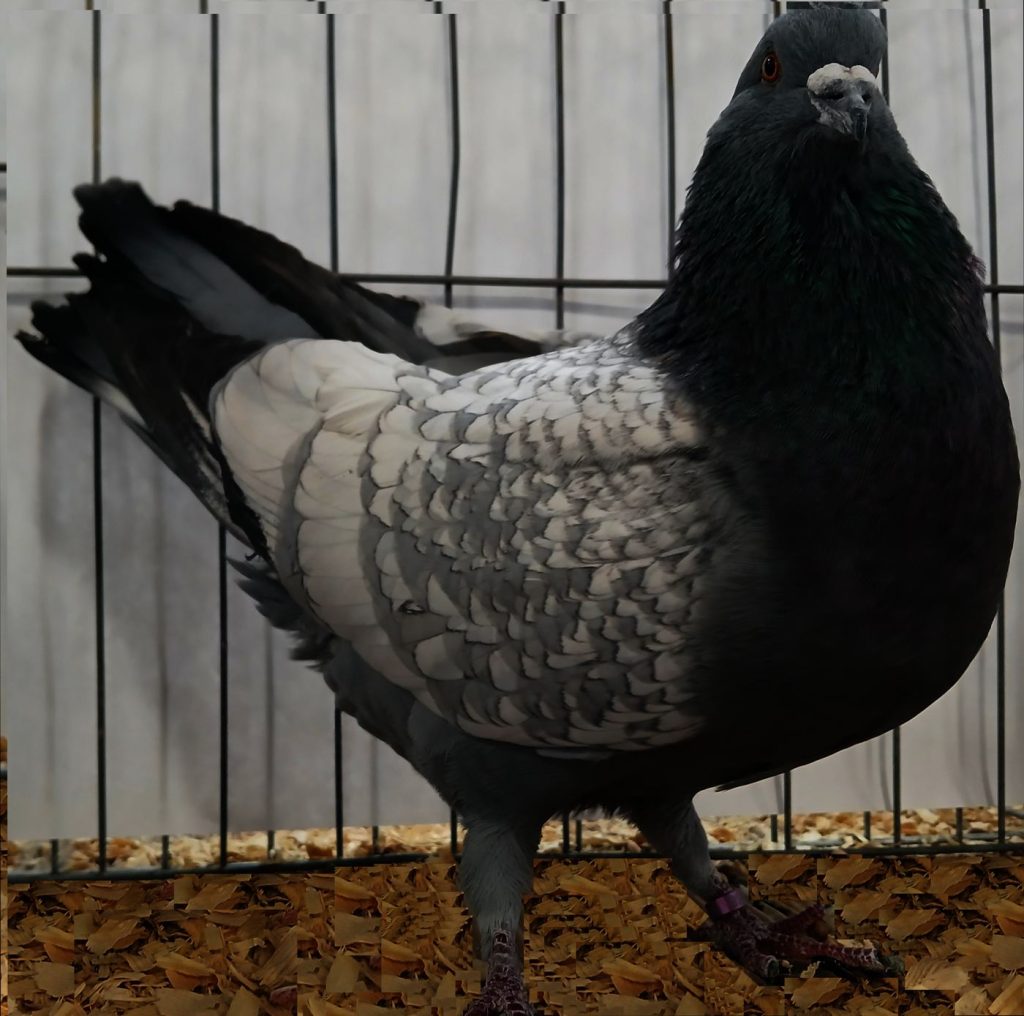
The NPA’s 2022 standard describes a very large, lively pigeon with long wings and a long tail, and a slightly upright stance. The head is medium-sized, long and well rounded, with a vaulted forehead, and looks small against the body. The breast is broad and rounded, and the bird carries it fairly high and well forward. The back is broad between the shoulders, rather flat, and slopes fairly steeply. The wings cover the back and rest on the tail without crossing. The legs are clean, strong and of medium length.
The German standard, taken from the 2013 Deutscher Rassetaubenstandard, adds a slight crop. A strong crop is a fault. That hint of a crop is a leftover of the cropper ancestry both the NPA and the German standard record. It should not be confused with the inflated globe of a pouter.
Eyes are bright orange-red, a little lighter in the pale colours. The eye cere is small and fine, and its colour follows the plumage: violet-red in blues, rose-red or rich pink in silvers, and from dark to violet-red to rose-red across the range. The beak is of medium length, strong, almost straight and thick at the base. It is dark to black on black and blue-ground birds, and horn to pale on dilute-blue, red and yellow birds. The wattle is white, rather long, smooth and not pronounced. The NPA wants nail colour to match the body; the German standard ties it to the beak.
Weight and wingspan
Published Cauchois weights
Grams, as given in the current standards. The bars show each published range.
The SNC’s 2024 summary of the 24 French breeds gives 700 to 800 g for cocks and 650 to 700 g for hens (about 25 to 28 oz and 23 to 25 oz). The NPA standard (2022) and the German standard (2013) both give a single range of 700 to 800 g, without splitting the sexes.
NPA wingspan
Centimetres. These figures appear only in the NPA standard.
The NPA also gives a wingspan: about 85 to 90 cm for cocks and 80 to 85 cm for hens. The SNC summary and the German standard do not publish a span, so those figures belong to the American standard only.
The white half-moon and the white rump
Two markings define the breed on the show bench.
Every colour must show a white lower back, or rump. A fully coloured rump, or only a few white feathers there, is a fault in the German standard, and the NPA likewise requires the white rump in all colours.
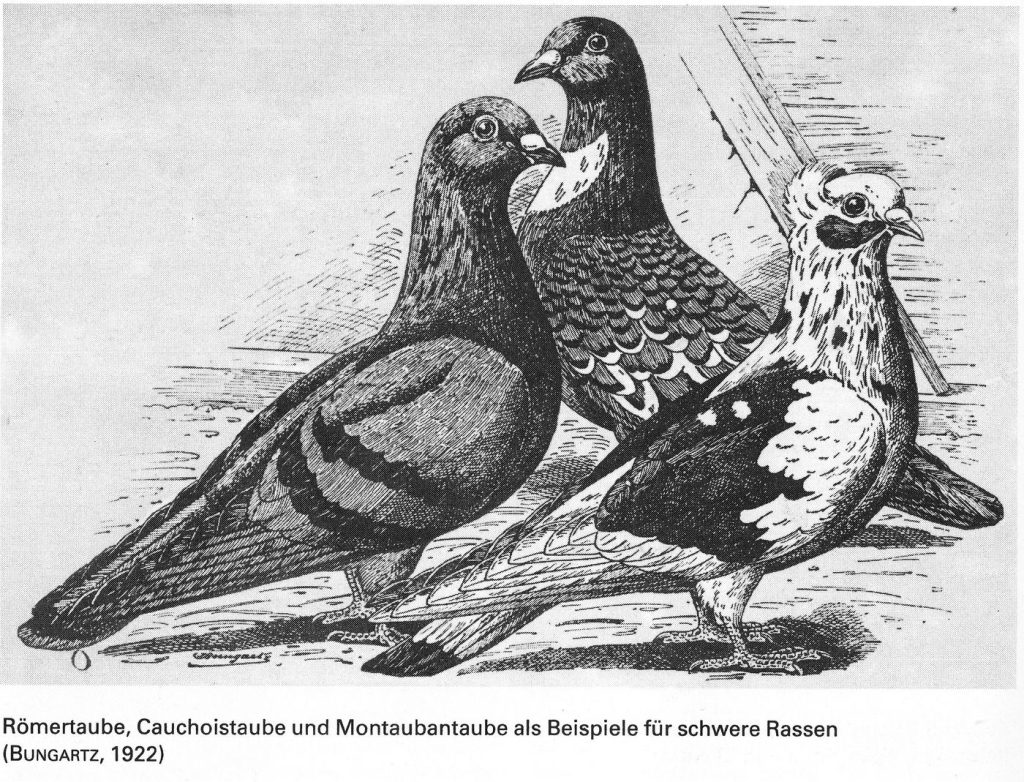
The second mark is the white half-moon, or bavette, on the upper part of the neck and breast. Where it is present, both the NPA and the German standard want it about 4 cm wide, sitting high on the neck, ending on each side in an upward peak, and not running around the back of the neck. A half-moon that is too large is an NPA fault. One that blurs into the nape is a German fault.
The rules for when that mark is required are not the same:
The French SNC summary and the German standard allow every colour to be shown with or without the half-moon.
The NPA standard requires it on self-coloured birds (red, yellow and black). In the other colours it is optional. A self-colour bird that lacks the half-moon is an NPA fault.
The photograph at the top of this page is a white-check Cauchois without a half-moon, which both systems allow. The 1922 plate below shows the mark clearly on the middle bird.
Colours
The SNC lists 19 varieties. The NPA and German standards name a core set of checkers, bars and self colours, and still give some of the older trade names in brackets.
The checkers include blue-bronze (once called red checker), dilute-blue sulphur (once yellow checker), blue-rosa or peach-blossom, and blue-white (once hyacinth). The NPA notes that the checker pattern is hard to describe because almost every feather is different. Judges look for even, distinct checkering, with a narrow dark edge to the point of each triangular mark, and some of the checkering colour in the inner web of the primary flights.
Barred birds come in blue with bronze, pink or white bars, and in dilute blue with sulphur or white bars. The bars should be distinct and should cross the wing shield fully, with a narrow dark edge. Mealy and cream birds (rotfahl and gelbfahl in the German standard) have head, neck, breast and bars in the ground colour, with paler, even wing shields and a clear step to the white rump.
Self colours are red, yellow and black. Both standards want the colour deep, even and glossy. Under the NPA rules, these selfs must also carry the white half-moon.
The Club Français du Cauchois records that in 2019 the SNC standards commission accepted four further varieties: brown red-checker, khaki yellow-checker, brown red-bar and khaki yellow-bar. Those additions help to explain how the official French count reaches 19. The 2013 German list, written before that decision, is shorter.
The older name “maillé de Caux” (chequered pigeon of Caux) referred to the original chequered plumage. A note from the municipal farm at Navarre, in Évreux, says that name was dropped once barred and self-coloured birds were written into the standard, because “maillé” describes the chequered pattern.
Origin and history
The name is simply “the pigeon of Caux”. Nicolas Boileau-Despréaux already used “pigeons cauchois” in Satire III (opens in new tab), written in 1665. In that poem they appear as table birds, set beside rabbits, and a guest tries to pass them off as woodpigeons. The passage shows that large pigeons from the Pays de Caux were a known food in seventeenth-century Paris. It does not describe the modern show standard.
The SNC summary says the breed has been kept in the Pays de Caux since at least the seventeenth century. The NPA standard describes the Cauchois as an old French breed from the Caux de Normandie, “bred from Croppers, Mondain, Carneau and Field Pigeons.” The German standard says it was first made from croppers and field colour pigeons (pigeon maillé), and later refined with meat breeds such as the Mondain and the Carneau. Those are statements in the breed standards, not a documented pedigree.
The modern show type, with fixed points of type and colour, is later. The German Cauchois club, drawing on Jürgen Schulz’s 2009 monograph, dates that work to the years between about 1860 and 1900. The same account says a bird of the modern type was first shown in Paris in 1891 by a Monsieur Brindel of Fécamp, in the Pays de Caux, and that the breed was described in detail by Jacques Danchin and accepted as “Cauchois” at a Lille show in 1905. Those dates have not been checked against the 1891 and 1905 catalogues here.
The Club Français du Cauchois (opens in new tab) was founded in December 1949 and recorded in the Journal officiel in January 1950. It is the French breed club and, in its own words, the guardian of the standard. A German special club followed in 1966. The German club says the 1950 French standard was republished in German poultry journals in 1954, which is how the breed gained recognition with the Bund Deutscher Rassegeflügelzüchter.
Dates in the record
- 1665Boileau uses “pigeons cauchois” for table birds from Caux in Satire III.
- 17th centuryThe SNC says the breed has been kept in the Pays de Caux since at least this century.
- c. 1860-1900German club / Schulz: the modern show type was fixed in these years.
- 1891German club / Schulz: a modern-type bird shown in Paris by Brindel of Fécamp.
- 1905German club / Schulz: described by Danchin and accepted as Cauchois at Lille.
- 1949-50Club Français du Cauchois founded (December 1949; Journal officiel, January 1950).
- 2019Club Français: SNC accepts four brown and khaki varieties.
How it compares with other form pigeons
The Cauchois sits in the same EE group as the French Mondain and the Carneau: form or utility pigeons, numbers 0006 to 0008 on the 2018 list. The King is a later American utility breed often shown alongside them. The Strasser is another large utility type, but it is a marked bird with a white body and a coloured head, bib and wings, not a self or chequered form pigeon of the Norman type.
| Breed | Country (EE 2018) | EE ring | Published weight |
|---|---|---|---|
| Cauchois | France | 10 mm | SNC: cocks 700-800 g, hens 650-700 g |
| Carneau | France (NPA also gives Belgium and northern France) | 9 mm | NPA European standard: 600-675 g |
| French Mondain | France | 11 mm | Heavier, low-legged type; see the Mondain guide |
| King | United States (not on this EE list) | n/a | American King Club show standard: 30-37 oz (about 850-1,050 g) |
The Cauchois is more elongated, with a longer wing and tail, than the compact European Carneau, and it is lighter than the heavy French Mondain. A slight crop is part of the German description of the Cauchois; it is not a feature of the Mondain or the Carneau standards.
In the loft
The Cauchois is a big bird with a long wing. The NPA span of 80 to 90 cm is a practical reason to give it more clear flight and perch space than a compact utility breed. It is clean-legged. The German standard treats a strong crop as a fault, so the bird should not be managed as if it were a pouter.
Historically it was a farm and manor pigeon in Normandy, kept for the table as well as for its looks. The SNC now classes it as a form pigeon whose breeders place a great deal of importance on the perfection of colour and marking. Modern keepers show it rather than farm it for squabs, though nothing in the standard stops a bird being used as a large utility pigeon.
Our types of pigeon hub places the form and utility breeds in that wider domestic group.
Standards and rings
These are the three current references:
The SNC’s 2024 illustrated summary of the 24 French pigeon breeds (opens in new tab), which gives the official French weights, the count of 19 varieties, and the optional bavette.
The NPA Book of Standards, Form Pigeons, Cauchois, edition marked 2022, used in North America.
The German standard of 2013 (opens in new tab), published by the German Cauchois club from the Deutscher Rassetaubenstandard.
The EE list of fancy pigeon breeds (revision of 1 October 2018) records the Cauchois as breed number 0008, country France, ring size 10. The German standard also gives ring size 10. The UK National Pigeon Association ring list (opens in new tab) (sizes as of 1 January 2017) places the Cauchois in size E, the same letter group as Kings and Mondains. The US NPA chapter on the Cauchois does not state a band size.
The main point of disagreement for exhibitors is the half-moon on self colours, required by the NPA and optional in the French and German rules.
Frequently asked questions
What is a Cauchois pigeon?
A large French form pigeon from the Pays de Caux in Normandy, kept today mainly as a show bird. It is elongated, with long wings and a long tail, and it often has a white half-moon on the neck.
Where does the name come from?
From the Pays de Caux. Boileau used “pigeons cauchois” in 1665 for table pigeons from that region. The older chequered type was also called maillé de Caux.
How heavy is a Cauchois?
The SNC gives 700 to 800 g for cocks and 650 to 700 g for hens. The NPA and German standards give 700 to 800 g without a split by sex.
What is the white half-moon?
A band of white feathers, about 4 cm wide, on the upper neck and breast. French and German rules allow it on any colour and also allow its absence. The NPA requires it on self-coloured red, yellow and black birds. All colours must have a white rump.
How does it differ from the French Mondain and the Carneau?
All three are French form or utility pigeons. The Cauchois is longer in wing and tail than the compact Carneau, and lighter than the heavy, low-legged French Mondain. It may show a slight crop, and its distinctive marks are the white rump and, often, the half-moon. The EE ring size is 10 mm, against 9 mm for the Carneau and 11 mm for the French Mondain.