
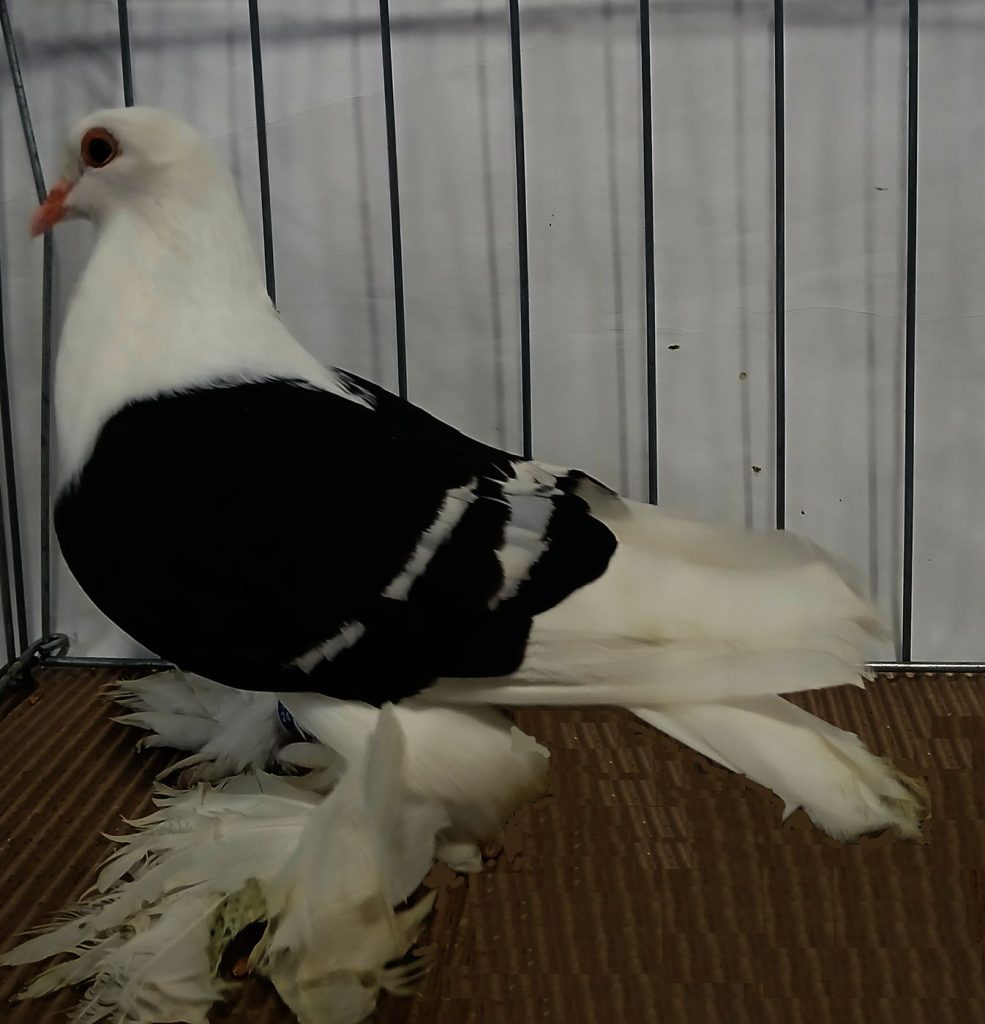
The Saxon Shield is a German colour pigeon from Saxony. It is a white bird with coloured wing shields, heavy muffs on its feet, and a low, strong field-pigeon shape. In German it is called the Sächsische Schildtaube; the French name is Bouclier de Saxe.
The coloured feathers are confined to the wing shields and the small thumb feathers at the wrist of the wing. The rest of the plumage is white, including eight to ten primary flights. Unlike the Saxon Priest, which is a coloured bird with a white cap and is always double-crested, the Shield may be plain-headed, shell-crested or double-crested.
Like other domestic breeds, it descends from the rock pigeon (Columba livia). Today it is kept as a show bird.
Saxon Shield at a glance
| Feature | Saxon Shield |
|---|---|
| Species | Domestic rock pigeon (Columba livia) |
| Origin | Saxony, Germany |
| Type | Colour pigeon (EE group 0400; breed no. 0471) |
| Head | Plain, shell-crested or double-crested |
| Marking | White body; colour on the wing shields and thumb feathers; 8 to 10 white primary flights |
| Colours | Black, red, yellow, blue and silver, with white bars or spangles; blue and silver also with dark bars, checkers, or barless |
| Eyes | Dark; cere narrow, light flesh to red |
| Beak | Medium to long, flesh-coloured |
| Feet | Low station, with long muffs and well-developed hock feathers |
| Band size | NPA: 11. EE list: 11 mm |
| German club | Sonderverein der Züchter Sächsischer Farbentauben von 1895 (opens in new tab) |
The shield marking
The name comes from the coloured wing shield, or Schild in German. On a well-marked bird the colour sits on the shields in a solid block, with two coloured thumb feathers at the wrist, and does not run onto the sides, thighs or back.
The flights are part of the white ground. The National Pigeon Association (NPA) standard wants eight to ten white primary flights. A white flight sitting among coloured ones, or colour where the body should be white, is a fault.
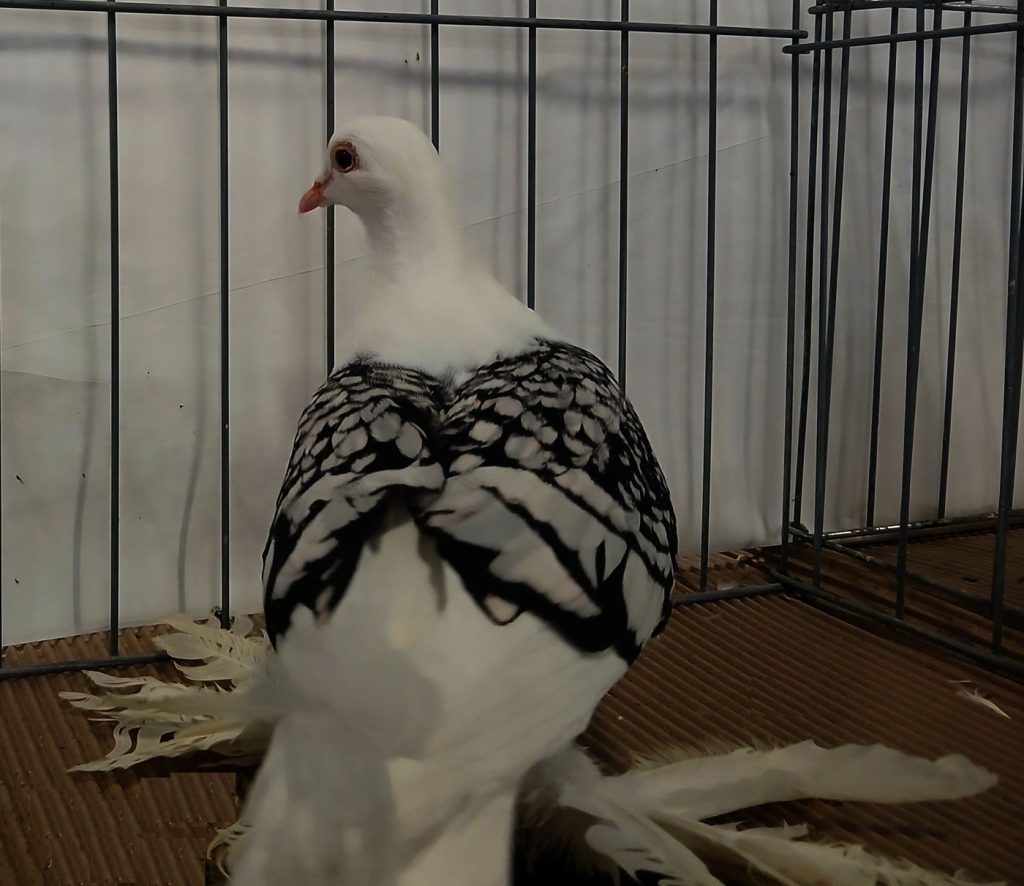
Bars should be pure white, long, narrow and well separated. On blue and silver birds a white bar has a thin black edge. Spangles are small white triangles, spread as evenly as possible over the shield; on blue and silver they also take a thin black edge. In reds and yellows the tips of the secondaries may fade a little if the bars themselves are clean.
Head, crest and beak
The head is oblong and curved, with a moderately high forehead. Three head types are accepted: plain-headed (smooth), shell-crested, and double-crested.
A shell crest should sit well on the head, broad and thick, and end in a rosette on each side. On a double-crested bird there is also a beak crest, which should be well developed but must not cover the eyes. A crest that slopes, caps the skull, or hides the eye is a fault, as is a small or pinched beak crest.
The beak is medium to long and flesh-coloured. Colour in the beak is a fault. The eye is dark, and the cere is narrow and even, from light flesh to red.
Body, muffs and stance
The standard asks for a strong field-pigeon shape with a low station. The chest is broad, well curved and carried forward. The back is long and slopes gently from broad shoulders. The wings are long, well closed and cover the back. The tail is long, closed and almost horizontal.
The legs are set low, with long, well-curved muff feathers and well-developed hock feathers. A weak body, a drooping stance, or standing too high counts against the bird, as do short, damaged or projecting muffs. The plumage should lie close, not loose.
Colours
The NPA lists five colours: black, red, yellow, blue and silver. All five may be shown with white bars or with white spangles. Blue and silver are also accepted with dark bars, as checkers, or without bars.
Blacks, reds and yellows should be as glossy and rich as possible. The photograph at the top of this page is a black bird with white bars. The second photograph shows white-check wing shields on the same white, muffed type.
Our guide to pigeon colours and genetics explains bars, checkers and spangles in more detail.
Origin and history
The NPA standard and the German association of fancy pigeon breeders, the Verband Deutscher Rassetaubenzüchter (VDT), both give Saxony as the home of the breed. Neither source gives a founding year.
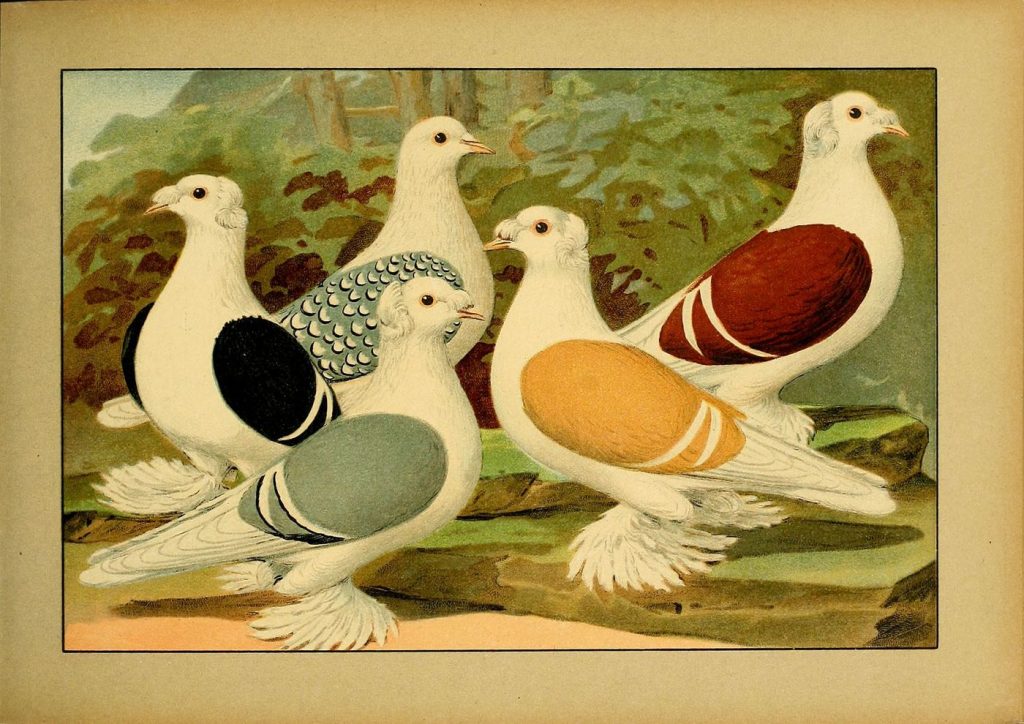
Shield-marked pigeons were already a named type in German books in the late nineteenth century. Gottlob Neumeister’s Das Ganze der Taubenzucht, published by 1876, has a colour plate titled “Die Schwalben-Taube” and “Die Schild-Taube” (the swallow pigeon and the shield pigeon). Emil Schachtzabel’s illustrated breed book, usually dated 1906, includes a plate of muffed shield pigeons with coloured wing shields, white bodies and crests. Those plates show the marking; they are not modern standard photographs, and Schachtzabel was describing muffed shield pigeons as a type, before today’s national breed splits were written in their present form.
In Germany the breed is looked after by the Sonderverein der Züchter Sächsischer Farbentauben von 1895 (opens in new tab), the specialist club for the Saxon Colour pigeons. The club’s own site says it was founded in 1895, and the VDT’s directory of member clubs uses that name.
Dates in the record
- by 1876Neumeister publishes a colour plate of the swallow pigeon and the shield pigeon (Die Schild-Taube).
- 1895Specialist club for the Saxon Colour pigeons founded, in the club’s own account.
- c. 1906Schachtzabel includes a plate of muffed shield pigeons (Schildtauben mit Latschen).
- 2018EE list: breed no. 0471, Germany, ring size 11 mm.
How it compares with other colour pigeons
The Shield belongs to the Saxon Colour pigeons, a group of muffed, low-standing field-pigeon breeds from Saxony that differ mainly in head shape and markings. The NPA book treats them as one family.
| Breed | Head | Main marking |
|---|---|---|
| Saxon Shield | Plain, shell-crested or double-crested | White bird with coloured wing shields |
| Saxon Priest | Always double-crested | Coloured bird with a white cap; white bars or spangles |
| Saxon Monk | Smooth | White head, white flights, tail and muffs; coloured body |
| Saxon Spot | Crested or smooth | White bird with a coloured forehead spot and tail |
| Saxon Whitetail | Always smooth | Coloured bird with a white tail |
| Saxon Breast | Smooth | Coloured head, neck and breast; the rest white |
Source: NPA Book of Standards, Saxon Colour pigeon standards.
The Saxon Priest is the bird people most often mix up with the Shield. A Priest is coloured, with a white cap, and must have both crests. A Shield is white, with colour only on the wing shields, and may be shown with any of the three head types.
The South German Shield (Süddeutsche Schildtaube) is a different breed. The Bund Deutscher Rassegeflügelzüchter describes it as an old Württemberg breed: a strong, refined field pigeon with a shell crest, an almost horizontal stance, and clean legs. The Saxon Shield is muffed and low-standing, and comes from Saxony.
The Ice Pigeon and the Archangel are other German colour pigeons kept for their plumage rather than for a white-and-shield pattern. Our Tiger Swallow guide covers the swallow-marked Saxon and related types.
In the loft
The long muffs are the part that needs most care. Keep loft floors dry and clean so the foot feathers do not soil or break, and give the birds regular baths. Short or damaged muffs count against a bird at a show.
A Shield also needs what most fancy pigeons need: a dry, airy loft, clean water, a good seed mix and grit. Our guide to what pigeons eat covers the diet.
Our types of pigeon hub places the colour breeds in that wider domestic group.
Standards and rings
These are the current references:
The NPA Book of Standards, Colour Pigeons, Saxon Shield, in the edition marked 2022, used in North America. It gives the description of type, the three head forms, the colours, the eight to ten white primaries, and band size 11. The current NPA Book of Standards (opens in new tab) is the published American reference.
The VDT breed page (opens in new tab) and the Bund Deutscher Rassegeflügelzüchter both describe a strong, low-standing field-pigeon shape, heavily muffed, and shown plain-headed, with a shell crest, or (in the VDT wording) double-crested. The VDT names the Sonderverein der Züchter Sächsischer Farbentauben von 1895 (opens in new tab) as the specialist club.
The EE list of fancy pigeon breeds (revision of 1 October 2018) records the breed as number 0471, Sächsische Schildtaube / Bouclier de Saxe / Saxon Shield Pigeon, country Germany, ring size 11 mm. That ring size matches the NPA band size.
In the UK the National Pigeon Association lists Saxon breeds in the colour section of its judges list and show guidance (opens in new tab). Our guide to pigeon shows explains classes and judging.
NPA order of evaluation
The standard gives no points scale. Judges work through the bird in this order.
The NPA standard gives no points scale for this breed. It sets an order of evaluation, so the judge looks at the overall bird first and the eye and beak colour last.
Frequently asked questions
What is a Saxon Shield pigeon?
A German colour pigeon from Saxony. It is a white, muffed, low-standing field pigeon with colour only on the wing shields and thumb feathers, shown plain-headed, shell-crested or double-crested.
How does it differ from the Saxon Priest?
A Priest is a coloured bird with a white cap, and it is always double-crested. A Shield is a white bird with coloured wing shields, and it may be plain-headed or crested. Both belong to the Saxon Colour pigeons and share the same muffed field-pigeon type.
What head types are allowed?
Three: plain-headed, shell-crested, and double-crested. The shell crest ends in a rosette on each side. On a double-crested bird the beak crest must not cover the eyes.
What colours does the Saxon Shield come in?
Black, red, yellow, blue and silver, each with white bars or white spangles. Blue and silver are also accepted with dark bars, as checkers, or without bars. Eyes are dark and the beak is flesh-coloured.
How does it differ from the South German Shield?
The South German Shield is a Württemberg breed with a shell crest, an almost horizontal stance and clean legs. The Saxon Shield is from Saxony, stands low, and has heavy muffs. They share a white body with coloured wing shields, but they are separate breeds.