
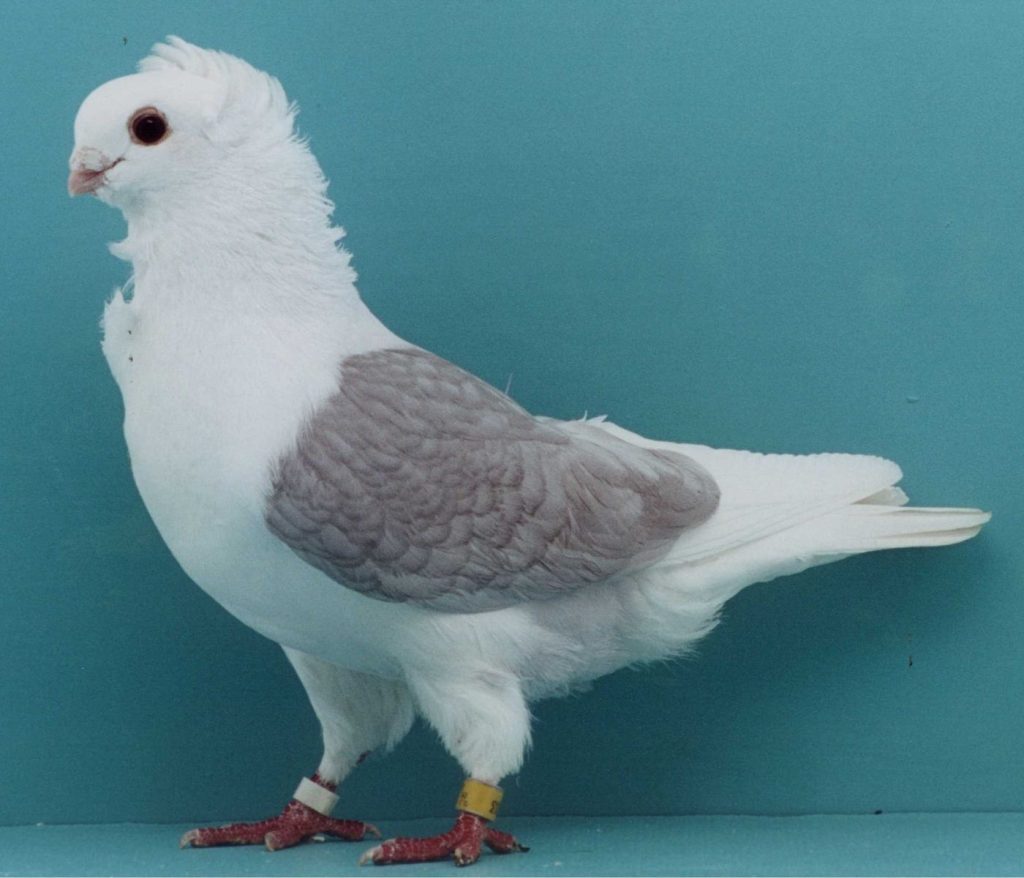
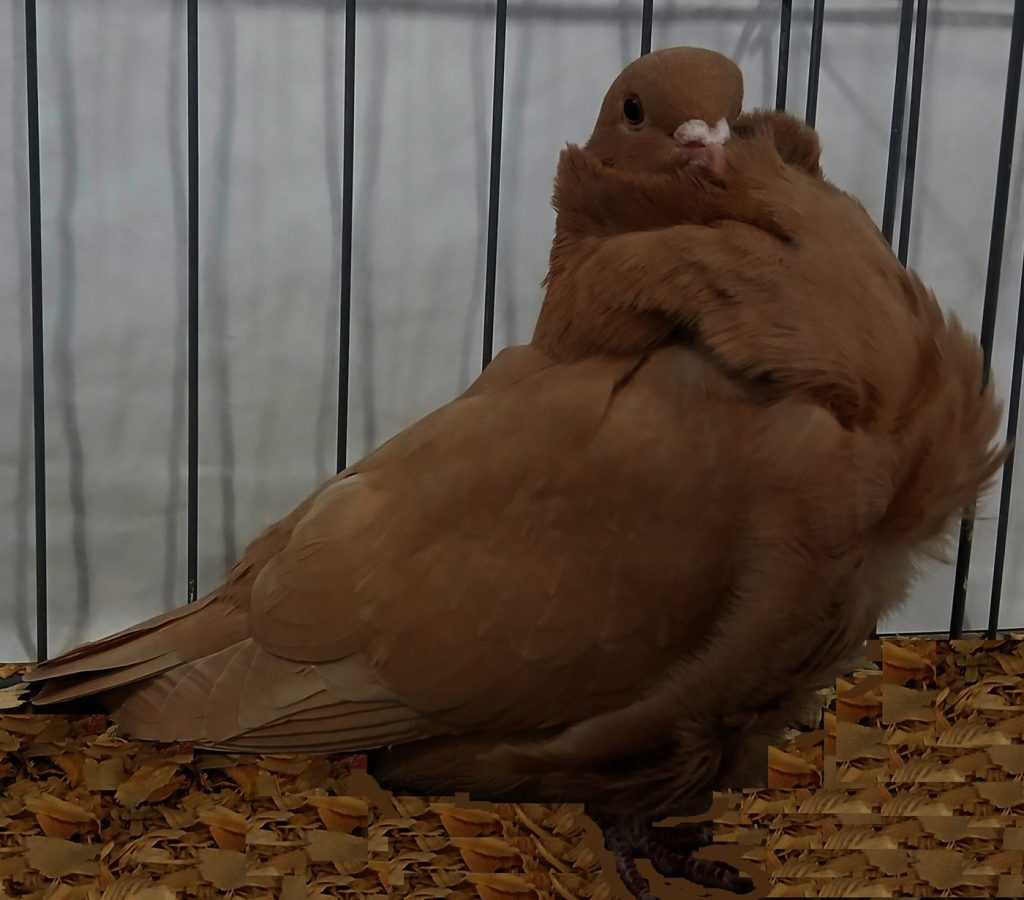
Owl pigeons are a family of domestic fancy pigeon breeds that share a frill: a line of feathers that grow outwards in different directions down the front of the neck and breast. Most also have a short, thick beak and a small dewlap under the throat, which fanciers call the gullet. The African Owl, Old German Owl, Italian Owl, Turbit and Oriental Frill all belong to the group. Like every domestic breed, they descend from the rock pigeon (Columba livia).
The US National Pigeon Association (NPA) puts 17 breeds in its Owls & Frills section. The European breed list kept by the Entente Européenne (the EE list) names the group Mövchen in German and pigeons cravatés in French, and its 2018 revision lists 31 breeds in it.
Owl pigeons at a glance
| Feature | Owl pigeons |
|---|---|
| Species | Domestic rock pigeon (Columba livia) |
| Group name | Owls and frills (NPA); Mövchen or pigeons cravatés (EE list, group 0700) |
| Defining mark | A frill of feathers growing in different directions down the front of the neck and breast |
| Beak | Short and thick in most breeds; nearer medium length in a few, such as the Classic Old Frill and Old Dutch Turbit |
| Gullet | Present in every owl breed, according to the NPA |
| Head | Plain in some breeds; a shell crest or a pointed peak crest in others |
| Breeds listed | 17 in the NPA Owls & Frills section; 31 in the EE list (2018) |
| Ring sizes | 7 to 10 mm in the EE list, depending on the breed |
What makes a pigeon an owl
Charles Darwin described the group in 1868, in The Variation of Animals and Plants under Domestication. He put Turbits and Owls together as one race and gave three marks: feathers diverging along the front of the neck and breast, a very short beak that is rather thick from top to bottom, and a slightly enlarged oesophagus. He wrote that these birds “can be recognised at once” by the feathers spreading like a frill down the front of the neck. He compared it with the hood on the back of the neck of the Jacobin, which is larger.
Darwin also noticed a habit. Owls keep briefly puffing out the upper part of the oesophagus, and each puff makes the frill move. When he inflated the oesophagus of a dead bird, it was larger than in other breeds.
On the beak, he measured the Turbit’s as 0.28 inch shorter than a rock pigeon’s once body size is allowed for, and thicker from top to bottom. Owls brought from Tunis by E. Vernon Harcourt had even shorter beaks.
The gullet is the third mark. The NPA’s Seraphim standard says plainly that owl breeds all have one. The African Owl standard describes it as filling the hollow at the throat, starting near the tip of the lower beak and running down into the frill.
The German name has its own story. The NPA’s Old German Owl standard says that breed was the first in Germany to be called Mövchen, “little gull”, because its colour and markings looked like a gull’s. The French word cravaté means wearing a cravat, which is the frill.
Main kinds of owl pigeon
The breeds fall into a few loose groups. These are descriptions, not official sections. For breeds outside the owl family, see the types of pigeon guide.
Short-faced owls
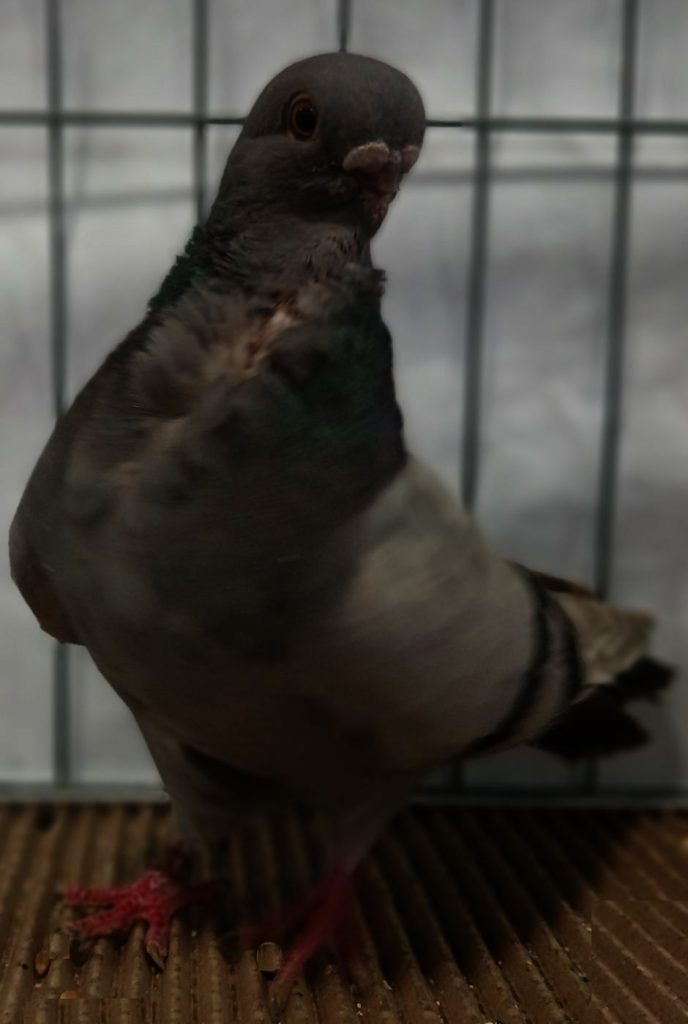
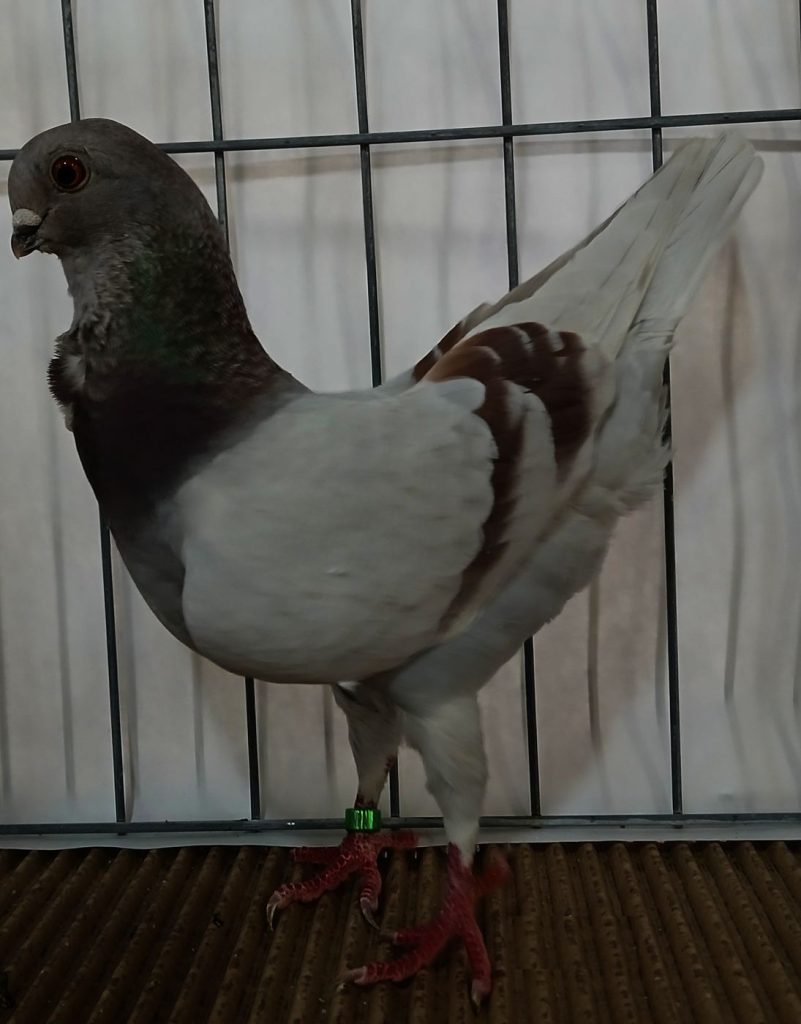
The African Owl is the best-known short-faced owl. The NPA standard (2018) asks for a large, round head that looks circular from the side with the eye in the centre. The short, thick beak should continue the curve of the head. The ideal bird measures about 8 inches (20 cm) from the front of the breast to the tip of the tail, and the same from the floor to the crown.
The English Owl is a larger bird: the EE list gives it a 10 mm ring, against 8 mm for the African Owl. The NPA says it was recorded by Willughby in 1678 and John Moore in 1735, and that the English Owl Club was formed in 1892.
The NPA points scale for the African Owl shows where judges look. Head, eye and beak together carry 46 of the 100 points. The frill, the group’s defining mark, carries 6.
How the NPA scores an African Owl
- Head, eye and beak: 46
- Size, shape and carriage: 20
- Neck, wings, tail and legs: 14
- Colour: 10
- Frill and gullet: 10
Shield owls and crested owls
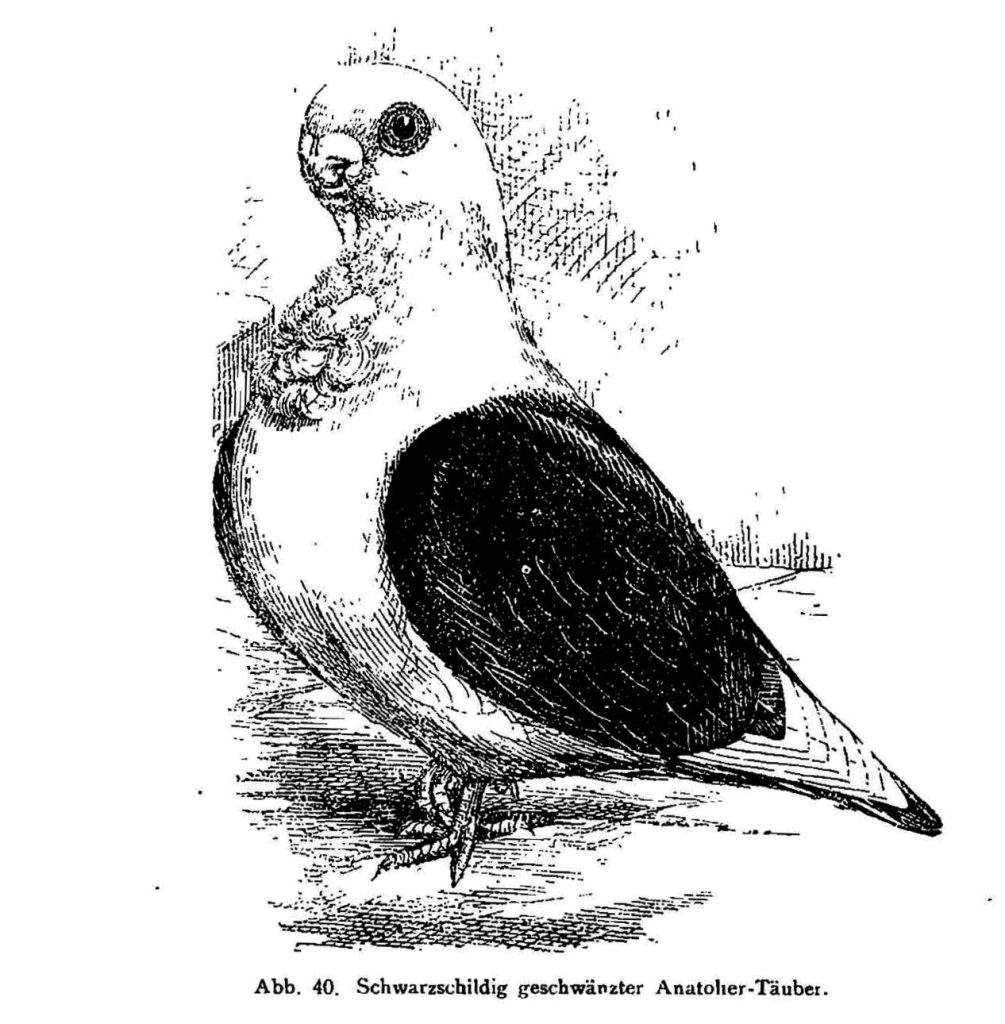
German breeders produced several crested owls and several shield-marked ones, white birds with coloured wing shields. The Old German Owl has a crest that forms a smooth arch across the back of the head and ends in small rosettes on both sides. The German Shield Owl and German Coloured Tail Owl also wear a shell crest, and the NPA says both are related to the African Owl. The Aachen Lacquer Shield Owl has a plain head, and any sign of a crest is a fault. Its standard asks for a shield colour with a strong sheen and 8 to 10 white primary flights.
The Macedonian Shield Owl is a small to medium-sized flying type. The NPA gives its origin as Macedonia, with ancestors that may have come from Turkey, Asia Minor and North Africa.
Long-legged owls
The Italian Owl stands apart. The NPA calls it a small, graceful pigeon that carries its body level on more than medium-long legs. The breed comes from northern Italy, where it is called Reggianino, and was first imported to Germany in 1880.
Frills and turbits
The Oriental Frill carries a pointed peak crest and comes in the Satinette and Blondinette patterns. The NPA keeps a separate standard for the Classic Old Frill, the older type with a medium-short beak from which the modern Oriental Frill was bred. The Turbit has a crest that rises from a mane at the back of the neck and ends in a fine point. A Turbit with no frill or no crest at all is disqualified under the NPA standard.
The Old Dutch Turbit, from the Netherlands, has a peak crest and a medium-length beak. The Seraphim is the newest breed in the NPA section. It was bred in 1986 in the loft of Anya Ellis in East Moline, Illinois, and was recognised by the NPA in 1995.
The smallest owls
The Valencian Figurita comes from the province of Valencia in Spain, where the name has been known since 1799. The NPA standard gives a weight of 150 to 170 g (5.5 to 6 oz) and says the aim is for it to be the smallest breed of pigeon. The Polish Owl is also very small. The NPA says it is a very old breed from south-east Poland, developed from Anatolian Owls.
Owl breeds compared
| Breed | Head | Notes from the standards | EE ring |
|---|---|---|---|
| African Owl | Plain, round | Short, thick beak; about 8 in long and 8 in tall | 8 mm |
| English Owl | Plain, large and round | Recorded in England in 1678; club formed 1892 | 10 mm |
| Old German Owl | Arched crest with rosettes | First German breed called Mövchen | 7 mm |
| German Shield Owl | Shell crest | Related to the African Owl (NPA) | 8 mm |
| Aachen Lacquer Shield Owl | Plain | White with a glossy coloured shield | 8 mm |
| Italian Owl | Plain, flat on top | Level body, legs longer than medium; from northern Italy | 7 mm |
| Turbit | Pointed crest | Disqualified without frill or crest (NPA) | 8 mm |
| Oriental Frill | Peak crest | Satinette and Blondinette patterns | 10 mm |
| Valencian Figurita | Plain, small and angular | 150 to 170 g; bred to be the smallest pigeon | 7 or 8 mm |
The short beak and raising young
A very short beak can make it hard for parents to feed their squabs. Several NPA standards address this directly. The Classic Old Frill standard says those birds can feed their young and do not need feeders, pairs of another breed that keepers use to rear the chicks. The Old Dutch Turbit standard says that breed raises its own young very well, “in contrast to many other frilled breeds”. The Macedonian Shield Owl standard says the beak must be long enough to feed the bird’s own young, and the Old German Owl standard notes that it feeds its young readily.
If you are choosing a first owl breed, ask the breeder whether their birds rear their own young or depend on feeders. It affects how many pairs you need to keep.
Dates in the record
Owl pigeons in the record
- 1678Willughby records the English Owl, according to the NPA; John Moore records it again in 1735.
- 1799The name Figurita is in use in Valencia.
- 1868Darwin groups Turbits and Owls together as one race.
- 1880The Italian Owl is first imported to Germany.
- 1892The English Owl Club is formed.
- 1920sThe Antwerp Smerle is developed in England from the Belgian Smerle, crossed with other breeds, the Turbit above all.
- 1923Paul Trübenbach publishes Die Mövchentauben.
- 1956The Old German Owl is formally recognised again in Germany; its first European standard follows in 1960.
- 1986The Seraphim is bred in East Moline, Illinois; the NPA recognises it in 1995.
- 2018The EE list revision names 31 breeds in the owl group.
Frequently asked questions
Are owl pigeons related to owls?
No. They are domestic pigeons, bred from the rock pigeon like every other fancy breed. “Owl” is the name of the breed group.
What is the frill on an owl pigeon?
It is a line of feathers on the front of the neck and breast that grow outwards in different directions instead of lying flat. The NPA African Owl standard asks for a frill as ample as possible, running well down the centre of the breast. A bird with no frill at all is disqualified.
Is the Chinese Owl an owl pigeon?
It has owl in its name, but the Chinese Owl is not judged with the owl breeds. The NPA classes it with the structure pigeons, and the EE list puts it in group 0600, structure pigeons, rather than group 0700.
Can owl pigeons raise their own young?
Some can and some struggle. The NPA standards for the Classic Old Frill, Old Dutch Turbit, Macedonian Shield Owl and Old German Owl all say those breeds feed their own young. Breeders of shorter-beaked owls often keep feeder pairs of another breed.
Which is the smallest owl pigeon?
The Valencian Figurita. The NPA standard gives 150 to 170 g and says the aim is for it to be the smallest breed of pigeon.