
Doves do not sing in the way a blackbird or robin does. They are not songbirds, and their coos are inborn rather than learned. Ornithologists still call the male’s advertising coo a “song”, because it does the same job: it claims a perch and attracts a mate. Doves also make sounds with their wings.
Why doves are not songbirds
Songbirds learn their songs by copying adults while they are young. Doves are different. Ring doves that were deafened young, and Streptopelia doves raised by another species, still developed the normal coo of their own species.
That is why a dove’s coo sounds much the same wherever you hear it. Each species has its own pattern, and males use it to hold a territory and court a female. You can compare this with the full list of sounds pigeons make.
The perch-coo: the nearest thing to a song
The Cornell Lab calls the mourning dove’s perch-coo its song. It is given mainly by unmated males from a conspicuous perch: a soft coo-oo, followed by two or three louder coos.
Feral and rock pigeons do the same job with a rolling series of throaty coos. A courting male bows, puffs up his throat and turns in circles while he calls. Our guide to how pigeons mate describes the full display.
The nest call
Once a pair has formed, the male changes his call. Paired mourning dove males give a three-part nest call while they build, coo-OO-oo, with the highest note in the middle.
Females are quieter. A sitting mourning dove female sometimes calls ohr ohr from the nest. The mourning dove guide has more on this species.
Wing whistles and wing claps
Some of the loudest dove sounds come from feathers, not throats. Mourning doves’ wings whistle as they take off and land, and the Cornell Lab says this may startle predators or warn flock mates.

Australian crested pigeons have a modified flight feather that makes a whistle. In a 2009 study, flocks took off at once in 11 of 15 trials when researchers played alarmed whistles, and never to normal take-off whistles. Male rock pigeons clap their wings together in display flights. More on this in why pigeons make a noise when they fly.
What common doves sound like
These are the doves most readers hear in gardens and towns. The descriptions come from the RSPB and the Cornell Lab of Ornithology.
| Species | What it sounds like | Where you hear it |
|---|---|---|
| Eurasian collared dove | Three notes, coo-COO-coo, repeated; a nasal “kwourrr” when landing | Gardens and towns in the UK and Europe, all year |
| Woodpigeon | Five notes, coo-coooo-coo, coo coo; deep snoring sounds at times | UK gardens, parks and farmland |
| Mourning dove | A soft coo-oo, then two or three louder coos; wings whistle on take-off | North and Central America |
| Feral pigeon | A rolling series of throaty coos during courtship | Towns and cities worldwide |

Doves kept for their voices
In southern Thailand and Indonesia, zebra doves are kept for their cooing and entered in contests. A 2005 study of Thai contests found birds were judged in low, medium and high pitch classes.
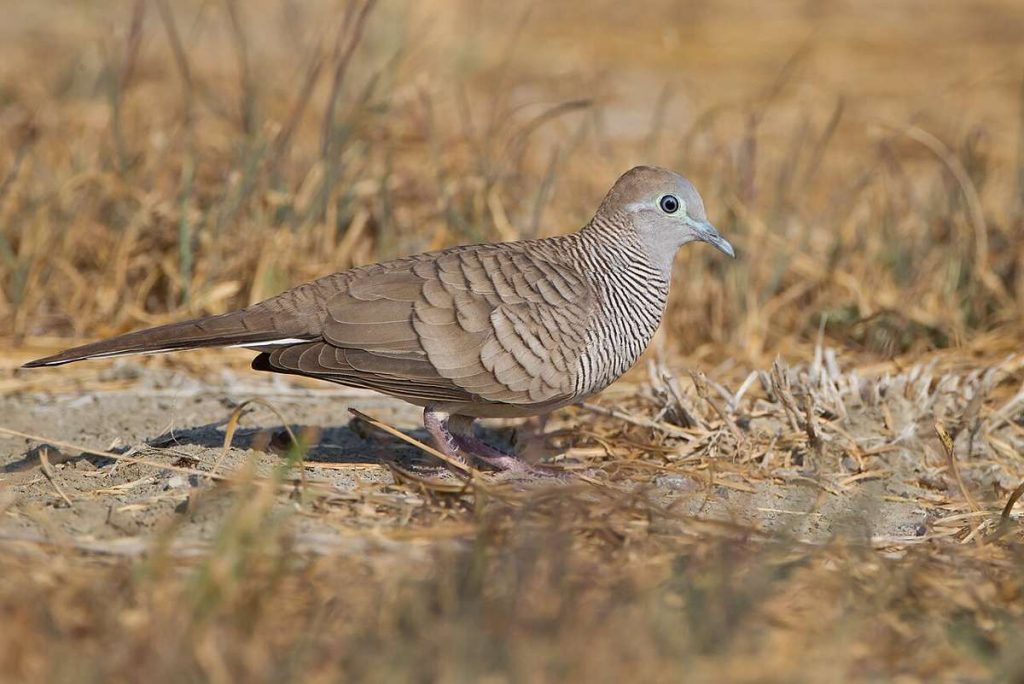
Judges in that study gave points for the opening note (20), the resonance and length of the end note (30 and 10), rhythm (20) and the length of the coo (20). Some domestic pigeon breeds were also bred for voice, such as the Bokhara Trumpeter.
Questions about doves and singing
Do doves sing or coo?
They coo. Doves are not songbirds and do not learn songs, but the advertising coo of a male works like a song: it attracts a mate and claims a perch.
Why do doves keep cooing?
Most repeated cooing comes from unmated males advertising for a mate from a prominent perch. Paired males coo far less and switch to the quieter nest call.
Do female doves coo?
Yes, but less often and more quietly than males. A sitting female mourning dove sometimes gives a soft ohr ohr call from the nest.
Which dove has a three-note call?
The Eurasian collared dove. Its coo-COO-coo is repeated many times. The woodpigeon has a five-note coo.
Can doves learn to sing songs?
No. Studies of ring doves and other Streptopelia doves found that birds develop their species’ normal coo even when deafened young or raised by another species.
Sources
This guide is based on:
- Cornell Lab of Ornithology, All About Birds: Mourning Dove sounds (opens in new tab)
- Cornell Lab of Ornithology, All About Birds: Rock Pigeon sounds (opens in new tab)
- Hingee, M. and Magrath, R. D. (2009). Flights of fear: a mechanical wing whistle sounds the alarm in a flocking bird. Proceedings of the Royal Society B (opens in new tab)
- ten Cate, C. (2021). Re-evaluating vocal production learning in non-oscine birds. Philosophical Transactions of the Royal Society B (opens in new tab)
- RSPB: Most common garden birds in the UK (collared dove and woodpigeon calls) (opens in new tab)
- Anderson, W. W. (2005). Beyond the Cockfight: Masculinity and the Thai Dove-Cooing Contest. MANUSYA (opens in new tab)
Last updated 17 November 2026 · Behavior