
The Philippine Green Pigeon is a medium-sized wild pigeon found in lowland forests of the Philippines.
It is one of the 6 species from the Pompadour Green Pigeon complex.
As the name suggests, this species is mainly green in color but also has yellow, white, and grey details making them easy to distinguish from other similar green pigeon species.
The Philippine Green Pigeon is sexually dimorphic so you can see which individuals are the males and which are the females by looking at their colors, specifically their shoulder and back coloring. This is helpful because it is usually hard to tell the sex of many pigeons.
Origins of the Philippine Green Pigeon
The Philippine Green Pigeon was first described in 1855 in the Conspectus generum avium (opens in new tab) by Charles Lucien Bonaparte (opens in new tab).
The bird was listed in the Treron genus, A.K.A the Green Pigeon genus.
Treron comes from the Ancient Greek trērōn, meaning “timid”, a word poets used for doves.
In 1816, ornithologist Louis Jean Pierre Vieillot (opens in new tab) introduced the genus Treron. The Thick-Billed Green Pigeon (Treron curvirostra) was later designated its type species.
The genus now has around 30 species. Although these species stretch across Asia and Africa, they are all known for their green color.
With that said, there are lots of other similarities in these pigeon species, they have diets based mainly on fruit, especially figs, and they prefer wooded habitats.
Distribution & Habitat of the Philippine Green Pigeon
Philippine Green Pigeons are found in lowland evergreen forests. They can usually be found in the tops of fruit trees.
They prefer subtropical/ tropical moist lowland forests and can be found from sea level up to about 1,200 m.
BirdLife International estimates the extent of occurrence of the Philippine Green Pigeon at 1,160,000 km2, a figure that includes the sea between the islands.
This range is much larger than that of the other species of the Pompadour Pigeon Complex, with the exception of the Ashy-Headed Green Pigeon.
Closest Columbidae Relatives of the Philippine Green Pigeon
The Pompadour Green Pigeon is a pigeon species complex that has been split into six species including Philippine Green Pigeon (Treron axillaris).
Below we’ve listed the other five and how they can visually be distinguished from the Philippine species:
Sri Lankan Green Pigeon (Treron pompadora)
Compared to the Philippines Green Pigeon, the Sri Lankan Green Pigeon (opens in new tab) has more yellow coloring around the face and darker colored eyes.
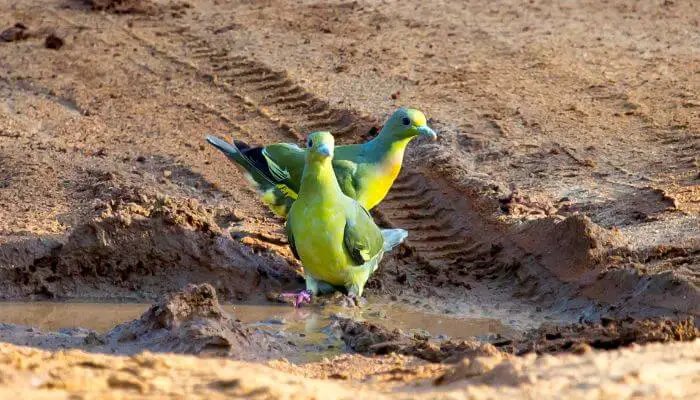
This species is found in the upper levels of the forests of Sri Lanka.
Andaman Green Pigeon (Treron chloropterus)
The Andaman Green Pigeon (opens in new tab) is distinguished by its white forehead, grey crown, and bright yellow-green rump.
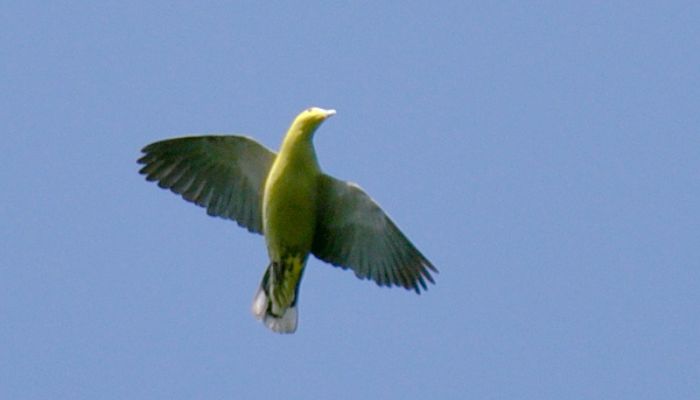
Grey-Fronted Green Pigeon (Treron affinis)
The Grey-Fronted Green Pigeon (opens in new tab) is very similar to the Philippine Green Pigeon except they do not have the red base on the bill.

Ashy-Headed Green Pigeon (Treron phayrei)
This is a similar-looking species but there are a couple of key differences between this and the Philippine Green Pigeon.

First, the Ashy-Headed (opens in new tab) has an orange-yellow breast patch as well as pinkish red feet. This species also lacks the red base on their bill.
Buru Green Pigeon (Treron aromaticus)
The Buru Green Pigeon (opens in new tab) looks very similar to the Philippine Green Pigeon but does not have the red base to the bill and has a smaller, darker maroon area on the back and a large, bluer crown.
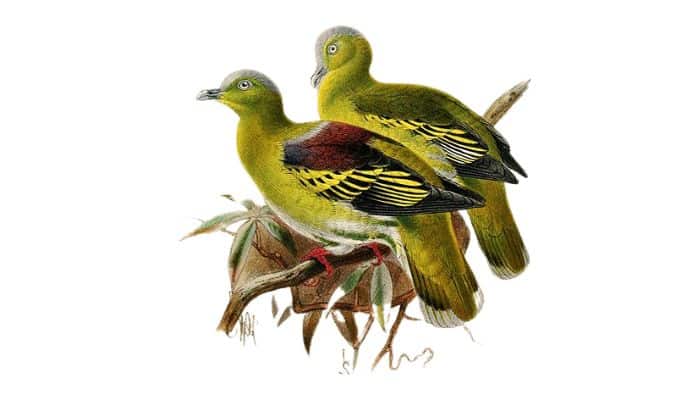
These Green Pigeons were previously known together as Treron pompadora. These species are found in forests across south and southeast Asia. They are all similar in size and colour but there are slight differences in size, appearance etc. depending on the subspecies.
As well as belonging to the Pompadour Green Pigeon complex, the Philippine Green Pigeon is one of around 30 green pigeon species in the Treron genus, all known for their green colour.
Philippine Green Pigeon Appearance
The Philippine Green Pigeon is medium in size and mostly green in color with a grey crown, yellow wing bars, yellow edges to their flight feathers, a lighter belly and white under the base of the tail.
These pigeons have light blue eyes and a white bill with red coloring at the base. The red at the base is one of the features that is not seen on most of the other similar-looking green pigeons.
There is a difference between the male and female Philippine Green Pigeon, the female has green shoulder and back feathers while the male has maroon-colored shoulder and back feathers.
The Philippine Green Pigeon looks similar to the Thick-Billed Green Pigeon although the Philippine does not have green around its eye and has a much thinner bill.
| Wingspan | Length | Weight | Coloring | |
|---|---|---|---|---|
| Philippine Green Pigeon | Unknown | 25-28cm | 234g (average) | Green with some grey and yellow |
| Average Feral Pigeon | 64 – 72 cm | 32 – 37 cm | 300 – 500 g | Bluish gray with some black |
Interesting Facts About The Philippine Green Pigeon:
- The males and females can be identified by their feather colors
- The Philippine Green Pigeon is one of six species in the Pompadour Green Pigeon species complex
- According to the IUCN Red List, the generation length of the Philippine Green Pigeon is 4.2 years
Philippine Green Pigeon Conservation
The Philippine Green Pigeon is listed as Least Concern on the IUCN Red List (opens in new tab).
The main issue regarding the Philippine Green Pigeon is hunting pressure, this is due to the local and national use of this pigeon as food. It is thought the ongoing hunting of the species has resulted in them being rare or uncommon in certain parts of their range.
Although the population is believed to be decreasing due to high hunting pressure and the number of these pigeons left is not known, the large range and available population information means the Philippine Green Pigeon is not currently considered to be at risk of extinction.
There are no specific conservation measures in place to protect this green pigeon species but there are existing conservation sites in the Philippines which help to conserve important habitats including forests.
Philippine Green Pigeon Character
These green pigeons are usually seen alone or in small groups. Although they prefer to be in forested areas, they can sometimes be spotted on the outskirts of suburban areas and towns.
When Philippine Green Pigeons fly their flight path is fast and direct.
Their wings move in regular beats with the occasional sharp flick of the wings, a characteristic flight movement seen in pigeons.
Philippine Green Pigeons live mainly in trees and do not migrate, they are endemic to the Philippines.
Diet
These green pigeons consume fruit. There is limited information on which specific fruits they eat but they can often be spotted in fruiting trees.
A wildlife center (opens in new tab) shared that the immature green pigeon they were rehabilitating loved to eat ripe guava and bananas.
Mating And Breeding Philippine Green Pigeons
Little is published about its breeding, but records suggest it nests mainly around May and June.
During this time, the female Philippine Green Pigeon will build a nest up in a tree using sticks.
The stick nest is basic and is positioned high up in trees that help to camouflage their color (to help avoid predators).
The female is thought to lay two eggs, as other green pigeons do, and these should hatch after 2 – 3 weeks of incubation.
Caring for Philippine Green Pigeons
The Philippine Green Pigeon is a wild pigeon species that is not well suited to domestication.
Therefore, the best way to care for these pigeons is by respecting their habitat and supporting conservation efforts to preserve the forests where they live.
Last updated 23 October 2026 · Types