
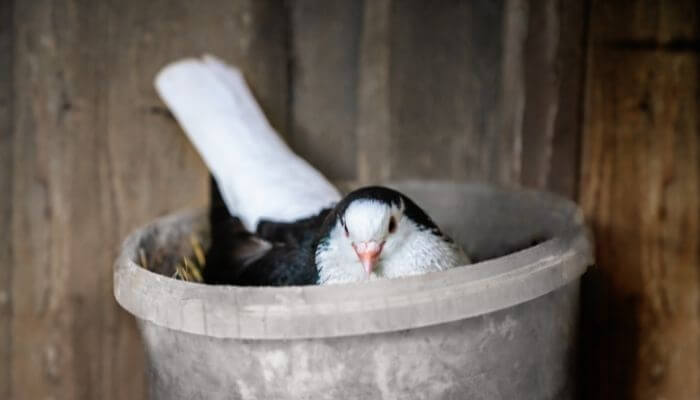
The Lahore is a large, broad fancy pigeon named after the city of Lahore, in present-day Pakistan. On the American Lahore Club standard the bird stands about 10.5 inches (27 cm) tall and 11.5 inches (29 cm) long, with a white body and tail, a coloured head, neck and entire wing, a pinkish-white beak and feathered feet. It is kept mainly as a show bird and pet.

Appearance and official measurements
The American Lahore Club published its Standard of Perfection in June 1991, and that is the description used for judging in the United States. For an old cock the standing height is about 10.5 inches, the length from chest to tail tip about 11.5 inches, and the width across the shoulders about 5.5 inches (roughly 27 cm, 29 cm and 14 cm). Hens and young birds are a little smaller. The body should feel broad, cobby and well fleshed, with a round chest that covers the wing butts, and the back sloping at about 35 to 45 degrees when the bird stands in show station.
Markings carry the most points on the standard (25 of 100). Colour starts at the wattle, runs in a line over the eye and down the neck to the wing butt, and covers the whole wing. The rump, tail and the rest of the bird are white. White flight feathers or a coloured tail are listed as disqualifications (with a note that some colours, such as grizzle, may show white in the flight if the feathers are tipped with colour). Eyes must be bull (dark). The beak must be pinkish-white; horn colour or dark staining is a disqualification. Feet should have heavy grouse feathering that is not so long it looks like a muff, and toenails are preferably pinkish white.
Recognised show colour classes on that standard are black, lavender, red, yellow, bars, checks and any other colour. Intense colours should be rich; bars and checks should be clear. The bird in the photographs on this page is a black Lahore, the colour most often pictured.
| Point | American Lahore Club standard (1991) |
|---|---|
| Height (old cock) | About 10.5 in (27 cm) |
| Length, chest to tail | About 11.5 in (29 cm) |
| Width at shoulders | About 5.5 in (14 cm) |
| Coloured plumage | Head, neck and entire wing |
| White plumage | Body, rump, tail and foot feathering |
| Eyes | Bull (dark); cracked or off-colour is a disqualification |
| Beak | Pinkish white, stout, about 7/8 in long |
| Temperament in the show pen | Calm and stately; wild or flighty birds may lose points |

Measurements for an old cock
Inches, with centimetres in brackets. Hens and young birds are a little smaller.
The wing tips end about 1 in (2.5 cm) from the end of the tail. In show station the back slopes at 35 to 45 degrees.
Where the 100 points go
A wild or flighty bird can also lose up to 10 “floating” points for temperament.
- Markings and design: 25
- Head, neck, body and size: 40
- Carriage, colour, feet and legs: 35
Name and history
The breed takes its English name from Lahore, a city now in Pakistan, in the wider Punjab region where similar pied, muffed pigeons have long been kept. Related birds are also associated with Shiraz in Iran, where they are often called Shirazi. It is now shown in Europe and North America as a form or colour pigeon rather than as a flying or racing breed.
Like other types of pigeon, the Lahore is a domestic form of the rock pigeon (Columba livia), not a separate wild species. Today it is kept as a show bird and pet. Specialist utility breeds such as the French Mondain pigeon and Giant Runt pigeon are the usual choice if someone wants a heavier table bird (see what pigeons you can eat).

Temperament and keeping
The American standard asks for a calm, stately bird in the show pen and allows judges to cut points for birds that are wild or flighty. That matches the breed’s reputation as a gentle, easily handled pigeon and a reasonable choice for someone who already knows the basics of pigeons as pets. They still need a dry loft, grit, clean water and a varied grain diet, and their feathered feet stay cleaner if the floor is kept dry.
Breeding pairs sit and feed like other domestic pigeons. Producing a bird that meets the markings is harder than hatching typical youngsters: the standard itself says a correctly marked Lahore is difficult to produce, which is why judges are asked to look for the main virtues rather than punish every small mismark. White across the nape, an open (white) forehead, a cut eye (solid colour across the eye), a coloured tail or white flights are among the listed disqualifications.

What disqualifies a Lahore
- 1White flights or coloured tail feathers (grizzles may show some white)
- 2A white collar across the back of the neck
- 3An open face: white across the forehead
- 4A cut eye: solid colour across the eye
- 5Any beak colour other than pinkish white
- 6A broken eye, or any eye colour other than bull
- 7Poor condition
- 8Too much trimming
- 9Faking, such as dyed feathers
- 10A young bird wearing the wrong size of band
Smaller mismarks, such as a “bishoped” wing or colour on the thigh, cost points but do not disqualify.
Lahore pigeon FAQs
What is a Lahore pigeon?
A large fancy pigeon with a white body and tail, a coloured head, neck and wing, a pinkish-white beak and feathered feet, named after Lahore in present-day Pakistan.
How big is a Lahore pigeon?
The American Lahore Club standard gives about 10.5 inches (27 cm) in height and 11.5 inches (29 cm) from chest to tail tip for an old cock.
Is the Lahore’s tail white or coloured?
White on the American standard. A coloured tail is a disqualification. The wing, including the flights, should be coloured.
Are Lahore pigeons good pets?
They are usually calm and handle well, which is why they are popular show and pet birds. They still need proper loft care, like any domestic pigeon.
Where does the breed come from?
It is named after Lahore and belongs to a group of pied, muffed pigeons long kept in Punjab and neighbouring regions, including birds known as Shirazi in Iran.
What colours do Lahore pigeons come in?
The American club lists black, lavender, red, yellow, bars, checks and any other colour. Black is the colour most often photographed.
Sources
Primary references used for this page:
Last updated 15 November 2026 · Fancy breeds, Types