
Spanish pouters, known in Spain as buchones, are the country’s own breeds of domestic pouter pigeon. Like other pouter pigeons they can fill the crop with air, but most of them were bred for a flying sport rather than for the show pen. A buchón cock is judged on how well he flies, displays and courts a hen, and in the old form of the sport, on whether he can lead a strange pigeon back to his own loft. The RFEC standard for the Gorguero traces that breed to an older “paloma de casta o ladrona”, a thief pigeon.
All of them descend from the rock pigeon (Columba livia). Most come from Andalusia, Murcia and the Valencia region, and nearly every breed takes its name from a town or province.
Spanish pouters at a glance
| Feature | Spanish pouters (buchones) |
|---|---|
| Species | Domestic rock pigeon (Columba livia) |
| Spanish name | Buchones, palomos de raza buchona |
| Main regions | Andalusia, Murcia, the Valencia region, the Balearic and Canary Islands |
| Main use | Flying and courtship contests; also shown |
| Governing body for the sport | Real Federación Española de Colombicultura (RFEC) |
| Breeds with an RFEC standard | 22 |
| Weight in the RFEC standards | About 300 to 550 g, depending on the breed |
| Ring size | 8 or 9 mm (FESACOCUR list) |
What makes a buchón different
Pouters elsewhere in Europe, such as the English Pouter, were mostly bred for their outline on the show bench. The Spanish breeds kept a working job. The RFEC standard for the Gaditano lists the three qualities a buchón needs: pursuit, seduction and staying power. It describes the bird as a conqueror, gentle with the hen and a keen flier, and says these traits come from generations of selection through releases and courtship trials.
The standards are full of courtship detail. The NPA standard for the Gorguero says cocks of the breed court hens with their deep voices without pecking or beating them, and that a flying Gorguero will place itself in front of other pigeons and guide them to its home. The RFEC standard for the Almendralejo pouter asks for a bird that is always gentle and never punishes the bird it is trying to win over. The Palomo de Clase standard lists striking the hen among its faults.
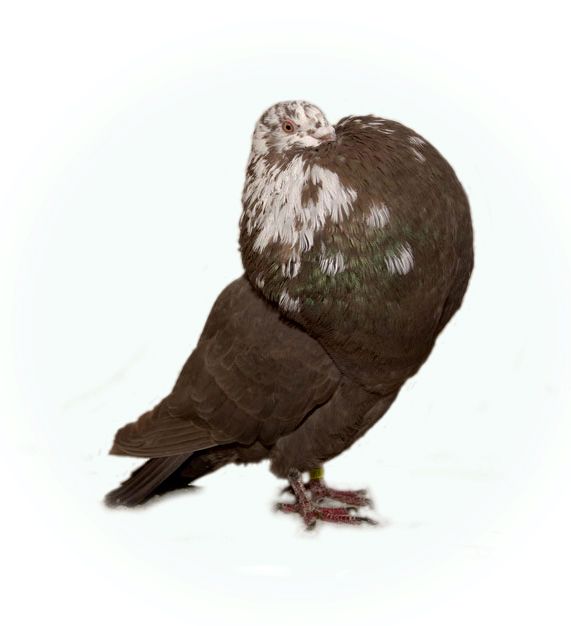
Each breed also has its own way of flying. The Colillano is judged on its “colocado” posture, flying slowly with the front of the body raised, wing tips pushed forward and the tail fully open and flat. The Marchenero flies with its tail curled down and forward. The NPA compares it to a lobster’s tail, and the long rump feathers stand out like a second tail.
How many Spanish pouter breeds are there?
The answer depends on whose list you use. The RFEC, which runs the flying and show contests, has published standards for 22 buchón breeds. FESACOCUR, the Spanish federation for poultry, pigeon and rabbit breeds, lists 17 recognised buchones, chosen by the number of breeders and by entries at national shows. Eleven of those are in the European breed list (the EE list) in group 0300 with the country code E. The US National Pigeon Association (NPA) has translated standards for six.
Spanish pouter breeds on each list
Number of Spanish buchón breeds each organisation lists or has a standard for.
The main breeds and where they come from
Most standards name a home town or area. The table below gives the place each standard names and one feature it stresses.
| Breed | Home area named in the standard | A feature the standard stresses |
|---|---|---|
| Marchenero | Seville | Very loose, curly feathering and a tail curled under in flight |
| Rafeño | Seville | A short, broad, square head and a very short, thick beak |
| Gorguero | Central Spain, later Jaén, Córdoba and Granada | A crop that ends in a fold like a ruff collar (gorguera) |
| Colillano | Seville | A flat, fully open tail in flight |
| Laudino Sevillano | Seville | A ram-shaped head and a large, creased, pear-shaped crop |
| Gaditano | Cádiz province | A round crop with a vertical crease that leaves the head clear |
| Granadino | Granada province | A large bird with a square head and a big hanging crop |
| Jiennense | Jaén province | Developed from crosses of several older breeds |
| Moroncelo | Morón de la Frontera (Seville) | A small crop, “like half an orange” |
| Morrillero Alicantino | Alicante | A long, thin neck arched at the back (the morrillo) |
| Laudino Murciano | Northwest Murcia | One branch of the old Valencian pouter |
| Quebrado Murciano | Murcia | A short, broad bird that hops towards the hen |
| Veleño | Vélez-Málaga | Kept there for about 200 years, according to its standard |
| Balear | Majorca | Probably bred from the old Valencian Laudino and the Rafeño |
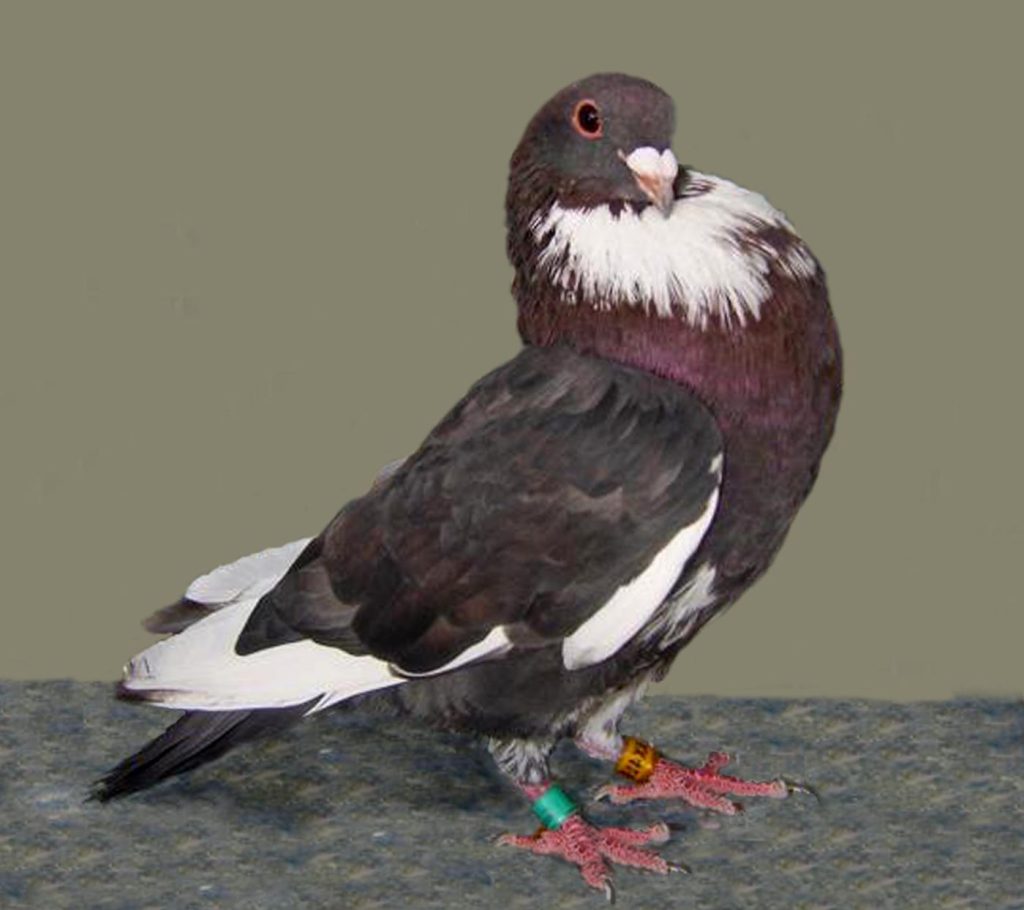
The pigeon in the photo at the top of this page is a Moroncelo, a red bronze bird with white on the crop and flights. According to the RFEC standard, the breed’s ancestor, an old “palomo de celo” from Morón, had plenty of white between the crop and the flights, a medium size and little crop.
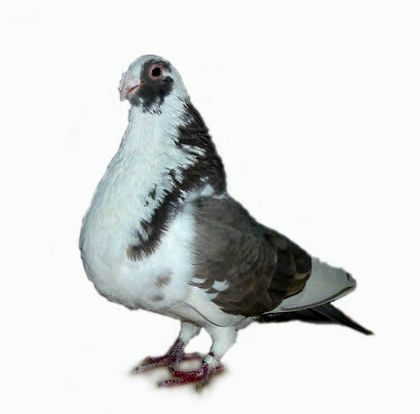
The Granadino is one of the larger buchones. Its standard asks for a chest about 12 to 14 cm wide, a body length of 26 to 28 cm and long, clean legs. In flight it carries the crop out and the tail open, with the tips curving upwards.
The Morrillero Alicantino looks quite different. It is finely built and slim, and its standard asks for a neck at least half the length of the body. Its wings must never be longer than the tail, and when it stands they hang below the tail.
Sizes and weights in the standards
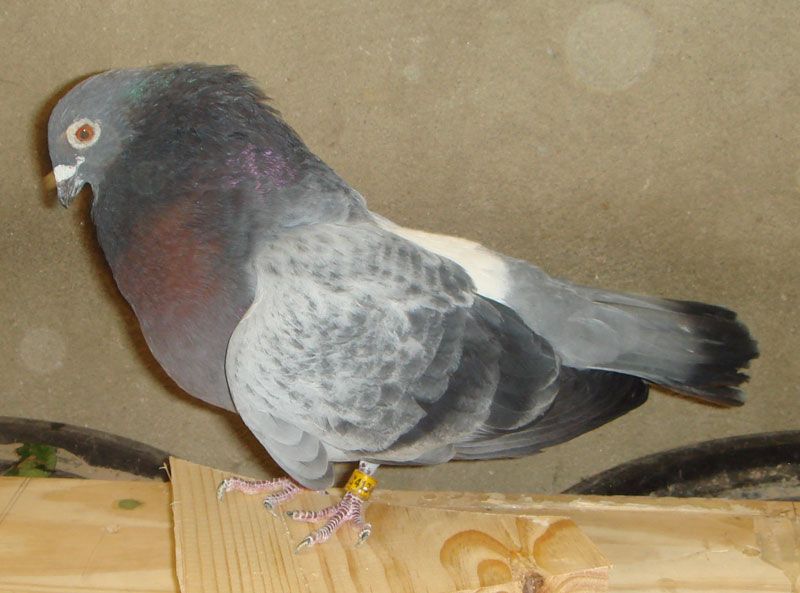
Most RFEC standards give a weight range, and several give a length measured from the front of the keel to the end of the tail, mostly between about 20 and 30 cm. The chart shows the weights. The Marteño has the widest range in the standards and the Porcelano one of the lightest.
Weight in the RFEC breed standards
Weight ranges in grams as stated in each standard. The Marchenero standard gives one figure and the Gorguero standard only a maximum, shown as a lighter bar.
The figures come from different standards and are not always measured the same way, so treat them as guides, not limits. The Laudino Murciano standard notes that a bird’s weight can change by 30 g either way depending on whether it has eaten. The standards also disagree with one another in places. The NPA gives the Marchenero as 7 to 10½ ounces (about 200 to 300 g), while the RFEC standard puts it at about 350 g.
Flying and judging
The RFEC runs two kinds of contest for these breeds. In a show (concurso exposición) the birds are judged in pens against their standard. In a flight and work contest (concurso de vuelo y trabajo) a judge watches each cock fly. Its 2025 competition rules set out how this works:
- Each bird flies for about 20 to 30 minutes.
- It flies alone at first. If no other pigeon has appeared after 10 minutes, a hen in breeding condition is released so the judge can see it work.
- Two hens are allowed per bird, in case the first flies off.
- Nobody may frighten the bird or throw stones at it.
- National flight contests run from 1 November to 31 May.
Birds may carry identification marks painted under the wings for flight contests, but the rules advise against painting birds that will be shown. The same rules describe a separate sport, hembreo, which tests how well a cock resists a hen’s courtship, and the other way round. The federation also keeps a separate section for palomos deportivos, the Spanish sport pigeons that are flown in their own contests.
Dates in the record
Some of these dates are traditions recorded in the standards rather than documented events, and they are given here as the standards give them.
Spanish pouter history in dates
Keeping Spanish pouters
Most standards ask for a bird that flies well. The NPA’s Laudino Sevillano standard lists “overly heavy bodied birds unable to fly” among its serious faults, and several standards fault a crop so large that it drags on the ground. A buchón kept only in a show pen loses the part of the breed the standards value most, so these birds need regular free flight or a large flight pen.
In the United States, the NPA standards for the six breeds they cover were translated from the Spanish ones by Frank Barrachina. The traditional sport involved bringing home lost and stray pigeons. Outside an organised contest, fly your own birds from your own loft, keep them ringed, and return any ringed stray that comes in. For general crop display in other pigeons, see why pigeons puff up their chests. For other kinds of domestic pigeon, see the types of pigeon guide.
Frequently asked questions
What does buchón mean?
Buchón comes from buche, the Spanish word for a bird’s crop. It means a pouter pigeon, one that inflates its crop. In Spain the word usually refers to the native flying pouter breeds.
How many Spanish pouter breeds are there?
The RFEC has published standards for 22 breeds. The FESACOCUR list of recognised Spanish breeds includes 17 buchones, and 11 of those are in the EE list.
Which is the biggest Spanish pouter?
Among the RFEC standards, the Marteño has the highest stated weight, up to 550 g, and the Laudino Murciano is given as 400 to 500 g. The Granadino and Marteño have some of the longest bodies, at 26 to 28 cm and 26 to 30 cm.
Can Spanish pouters fly?
Yes. Most were bred to fly, and the RFEC judges cocks in the air in flight and work contests. The Laudino Sevillano standard counts a bird too heavy to fly as a serious fault.
Where can I see Spanish pouters?
At RFEC shows and championships in Spain. The 34th Spanish Championship for buchón breeds was held in Arahal, in Seville province, from 1 to 3 May 2026.