
A pigeon that puffs up its chest is usually a male showing off. In the courtship display, the bow-coo, he fills his crop with air, raises his neck feathers, coos and turns in circles in front of a female. Pigeons also fluff their feathers to keep warm, to rearrange them after preening or bathing, and to look bigger when defending a nest. A pigeon that stays fluffed up and sleepy for hours may be ill.

The six reasons at a glance
| Reason | What you see | Who and when | Should you worry? |
|---|---|---|---|
| Courtship (bow-coo) | Swollen neck and crop, raised feathers, bowing, cooing, turning circles, tail dragged or fanned | Mostly males, near a female | No |
| Claiming home ground | Turning round and round while cooing, little head-lifting | Males landing at their nest site or facing a rival | No |
| Keeping warm | Whole body fluffed into a ball, often still | Any pigeon on a cold or windy day, or at rest | No, if it moves off when approached |
| Preening or after a bath | Feathers raised for a moment, then a shake | Any pigeon, often in sun after bathing | No |
| Defending a nest | Feathers raised, tail spread, a wing lifted, loud calls, wing slaps | Parents on eggs or chicks; older squabs too | No, but leave the nest alone |
| Illness | Fluffed up for hours, eyes half shut, not eating, may sit or stand on both legs | Any pigeon | Yes: see the illness section |
What is your pigeon doing?
Pick the description closest to what you can see.
The pigeon is…
1. Courtship: the bow-coo
Most of the chest puffing you see in a park or on a roof is courtship. The male inflates his crop and neck, raises the feathers of his neck, lower back, rump and belly, and bows low while giving his song, a coo usually written as “coo, roo-c’too-coo”. Between bows he lifts his head high, struts and turns in quick circles around the female, often spreading his tail and dragging it along the ground.
Females do it too, but less. The ornithologist Derek Goodwin noted that a female joining her mate at the nest often makes a short version of the display, and occasionally a female displays to her mate after a squabble with the neighbours. For what follows, see how pigeons mate; for the calls themselves, see what sound a pigeon makes.
2. Claiming home ground
A second, quieter form of the same display is about place rather than a partner. A male in breeding condition turns round and round cooing when he lands on or near his nesting territory, or when another pigeon, especially a stranger or rival, comes close. Goodwin even saw males do this alone on returning home after a long absence.
3. Keeping warm
Fluffing up is how birds keep warm. Raised feathers trap a thick layer of warm air next to the skin, so a pigeon on a frosty morning can look almost round. This is a whole-body fluff rather than a puffed neck, and the bird is usually still. Roosting pigeons fluff up slightly too (see how pigeons sleep). Our guide to how cold is too cold for pigeons covers what temperatures they cope with.
4. Preening and bathing
A common sequence in pigeons is to raise all the body feathers, hold the wings a little away from the body and shake vigorously, especially after preening. They also fluff out their feathers when bathing in a puddle or in the rain, and then dry off in a sunny spot. Pigeons rely mainly on powder down to dress their feathers, although feral pigeons do have a working oil (preen) gland.
5. Defending a nest
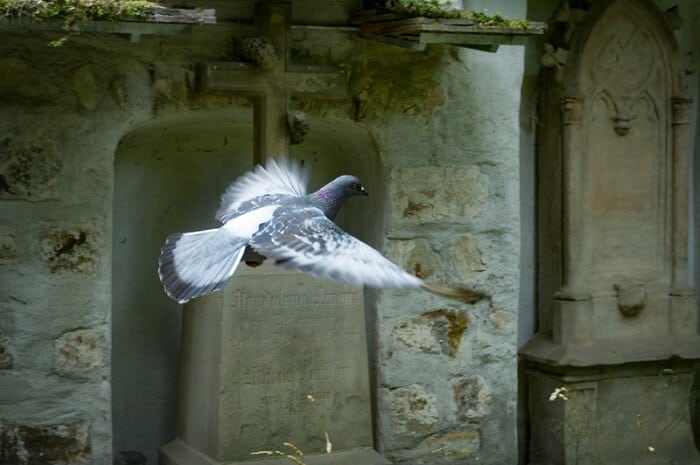
When a pigeon is torn between fleeing and attacking, it uses a defensive threat display: it raises most of its feathers, spreads its tail, lifts one or both wings, calls loudly and strikes out with the near wing. This is what a parent does when a hand comes towards its eggs or chicks. Half-grown squabs do something similar, rearing up, raising their neck feathers, making a puffing sound and snapping at the intruder.
Some domestic breeds take crop-puffing much further. Pouters and croppers have been selected to inflate the neck hugely at the slightest excitement; see our guide to the English Pouter. Two much smaller examples are the Holle Cropper and the Brunner Pouter.
6. Illness
A pigeon that stays fluffed up for long periods, looks sleepy, sits hunched or will not eat may be ill. Sick birds lose heat quickly, which is why rescues treat warmth as a first step. Goodwin noted that healthy adults rest on one leg, while sick birds use both legs to support themselves.
If you find a pigeon like this, the RSPCA advises taking it to a vet in a ventilated box, wearing gloves. Cascadia Pigeon Rescue recommends gentle warmth with a warm side and a cooler side so the bird can choose. Our guides to sick pigeon symptoms, a pigeon sitting still and not moving and what to do if you find an injured pigeon explain the next steps.
Do pigeons puff up to scare predators?
Not usually. Older versions of this article said pigeons puff up to frighten off a hawk or cat. Goodwin’s observations show the opposite: faced with a predator, a pigeon watches it, gives an alarm call, freezes with its feathers sleeked down and its wings hiding the white rump, and then flies off fast. Puffing up is kept for defending the nest against something close at hand. For more on what hunts them, see the natural predators of pigeons.
Frequently asked questions
Why do male pigeons puff up their chests?
To court a female and to claim their home ground. In the bow-coo the male inflates his crop and neck, raises his feathers, bows, coos and turns in circles.
Do female pigeons puff up?
Sometimes. Females make a shorter version of the display, for example when joining their mate at the nest, and both sexes fluff up to keep warm.
Why does a pigeon puff up and spin around?
That is the bow-coo or the related territorial display. The spinning male is courting a female or showing that a spot is his.
Is a puffed-up pigeon sick?
Usually not. Worry if it stays fluffed up for hours, looks sleepy, will not eat, or lets you walk right up to it.
Why are pigeons puffed up in winter?
Fluffed feathers trap warm air close to the body. It is normal on cold days as long as the bird is alert and moves off when approached.
What should I do with a puffed-up pigeon that cannot fly?
Put it in a ventilated cardboard box, keep it somewhere warm, dark and quiet, and contact a vet or pigeon rescue. The RSPCA advises wearing gloves.
Sources
We read each source on 30 October 2026.
- D. Goodwin, Pigeons and Doves of the World, and R. Johnston and M. Janiga, Feral Pigeons: ethogram excerpts (Great Lakes Pigeon Rescue) (opens in new tab)
- Audubon: How do birds cope with cold winter weather? (opens in new tab)
- Cascadia Pigeon Rescue: Why sick or injured birds need heat support (opens in new tab)
- RSPCA: Injured pigeon, what to do and how to help (opens in new tab)
Last updated 31 October 2026 · Behavior