
A female pigeon is called a hen and a male is a cock. A baby pigeon in the nest is a squab, and a youngster that has just left the nest is often called a squeaker. A group is a flock, or a kit when fanciers fly birds together. The other terms pigeon keepers use are explained below.
Male, female and baby pigeons
A male pigeon is a cock and a female is a hen. The words are the same as for chickens, but they are the standard terms in pigeon keeping and are used in extension guides for young keepers (Oregon State University Extension (opens in new tab)). In most breeds cocks and hens look alike and both incubate. Oregon State University’s 4-H pigeon guide describes the hen sitting from late afternoon until mid-morning, with the cock covering the middle of the day. Telling the sexes apart takes practice: see how to sex a pigeon.
A baby pigeon is a squab. Both parents feed it crop milk, and the same guide notes that squabs are full size at about four weeks. Squab is also the name for young pigeons raised for meat, which is how the word appears on menus. Once a youngster is out of the nest but still begging with a thin, squeaky call, fanciers call it a squeaker. For how they look at each stage, see what a baby pigeon looks like and the pigeon age chart.
Young bird, yearling and old bird
Racing and show fanciers group birds by year rather than by weeks. A young bird is one hatched in the current year, and racing calendars include young-bird races for them. A yearling is in its second year, and an old bird is older still, although each club’s rules decide exactly which birds may enter which race.
A bird’s year is shown by a seamless, numbered ring slipped over the foot while the squab is small. The OSU guide suggests fitting it at 5 to 10 days old, depending on the size of the breed, because the foot soon grows too big for the ring to pass. See pigeon banding.
What is a group of pigeons called?
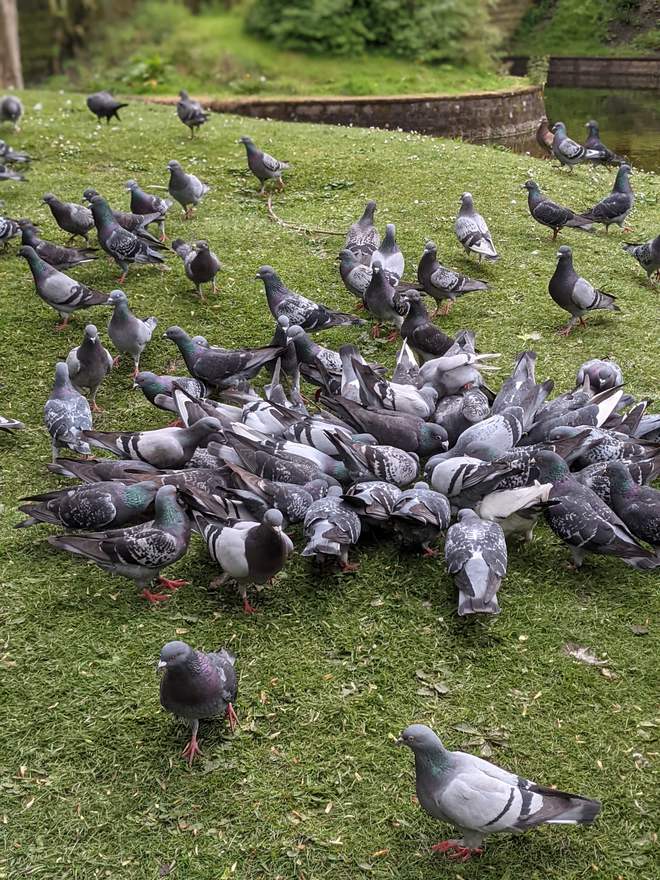
The everyday word is a flock. Fanciers who fly tumblers, rollers or tipplers call a group flying together a kit. Birds kept in one building are usually described by the building itself, the loft. Lists of collective nouns give a few rarer words, but they are not used in pigeon keeping.
Loft and equipment terms
- Loft: the building or shed where pigeons live, also called a coop. It should be dry, free of draughts and proof against cats and rats (Oregon State University Extension (opens in new tab)). See how to build a pigeon coop.
- Trap: the one-way entrance that lets birds into the loft but not back out.
- Nest box and nest bowl: the compartment, and the bowl inside it, where a pair nests. The OSU guide recommends two nest boxes per pair, because a hen may start a new clutch about a week after the first squabs hatch.
- Ring or band: the numbered leg ring that identifies a bird and its year.
- Fancier: someone who keeps, breeds, races or shows pigeons.
Body terms
- Wattle: the fleshy patch at the base of the upper beak, around the nostrils. Many keepers call it the cere. See pigeon cere.
- Eye cere: the ring of bare skin around the eye.
- Crop: the pouch at the base of the neck that stores food and, in breeding birds, produces crop milk. See crop milk.
- Hackle: the neck feathers. The saddle and rump are the back and lower back, and the flights are the long wing feathers.
- Wing bars: the two dark bands across the folded wing of a blue-bar pigeon. More parts are labelled in pigeon anatomy.
Pigeon, dove, rock dove and feral pigeon
Pigeon and dove are not separate scientific groups. Both cover the family Columbidae (pronounced kuh-LUM-bih-dee), and English tends to use pigeon for the larger species and dove for the smaller ones (US National Park Service (opens in new tab)). The rock dove, Columba livia, is the wild ancestor of all domestic breeds. A feral pigeon is a domestic pigeon, or a descendant of one, living wild in towns. A homer is a pigeon bred for homing, and racing pigeons are homers. See the difference between a dove and a pigeon and feral pigeons.
Pigeon terminology FAQs
What is a female pigeon called?
A hen. A male pigeon is a cock, and both are the standard terms in pigeon keeping.
What is a male pigeon called?
A cock. In most breeds cocks and hens look alike, so sex is usually judged by behaviour or by an experienced keeper.
What is a baby pigeon called?
A squab while it is in the nest. Just after it leaves the nest it is often called a squeaker, and racing fanciers call all birds of the current year young birds.
What is a group of pigeons called?
A flock. Fanciers call a group of birds flying together a kit.
What is a yearling pigeon?
A pigeon in its second year. In racing, the exact age classes depend on club rules.
Is squab the same as pigeon?
Squab means a young pigeon. The word is also used for young pigeons raised for meat.
Sources
References used for this page:
- Oregon State University Extension Service, 4-H 154: Pigeons and doves (hen and cock incubation shifts, squab growth, nest boxes, ringing at 5 to 10 days, body part chart) (opens in new tab)
- US National Park Service, Rock Pigeon (Columba livia): use of the words pigeon and dove (opens in new tab)
Last updated 9 November 2026 · Facts