
The Dragoon is an old English wattle pigeon. John Moore described it in his Columbarium in 1735, and the National Pigeon Association (NPA) still lists it among its wattle pigeons. The NPA standard asks for a bird that is “medium in size and excessive in no property”, with an erect, bold carriage.
Wendell Levi’s The Pigeon (1977), as cited in the Wikipedia article on the breed (opens in new tab), names the Dragoon among the breeds used in developing the Racing Homer.
Dragoon origins and name
Moore called the Dragoon “absolutely and without dispute a bastard strain”, bred from a Horseman crossed with a Tumbler and then mated back to the Horseman to gain stoutness. He rated it “a very good breeder”. Over ten or twenty miles he thought it faster than the Horseman, though a good Horseman would beat it over longer distances.
Charles Darwin, a well-known pigeon fancier, kept the breed under the name Dragon. In The Variation of Animals and Plants under Domestication (1868) he placed Dragons with the carriers. He wrote that the English Dragon is smaller than the improved English Carrier in all its dimensions, with less wattle round the eyes and over the nostrils, and none on the lower mandible. He also noted that one Dragon owned by Mr Brent never had more than ten tail feathers.
Moore uses both “Dragoon” and “Dragons”, Darwin writes Dragon, and the NPA uses Dragoon. None of these sources explains where the name came from. Today the Dragoon is one of many breeds of pigeon kept for exhibition.
The Dragoon in print
- 1735John Moore describes the Dragoon as a cross of the Horseman and the Tumbler. He says it is faster than the Horseman over 10 or 20 miles, though a good Horseman wins over longer distances.
- 1868Charles Darwin groups Dragons with the carriers in The Variation of Animals and Plants under Domestication, and records measurements of Dragon specimens.
- 2022The NPA prints a Dragoon standard that asks for a bird “medium in size and excessive in no property”.
Dragoon appearance
In the NPA order of judging, carriage and outlook come first, then the head, then the body, then colour and markings. The bird stands erect and bold on short legs set well back, with stout, muscular thighs. The breast is broad and full with a straight keel, and the back is broad and flat across the shoulders, tapering to the rump.
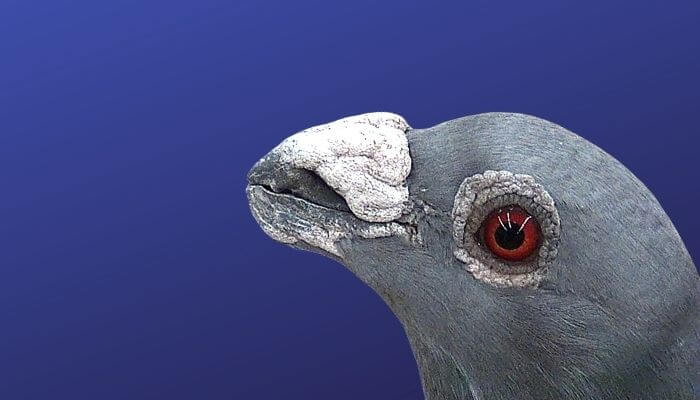
The skull is fairly massive and deep, and from the eye to the back of the skull it is wedge-shaped and broad. The eye is large and prominent. The cere is small, hard and finely laced, and on an adult bird it shows three clear circles in the upper part and two in the lower. In blues the standard describes the cere as dark blue grey, “usually described as damson”, and the eye as bright red.
Both mandibles are stout, straight and of equal substance, and the beak ends as bluntly as possible. The wattle is “peg-shaped”: broad, highest at the back and narrowing with equal sides. The lower mandible should be as free as possible from wattle growth, which the standard calls “jewing”.
The wings are powerful, with short, broad flights resting on the tail. The tail runs in line with the back, fits closely and is carried clear of the ground. The feathering is hard and very close.
Darwin’s measurements: Dragon and wild rock pigeon
Inches, as Darwin measured them with compasses, with centimetres in brackets.
Allowing for body size, Darwin found the Dragon’s feet 0.06 in too long and its sternum 0.41 in too short compared with the rock pigeon.
Measurements in the NPA standard
Inches, with centimetres in brackets.
From beak tip to tail tip, outstretched, the bird should measure about 15 in (38 cm).
Dragoon colours
The NPA lists twelve colour classes, from blue and blue chequer to red, white and black. Further classes cover cream bar, light chequer, rare colours and any other colour. Eye colour follows the plumage: bright or rich red in most colours, orange red in yellows and reds, and bull or dark hazel in whites. Our guide to pigeon colours and genetics explains how these patterns are inherited.

A black should show no trace of bars. The standard also recalls that some very beautiful chequers with light markings on the butts existed in former times, and says that if they recur they “should not be unduly penalized”.
Colour classes in the NPA standard
- Blue
- Blue chequer
- Silver
- Silver chequer
- Grizzle
- Red chequer
- Yellow chequer
- Mealy
- Yellow
- Red
- White
- Black
Additional classes
- Cream bar
- Light chequer
- Rare colours (reduced, opal, indigo, brown, khaki)
- A.C.C. (duns, chequered grizzles, stork marked, pied)
Eye colour
- Bright or rich red: blues, silvers, chequers, grizzles, mealies and blacks
- Orange red: yellows, yellow chequers and reds
- Bull or dark hazel: whites
Swatches are approximate and only show the general shade.
Keeping and breeding Dragoons
Moore wrote that Dragoons “ought to be flown and trained” in the same way as the Horseman. He also kept them as nurse birds for other breeds. Because Dutch Croppers fed their own young badly, he advised moving the young under “small Runts, Dragons, or Pouting-horsemen” kept as nurses.
The show standard sets no rules for housing or feeding. General advice on building a coop and on keeping pigeons as pets applies. Breeders of show birds select closely for the head, since the standard judges it straight after carriage: beak substance, wattle shape, skull, eye and cere.
Like every domestic breed, the Dragoon descends from the rock dove. Our guide to pigeons covers the wider family.
Sources
- John Moore, Columbarium: or, The Pigeon-House (opens in new tab) (1735; reprinted 1874), entry “The Dragoon”.
- Charles Darwin, The Variation of Animals and Plants under Domestication (opens in new tab), vol. 1 (1868), chapters 5 and 6.
- National Pigeon Association, NPA Book of Standards (opens in new tab), Dragoon (2022).
- Dragoon pigeon (opens in new tab), Wikipedia, citing Wendell Levi, The Pigeon (1977).
- Dragoon (opens in new tab), Darwin’s Pigeons photo project.
Last updated 15 November 2026 · Fancy breeds, Types