
The spotted dove is a pink-breasted dove with a black patch at the back of the neck, densely marked with white spots. In 2024 the IUCN Red List assessed it as two species: the Eastern Spotted Dove (Spilopelia chinensis) and the Western Spotted Dove (Spilopelia suratensis). In Indonesia the Eastern bird is the familiar burung tekukur. It is larger than a zebra dove (perkutut), and Eastern birds have been introduced to places including Australia and Hawaii.
How to identify a spotted dove
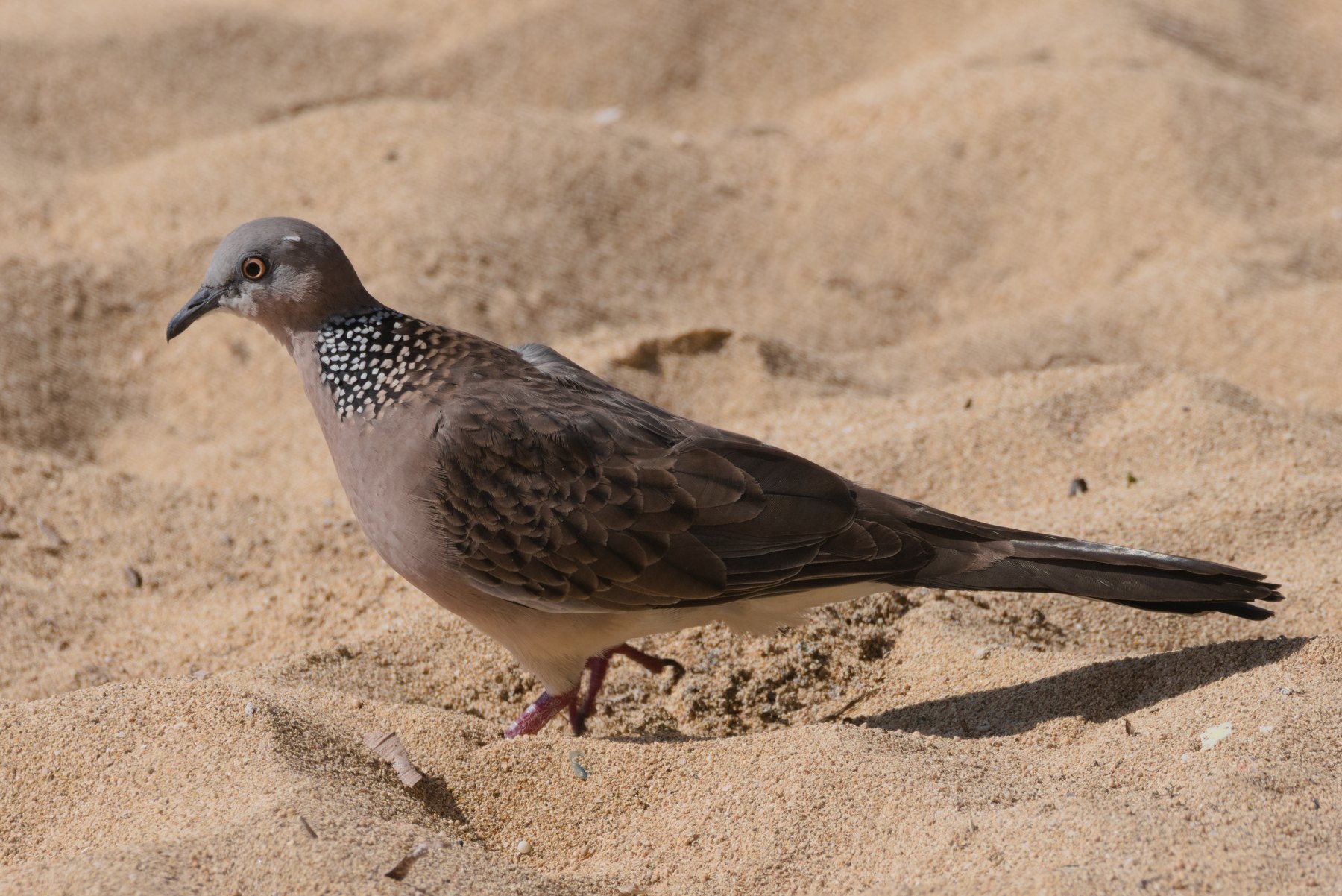
Start with the hind-neck. Adults have a large black patch there, filled with white spots, which is the mark most people notice first. The head is grey, the underparts are tinged with pink or rose, and the upperparts are light brown. In flight, the tail shows white tips. The sexes look alike. BirdLife Australia’s profile (opens in new tab) notes that young birds are similar, but their collar is mostly dark grey rather than black and white.
The bird is a typical dove in shape, with a long tail, and it is substantially heavier than a zebra dove. Our zebra dove comparison table, which draws on the Cornell Lab of Ornithology, gives a spotted dove weight of 144 to 171 g, against 50 to 72 g for a zebra dove.
Eastern and Western Spotted Doves: the 2024 split
For many years field guides lumped these birds as one species, often under the older names Streptopelia chinensis or Stigmatopelia chinensis. The 2014 HBW and BirdLife checklist split them. In June 2024 the IUCN Red List published separate assessments, both Least Concern: the Eastern Spotted Dove (Spilopelia chinensis) (opens in new tab) and the Western Spotted Dove (Spilopelia suratensis) (opens in new tab).
The two species meet in the Indian region and then occupy different parts of Asia. Western birds are native in Pakistan, India, Nepal, Bhutan, Sri Lanka and the Maldives, and have been recorded as vagrants in Afghanistan. Eastern birds are native from eastern parts of the Indian region through China and mainland Southeast Asia to Indonesia, the Philippines, Malaysia, Singapore, Brunei, Timor-Leste and neighbouring countries. Older books, and some current checklists, still treat them as one species, so a label of Spilopelia chinensis on a photograph is not enough on its own to tell you which taxon you are looking at.
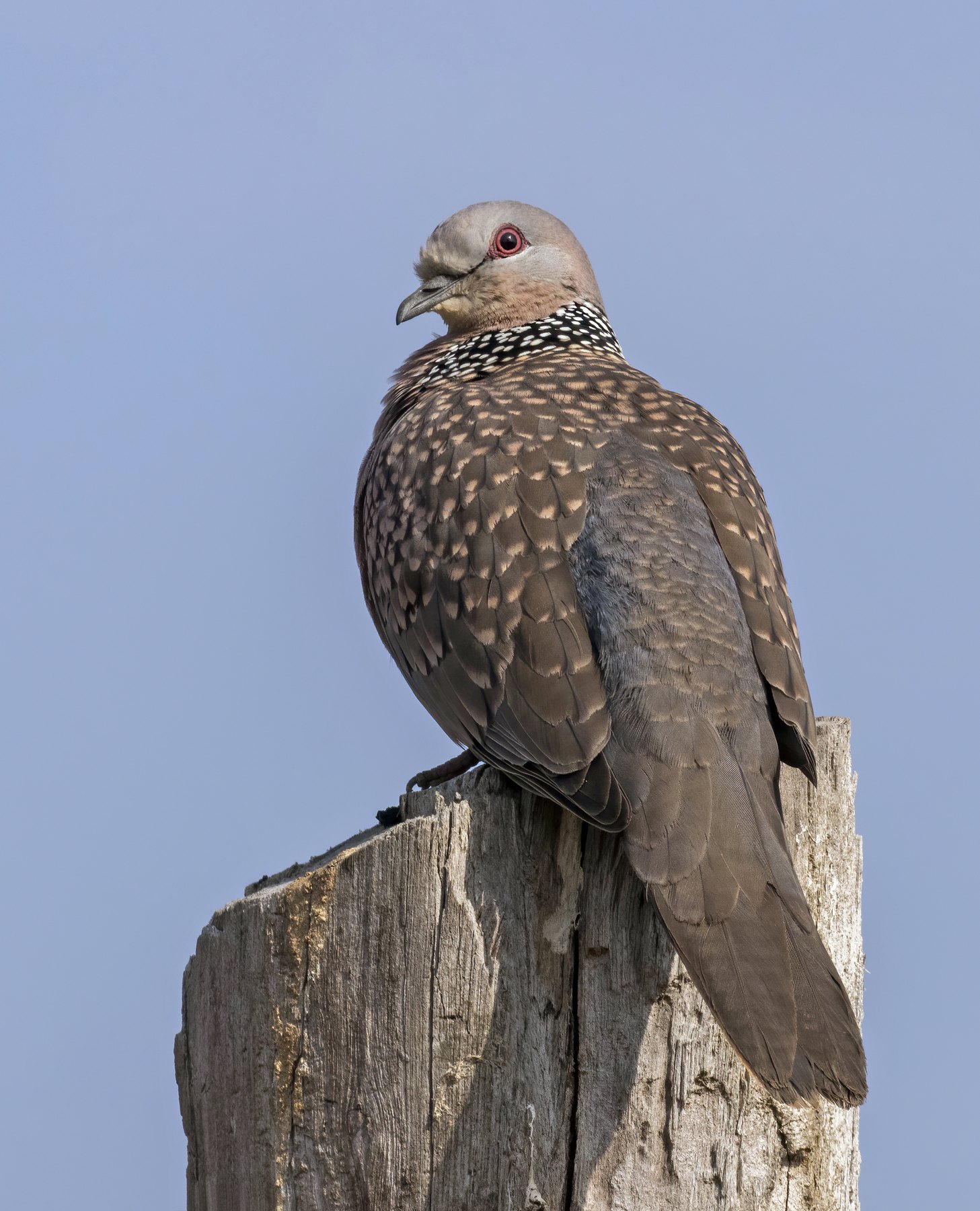
The two photographs here show the difference in markings. The Bali bird above is the Eastern form tigrina: the wings are brown with darker centres, and the white-spotted black hind-neck patch is the main “spotted” feature. The bird below was photographed at Kanha National Park in Madhya Pradesh, India, and belongs to the Western taxon, which has dense pale spotting across the wings and back as well as the neck patch.
| Eastern Spotted Dove | Western Spotted Dove | |
|---|---|---|
| Scientific name | Spilopelia chinensis | Spilopelia suratensis |
| IUCN status (2024) | Least Concern | Least Concern |
| Native range, in outline | East and Southeast Asia, including Indonesia, plus China and parts of the Indian region | Indian subcontinent, Sri Lanka and the Maldives |
| Introduced range, in outline | Australia, the United States (including Hawaii), New Zealand, Fiji, Mauritius, Mexico, New Caledonia, Papua New Guinea and other places listed by IUCN | Not listed with a comparable introduced range in the 2024 assessment |
| Form in Indonesia | The usual burung tekukur, including the form tigrina | Not the native Indonesian bird |
Spotted dove vs zebra dove
In Indonesia this is the comparison that matters most. Burung tekukur is the spotted dove. Perkutut is the zebra dove (Geopelia striata). They often feed in the same gardens, but they are different species in different genera.
| Feature | Spotted dove (burung tekukur) | Zebra dove (perkutut) |
|---|---|---|
| Scientific name | Spilopelia chinensis (Eastern) | Geopelia striata |
| Size | Much heavier: 144 to 171 g (Cornell Lab, via our zebra dove guide) | 50 to 72 g; length 20.5 to 21.5 cm |
| Pattern | Black hind-neck patch with white spots; brown wings | Fine black-and-white barring on the neck, breast and flanks; no black spotted collar |
| Voice | A slower, musical coo; BirdLife Australia gives “cocoo, crooor” | A faster, higher series of short coos |
A laughing dove is smaller again and has a different neck pattern. A mourning dove is a slim North American species without the white-spotted black collar.
What does a spotted dove sound like?
The usual song is a soft, musical coo, slower than a zebra dove’s. BirdLife Australia writes it as “cocoo, crooor”. Written versions of bird calls are only a rough aid: listen to the recording on the BirdLife Australia page (opens in new tab) and compare it with the bird you heard. Avoid playing calls to draw birds in near a nest.
Where they live, and where they have been introduced
In their native range, Eastern Spotted Doves are widespread resident birds of open woodland, farmland, villages and towns. In Indonesia they are familiar around houses, gardens and roadsides.
Eastern birds have also been introduced well beyond Asia. IUCN lists established introduced populations in Australia, the United States, New Zealand, Fiji, Mauritius, Mexico, New Caledonia and Papua New Guinea, among other places. In Australia, BirdLife Australia (opens in new tab) records the first release in Melbourne in the 1860s, with later releases in other cities. The species is now found along the east coast and in parts of South Australia and Western Australia, mainly around parks, gardens and farmland. It has not spread far from settled country. Our guide to Australian pigeons and doves includes a short profile under the older name spotted turtle dove.
Some birds stay in the same area all year; others move around locally. That is not the same as a long-distance seasonal migration.
Food, courtship and nesting
Spotted doves feed mainly on the ground, on grains, seeds and scraps. BirdLife Australia also notes that they sometimes take seeds in trees and bushes, and that they may go into animal houses, such as chicken coops, to eat commercial feed. They are usually seen alone or in small groups.
In Australia they can nest at any time of year, with most activity from September to December. The male has a display flight: a steep climb with loud wing-claps, then a glide down from about 30 or 40 m with the wings and tail spread. On the ground he may walk in front of the female with the neck patch fluffed, bowing. The nest is a loose platform of sticks, placed in a variety of sites, and both sexes share incubation and the care of the young. BirdLife Australia notes that the nest can look so thin that the eggs are visible from below, but broods still fledge from these frail platforms.
Conservation status
Both the Eastern and the Western Spotted Dove were assessed as Least Concern in 2024. The Western assessment says the population appears to be increasing and has not been given a global headcount. Least Concern is a global extinction-risk category. It does not mean the bird is harmless in places where it has been introduced, and it does not mean every local population is stable.
Spotted dove FAQs
Are Eastern and Western Spotted Doves different species?
Yes, according to the IUCN Red List assessments published in 2024, which follow a split first made in the 2014 HBW and BirdLife checklist. Many older books still treat them as one species under Spilopelia chinensis or Streptopelia chinensis.
Is burung tekukur the same as a perkutut?
No. In Indonesia, burung tekukur is the spotted dove (Spilopelia chinensis). Perkutut is the zebra dove (Geopelia striata), a smaller bird with fine barring and no black spotted collar. Some pages use “tekukur” loosely for doves in general; the species name matters.
How can I tell a spotted dove from a zebra dove?
Look at size and pattern. The spotted dove is much heavier and has a black hind-neck patch with white spots. The zebra dove is small, with fine black-and-white barring on the body and no such collar. The zebra dove’s coo is higher and faster.
Are spotted doves native to Australia or Hawaii?
No. They were introduced. In Australia the first birds were released in Melbourne in the 1860s. IUCN lists the United States, including Hawaii, among the Eastern species’ introduced range.
What does a spotted dove eat?
Mainly grains, seeds and scraps, taken on the ground. They sometimes feed in trees and bushes, and they may take commercial feed from animal houses.
Do spotted doves migrate?
They can be seen throughout the year in much of their range. BirdLife Australia says some birds stay put and others move around locally. That is not a long-distance migration like a swallow’s.
Last updated 10 November 2026 · Types