
Pouter pigeons, also called croppers, are domestic fancy pigeon breeds that fill the crop and gullet with air until the front of the neck becomes a round ball, which fanciers call the globe. Most stand tall on long legs. The English Pouter, Dutch Cropper, Holle Cropper and Brunner Pouter all belong to the group. Like every domestic breed, they descend from the rock pigeon (Columba livia).
The US National Pigeon Association (NPA) lists 32 breeds in its Croppers & Pouters section. The European breed list kept by the Entente Européenne (the EE list) puts 56 breeds in group 0300, called Kröpfer in German and pigeons boulants in French.
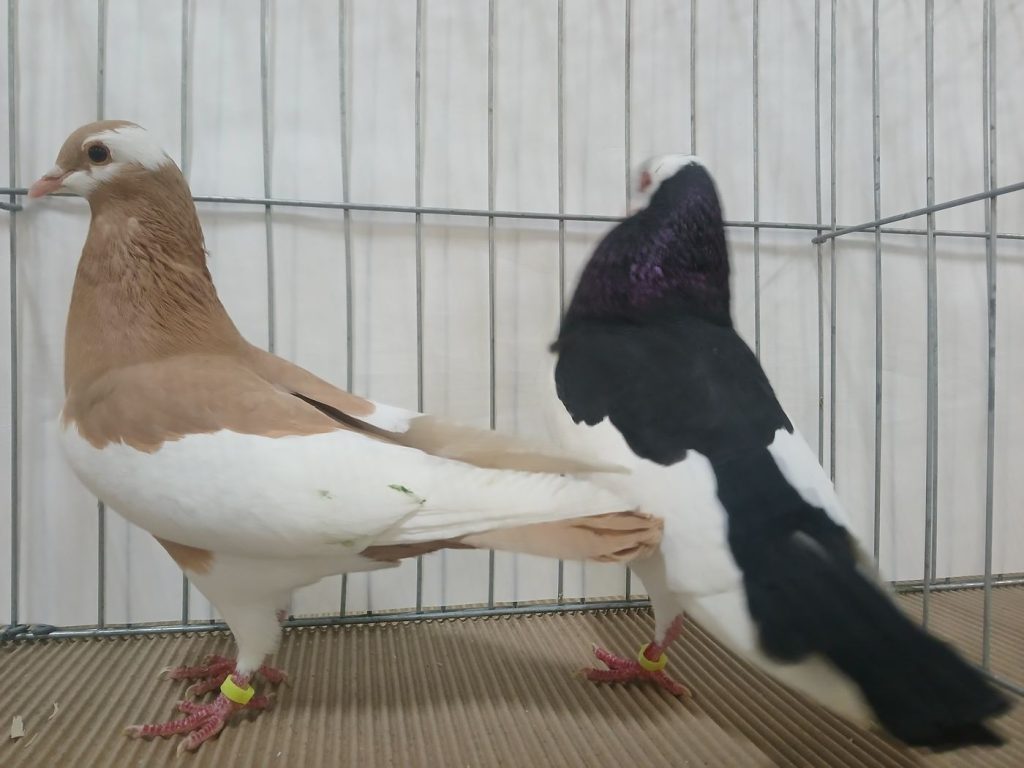
Pouter pigeons at a glance
| Feature | Pouter and cropper pigeons |
|---|---|
| Species | Domestic rock pigeon (Columba livia) |
| Group name | Croppers & Pouters (NPA); Kröpfer, pigeons boulants or pouter/cropper (EE list, group 0300) |
| Defining mark | A crop and gullet that the bird fills with air to make a round globe |
| Stance | Upright in most breeds; close to horizontal in the Dutch Cropper and Holle Cropper |
| Legs | Clean in some breeds, heavily feathered (muffed) in others |
| Breeds listed | 32 in the NPA section; 56 in the EE list (2018) |
| Ring sizes | 7 to 13 mm in the EE list, depending on the breed |
What makes a pigeon a pouter
Every domestic pigeon can puff out its crop a little, and cocks do it when they display. Charles Darwin, who kept pouters, wrote in 1868 that in these breeds the habit is “carried to an extreme”. He described the group as having an oesophagus of great size, barely separated from the crop and often inflated, with a long body and long legs. The crop itself, he found, differs from other pigeons’ only in size.
Darwin watched his own birds closely. Males pouted more than females, especially when excited. Pouters often took off with the crop still full of air, and in flight they often struck the backs of their wings together with a clapping sound. A fancier whose bird would not “play”, he wrote, might take its beak in his mouth and blow it up “like a balloon”.
He also measured one English Pouter: 34½ inches (88 cm) from wingtip to wingtip and 19 inches (48 cm) from beak to tail. A wild rock pigeon from the Shetland Islands measured 28¼ and 14¾ inches (72 and 37 cm). In proportion to the body, a pouter’s legs and feet really are longer than a rock pigeon’s, and the upright stance makes them look longer still. For the ordinary crop display of street pigeons, see why pigeons puff up their chests.
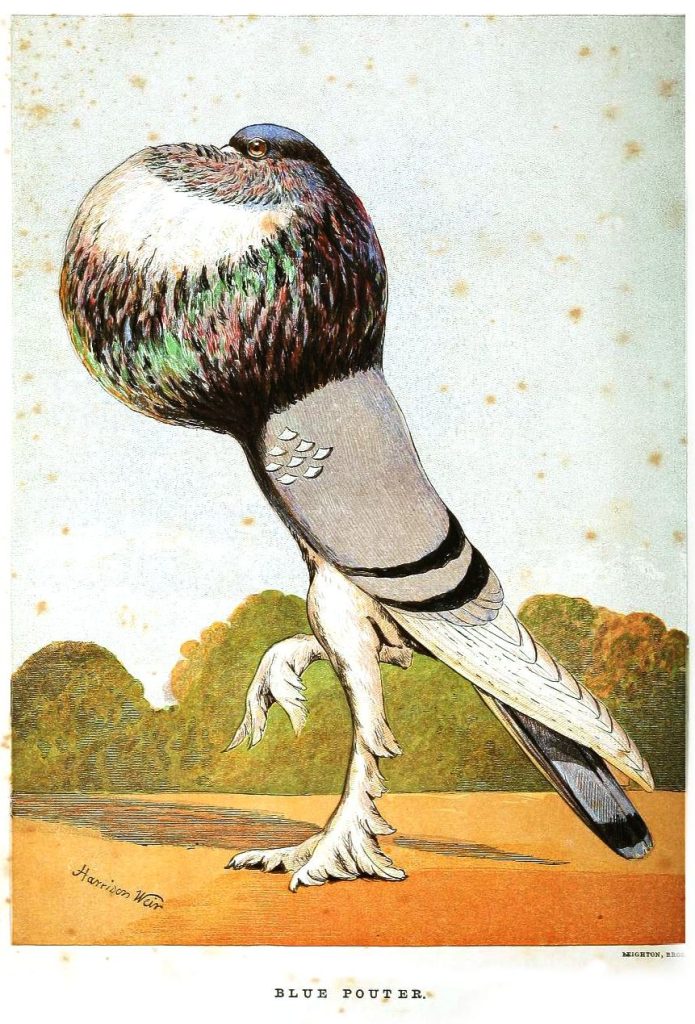
Pouter or cropper? Both names are in use and there is no fixed line between them. The NPA and the EE list each keep all these breeds in a single group, and the name a breed carries comes from its own history. Britain, for example, has both the English Pouter and the Norwich Cropper.
Main kinds of pouter pigeon
The groupings below describe body type and region. They are not official sections. For breeds outside the pouters, see the types of pigeon guide.
Tall English-type pouters
The English Pouter is a tall, slender breed. The NPA standard asks for a bird standing about 16 inches (41 cm) from the floor to the top of the head, with long legs feathered down to the toes. Its markings are a white crescent across the front of the crop, a bib below the throat, a rose of about ten feathers on each shoulder and a belt across the belly. The limbs carry 20 of the standard’s 100 points and the globe 15. The Pigmy Pouter, in the NPA’s words, is intended to be a miniature English Pouter.
Croppers from the Low Countries
The NPA calls the Dutch Cropper one of the largest croppers. It gives the breed’s origin as Holland, first bred in the 1600s, and describes heavy muffs and a body carried almost level. Darwin wrote that the Dutch Pouter seemed to be the parent form of the English Pouter. The Holle Cropper, also Dutch, is small and short. Its standard asks for the body, neck and globe to look like a ball, with the tail as a horizontal handle.
The Voorburg Shield Cropper is a recent breed. According to the NPA, C. S. Theodore van Gink developed it in the Netherlands in 1935, and it is midway in size between the Brunner Pouter and the Norwich Cropper.
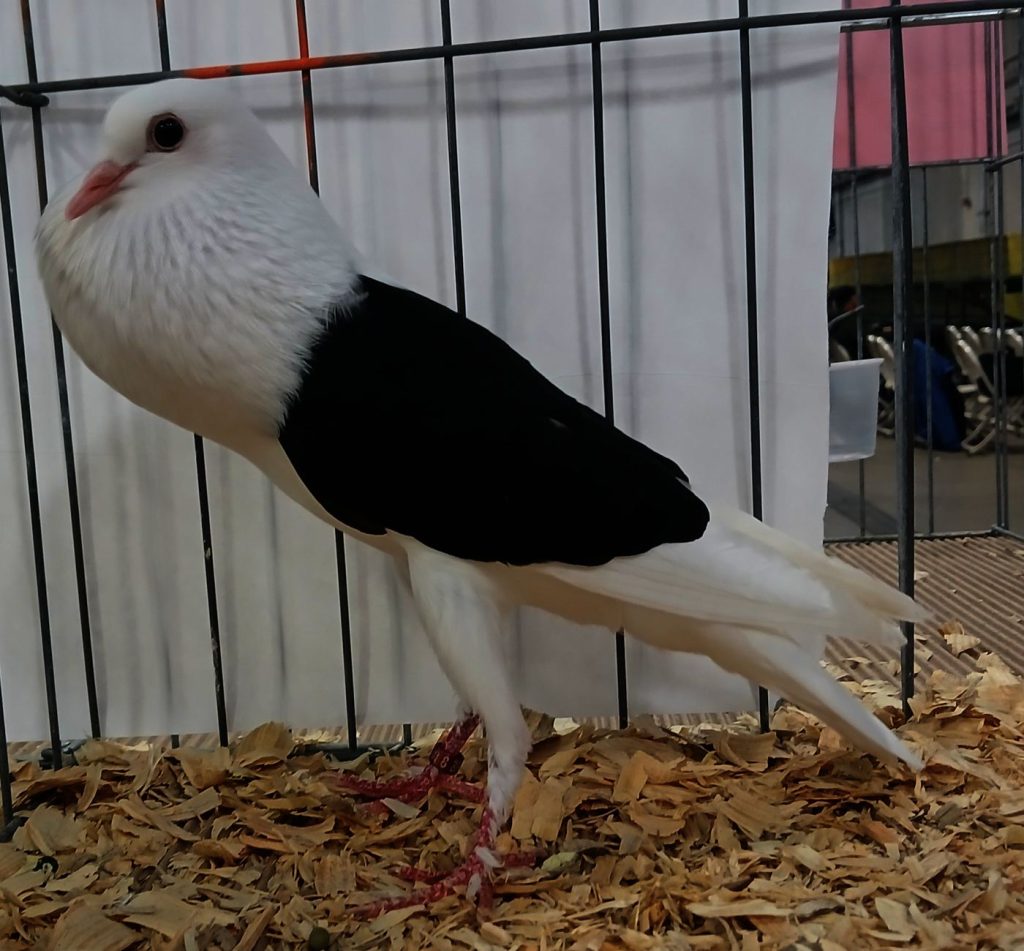
German and central European pouters
Germany and the Czech lands have produced many pouter breeds. The NPA says the Pomeranian Pouter, from Pomerania, is a direct descendant of the Dutch Cropper, developed by breeders who wanted longer legs and an upright stance. Its standard gives 20 to 24 inches (51 to 61 cm) from beak to tail and a weight of 22 to 30 ounces (620 to 850 g). The Reversewing Pouter dates from early 19th-century Saxony and Thuringia. The Hana Pouter was bred in Moravia in the first half of the 1800s by crossing Pomeranian and English Pouters with Moravian Strassers.
At the small end, the NPA calls the Brunner Pouter, from Bohemia and Moravia, “the smallest and finest of all pouter breeds”. The EE list gives it a 7 mm ring, the smallest in the group.
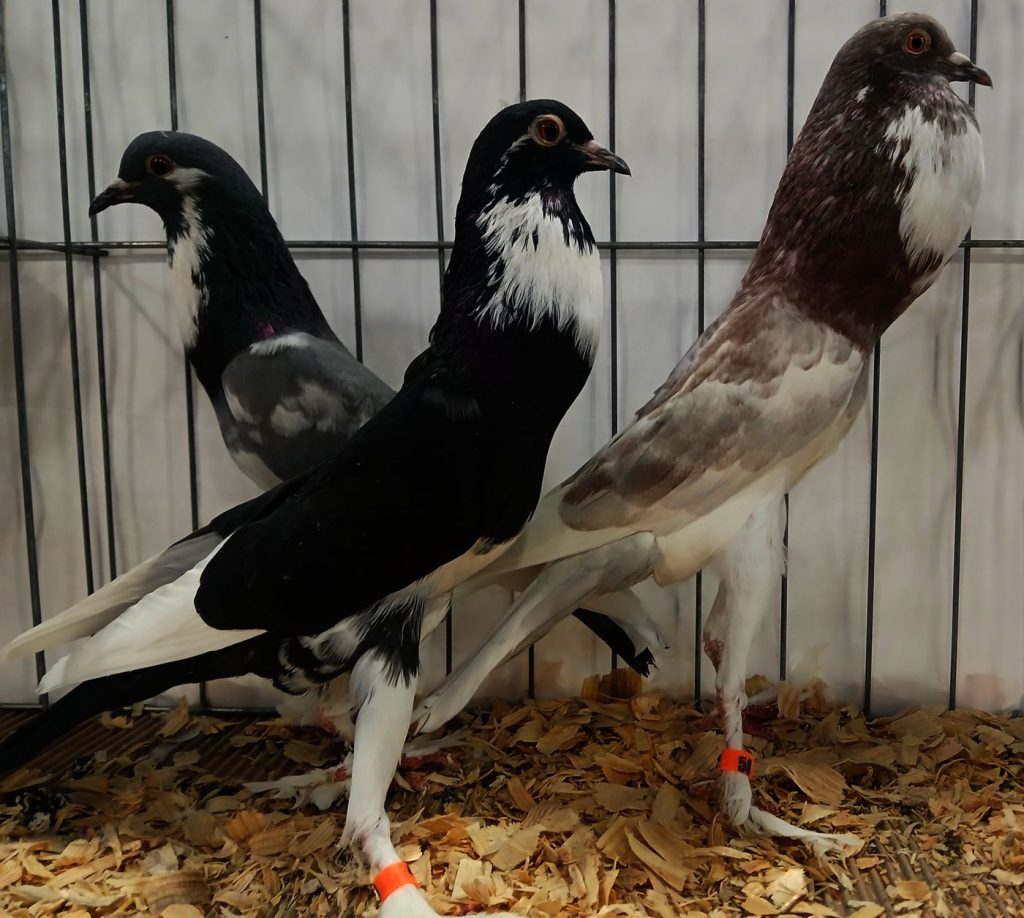
British working pouters
Britain has two other pouter breeds with long histories. The NPA traces the Horseman Thief Pouter back to the 17th century, possibly earlier, when it was a “working thief pigeon” around London. For more than a hundred years its stronghold has been Glasgow, and fanciers now treat it as a Scottish breed. The ideal bird stands 10 inches (25 cm) from the top of the skull to the ball of the foot.
The Norwich Cropper comes from Norfolk, Suffolk and Essex. Its standard says it appears to derive from the Powting Horseman or the Dutch Uploper described by John Moore in 1735, both now extinct. It gives an average weight of 15 to 16 ounces (425 to 455 g) and calls the breed very friendly and companionable.
Spanish pouters
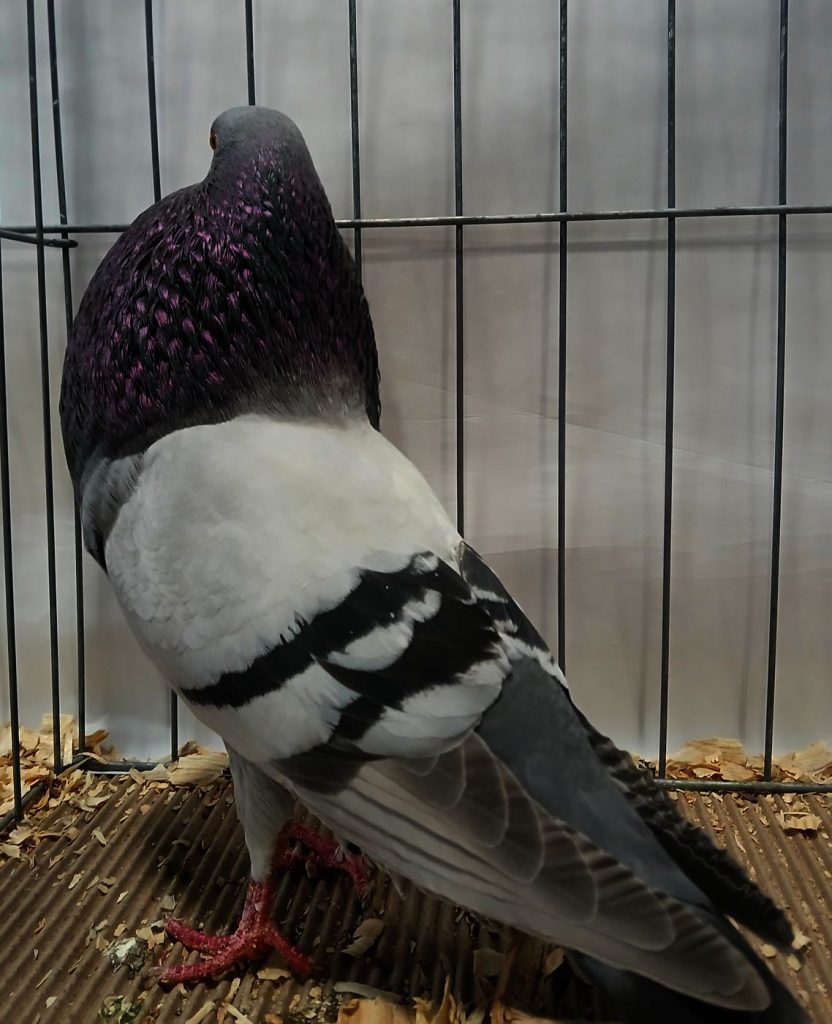
Spain has its own pouter tradition, the buchones. The EE list has 11 Spanish breeds in the group, more than any country except Germany. The NPA dates the Gorguero Pouter to the 16th century. It says a Franciscan friar, Antonio Llaudi, first developed the Laudino Sevillano in Valencia in the early 1700s. The Marchenero, from Seville, was developed from the Colitejo, which the NPA says was bred in Spain almost a thousand years ago. The Gaditano is named after the city of Cádiz.
Pouter and cropper breeds in the EE list, by country code
The 56 breeds in EE group 0300 (revision of 1 October 2018), counted by the code given for each breed. Codes mark the country of origin or development. ESKT is the EE standards commission, used here for the English Pouter, Pigmy Pouter and Norwich Cropper.
Pouter breeds compared
| Breed | Where it comes from | Notes from the standards | EE ring |
|---|---|---|---|
| English Pouter | England | About 16 in (41 cm) tall; feathered legs | 11 mm |
| Norwich Cropper | Norfolk, Suffolk and Essex | Clean legs; average 15 to 16 oz | 9 mm |
| Horseman Thief Pouter | London, later Glasgow | Ideal height 10 in (25 cm) | 8 mm |
| Dutch Cropper | Holland, 1600s | One of the largest croppers; heavy muffs | 12 mm |
| Holle Cropper | Netherlands | Small, level and ball-shaped | 8 mm |
| Voorburg Shield Cropper | Netherlands, 1935 | Between the Brunner and the Norwich in size | 8 mm |
| Pomeranian Pouter | Pomerania, Germany | 20 to 24 in long; 22 to 30 oz | 12 mm |
| Brunner Pouter | Bohemia and Moravia | The smallest pouter breed (NPA) | 7 mm |
| French Pouter | Northern France, 1800s | 42 to 48 cm long | 9 mm |
Sizes in the standards
The standards measure size in different ways. Some give a length from beak to tail, some only a maximum, and the English Pouter’s 16 inches is a height. The chart uses the length figures only, converted to centimetres.
Body length from beak to tail
Figures from breed standards, plus Darwin’s single measured bird. Lighter bar sections show the upper end of a range or of a stated maximum.
Keeping pouters
Several standards describe temperament. The Norwich Cropper is “very friendly and companionable”, the Voorburg Shield Cropper is noted for its friendly disposition, and the Horseman Thief Pouter standard calls a good bird “pushy” because it keeps cooing and bowing at other birds and at people.
The globe is judged as well as admired. The Norwich Cropper standard counts it as a fault if a bird blows the globe so far that its head is forced back and its beak points upwards, and also if it fails to inflate the globe in the show pen. The English Pouter standard lists leg faults such as buckling and straddling as serious; straddling, it says, stops the bird standing at its full height.
Pouters are not only show birds. The NPA says the Slovak Pouter was kept as a prolific breeder on farms around Myjava in western Slovakia before it spread to other countries as a show breed. Darwin heard peas rattling inside one of his pouters’ inflated crop as it flew up to feed its nearly fledged young.
An air-filled globe is normal display. A crop that stays full of food or fluid and smells sour is a different problem, covered in our guide to sour crop.
Dates in the record
Pouter history in dates
Frequently asked questions
What is the difference between a pouter and a cropper?
There is no fixed difference. Both names are used for breeds that inflate the crop, and the NPA and the EE list each keep them in one group. The name a breed carries comes from its history, which is why Britain has both the English Pouter and the Norwich Cropper.
Why do pouter pigeons puff up?
All pigeons inflate the crop a little when they display. Pouters have been bred to take this much further. Darwin noted that males pout more than females, especially when excited.
Which is the biggest pouter pigeon?
Of the standards quoted here, the Pomeranian Pouter has the largest figures: 20 to 24 inches (51 to 61 cm) from beak to tail and 22 to 30 ounces (620 to 850 g). The NPA also calls the Dutch Cropper one of the largest croppers.
Which is the smallest pouter pigeon?
The NPA describes the Brunner Pouter as the smallest and finest of all pouter breeds. The EE list gives it a 7 mm ring, the smallest in the group.
Can pouter pigeons fly?
Yes. Darwin wrote that his pouters often took off with their crops inflated and clapped their wings together in flight. The Horseman Thief Pouter standard asks for hard, tight feathering in good flying condition.
Where do pouter pigeons come from?
From many parts of Europe. In the EE list, Germany has the most breeds in the group, followed by Spain, the Czech Republic and the Netherlands. The oldest dates in the NPA standards are the 16th century for the Gorguero Pouter of Spain and the 1600s for the Dutch Cropper.