
To keep pigeons out of an attic or loft, also called the roof space, find the hole they use, wait until any nest is empty, then repair it or cover it with mesh. Spikes on the ridge and plastic owls will not close a gap in the eaves, soffits or tiles.
Signs of pigeons in the loft
In Britain the space under the roof is usually called a loft; in the United States it is an attic. The problem is the same. University of Missouri Extension (opens in new tab) lists lofts and attics among the indoor places pigeons use to roost and nest when they can find an opening and a flat surface.
These are the usual signs:
- Cooing, wing-flapping or footsteps in the roof, often early in the morning and again in the evening.
- White droppings, also called pigeon guano, on insulation, joists, stored items or on the wall and soffit outside the entry hole.
- A rough nest of twigs and grass, loose feathers, or eggs, often tucked against a vent, a rafter or the eaves.
- A hole in a fascia, soffit, bargeboard or a slipped or broken tile, sometimes with light showing through into the roof space.
One sign is not proof on its own. Other birds use the same gaps, and bats roost in roofs as well. If you can get into the loft safely, look with a torch rather than guessing from noise alone. Our page on where pigeons build their nests covers how to tell a pigeon nest from other sites.
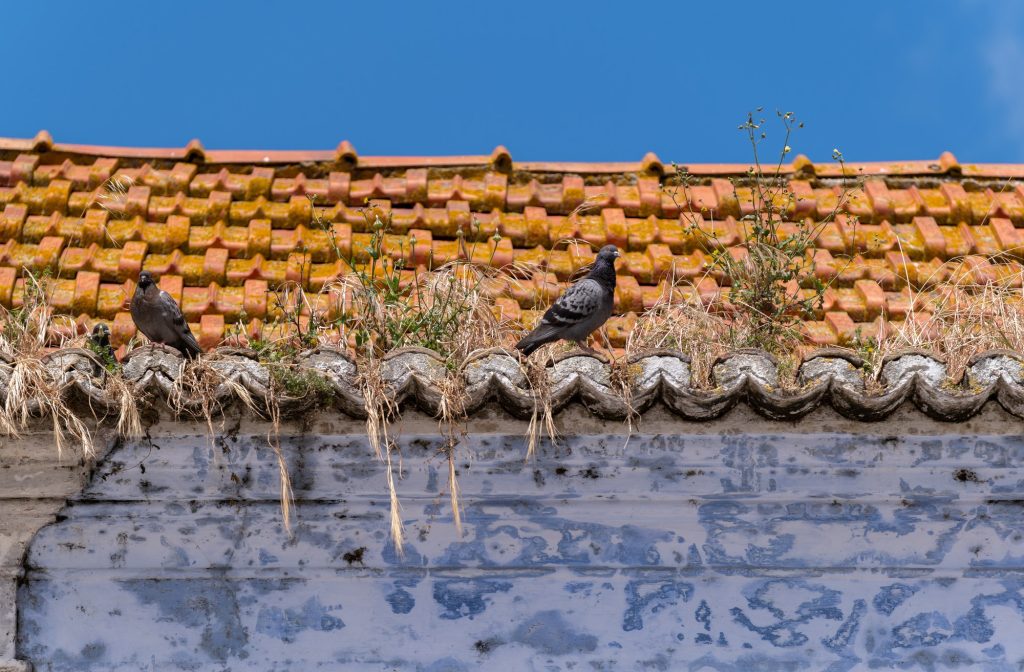
How they get in
Pigeons reach a loft through broken or slipped tiles, gaps at the eaves and soffits, and open vents. Internet Center for Wildlife Damage Management (opens in new tab) says openings to lofts, vents and eaves should be blocked, and University of Arizona Cooperative Extension (opens in new tab) recommends 1/4-inch (about 6 mm) hardware cloth over vents in the attic and on the roof. Wear gloves when you cut and fit the mesh, because the edges are sharp.
The Basel tests give the sizes to aim for: feral pigeons could not get through a slot 4 cm wide or 5 cm high, or a square hole of 6 × 6 cm (Haag-Wackernagel and Geigenfeind, 2008 (opens in new tab)). Anything larger needs closing. Repair the tile or soffit itself where you can, because mesh over a rotten board is only a patch.
| Entry point | What to look for | What works | What to avoid |
|---|---|---|---|
| Slipped or broken tiles | Daylight in the loft; droppings on the tiles below | Refit or replace the tile | Mesh over a tile that still moves |
| Eaves, soffits and fascias | A hole or rotten board; droppings on the wall | Repair, then mesh any remaining slot | Sealing before you check it is empty |
| Roof or wall vents | Feathers or droppings at the grille | A fixed cover with 6 mm mesh | A loose cover a bird can lift |
| Open chimney or flue | Cooing in the stack; debris in the hearth | A mesh-sided cap, fitted once empty | A flat cover that blocks the flue |
Check for a nest first
Look before you block anything. In England, Scotland and Wales the Wildlife and Countryside Act 1981 (opens in new tab) makes it an offence to take, damage or destroy the nest of any wild bird while it is in use or being built. The RSPB (opens in new tab) says you must let the chicks leave before you remove a nest or block the way in, and it notes that pigeons can nest in any month. It also suggests doing this kind of work in winter, when fewer birds are nesting, though pigeons can still be breeding then.
House sparrows and starlings often get in between the tiles and the gutter, and swifts use gaps under torn felt or rotten soffits, so a hole with birds going in and out is not always a pigeon’s. Bats roost in roofs as well and have their own legal protection. If you are not sure what is in there, wait and watch, or ask a wildlife specialist.
In the United States, feral pigeons are not covered by the Migratory Bird Treaty Act because they are not a native species (US Fish and Wildlife Service, 2020 (opens in new tab)). Mourning doves, which also nest on houses, are on the protected list (50 CFR 10.13 (opens in new tab)), and state or city rules can apply to either. Elsewhere, check local wildlife law before you touch a nest.
Work safely, and take care with droppings
If the hole is at the eaves or on the roof slope, the work is at height. The Health and Safety Executive (opens in new tab) sets out the risks of roof work and when a ladder is not enough. If you are not used to working at height, pay someone who is.
A few fresh droppings are a lower risk than a thick, dry build-up. The Health and Safety Executive guidance on bird droppings (opens in new tab) says the main risk is during work that disturbs a lot of material, such as a clear-out of a dirty loft. Wet the work down, do not use a high-pressure washer, and wear a close-fitting respirator with a P3 filter (FFP3) if dust or spray could be given off. People with a weakened immune system should not do this work themselves. Eat and drink away from the loft, and wash your hands. Our guide on how to clean pigeon poop covers the method in more detail.
Close the way in
Internet Center for Wildlife Damage Management (opens in new tab) and University of Missouri Extension (opens in new tab) both treat exclusion as the lasting method: block the openings with wood, metal, masonry or rust-proof mesh, rather than trying to scare the birds off. Once the loft is empty, repair the damaged board or tile, then cover vents and any remaining slot with 6 mm (1/4 inch) wire mesh, often sold as hardware cloth. Fix it so the bird cannot lift a corner.
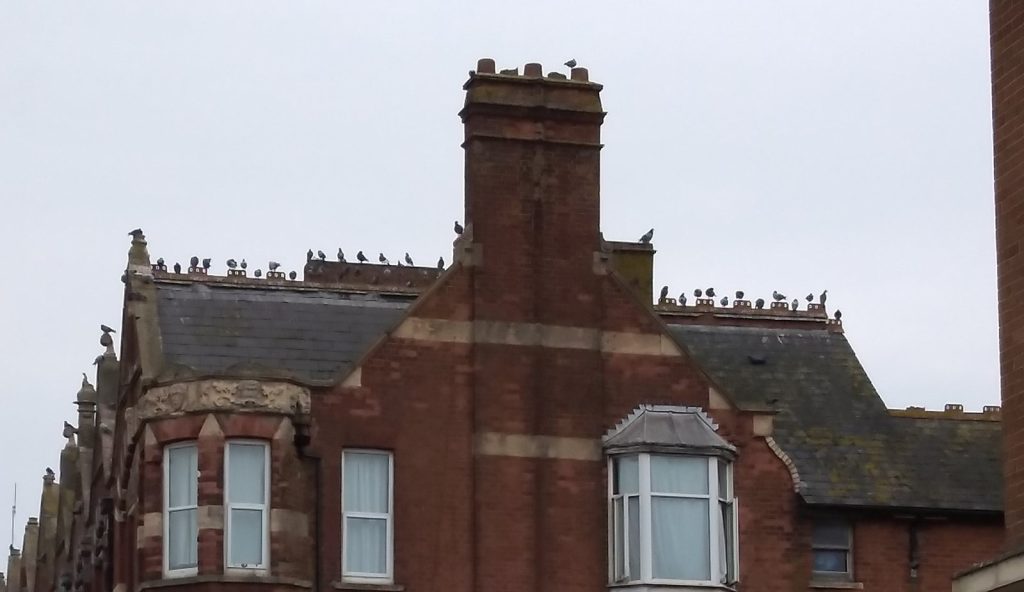
If pigeons also sit on the ridge or get under solar panels, closing the loft will not solve those problems on its own. See our guide to keeping pigeons off a roof and the page on how to stop pigeons nesting under solar panels. Spikes on a ledge can stop perching, but they will not close a hole in the eaves. The general guide to keeping pigeons away covers other parts of the house and garden, and the guide to keeping pigeons out of the garden is useful if food in the garden is drawing birds to the house.
What will not keep them out of the loft
A plastic owl or a rubber snake on the roof will not close a hole, and University of Missouri Extension (opens in new tab) says those decoys are not effective. The same guide says ultrasonic devices are inaudible to pigeons as well as to people, so a gadget in the loft will not drive them out. Removing a nest and leaving the hole open usually means the site is used again.
Our guide to pigeon deterrents reviews those products in more detail. They may have a short-lived effect on a perch, but exclusion is what keeps pigeons out of a roof space.
Frequently asked questions
How do I get pigeons out of my loft or attic?
Find the hole, check that no nest is in use, then let any birds leave. A screen fixed on two sides for a day will show if something is still inside. Once the space is empty, repair the opening or cover it with 6 mm mesh so they cannot return.
Are pigeons in the loft a health risk?
A few fresh droppings are a lower risk than a thick, dry build-up that you then disturb. The Health and Safety Executive says to wet the work down, avoid high-pressure washers, and wear an FFP3 respirator if dust could be raised. People with a weakened immune system should not do a heavy clear-out themselves.
Can I block the hole now?
Only if you are sure nothing is inside and no nest is in use. In Great Britain it is an offence to damage or destroy a wild bird’s nest while it is in use or being built. Pigeons can nest in any month, so look first.
Is a loft the same as an attic?
Yes, for this problem. Loft is the usual word in Britain and Ireland; attic is the usual word in the United States. Roof space means the same area.
Do I need a pest-control firm?
Not always. A small, empty gap in a soffit can be a home repair. Call a professional if the hole is at height, if a large mass of dry droppings has to be removed, if you suspect bats, or if you cannot tell whether a nest is still in use.
Will the pigeons come back?
They often return to a loft that still has an opening. Closing every gap after the space is empty is what stops them. Check the repair after storms, and look at the rest of the roofline for a second hole.
Sources
The advice on this page comes from the sources below.
- RSPB. What to do if birds are nesting in your roof or eaves. (opens in new tab)
- RSPB. What does the Wildlife and Countryside Act 1981 do? (opens in new tab)
- RSPCA. Pigeons nesting in gardens and balconies: what to do. (opens in new tab)
- University of Missouri Extension. Controlling nuisance pigeons (G9448). (opens in new tab)
- University of Arizona Cooperative Extension. Managing pigeons (AZ2001). (opens in new tab)
- Internet Center for Wildlife Damage Management. Pigeon damage control and prevention methods. (opens in new tab)
- Haag-Wackernagel, D. and Geigenfeind, I. (2008). Protecting buildings against feral pigeons. European Journal of Wildlife Research 54: 715–721. (opens in new tab)
- Montana Department of Agriculture (rev. 2025). Management of pigeons. (opens in new tab)
- Health and Safety Executive. Roof work. (opens in new tab)
- Health and Safety Executive. Psittacosis and other diseases from work involving bird droppings. (opens in new tab)
- US Fish and Wildlife Service (2020). List of bird species to which the Migratory Bird Treaty Act does not apply. Federal Register, 16 April 2020. (opens in new tab)
- Electronic Code of Federal Regulations. 50 CFR 10.13: list of birds protected by the Migratory Bird Treaty Act. (opens in new tab)
Last updated 24 November 2026 · Problems