
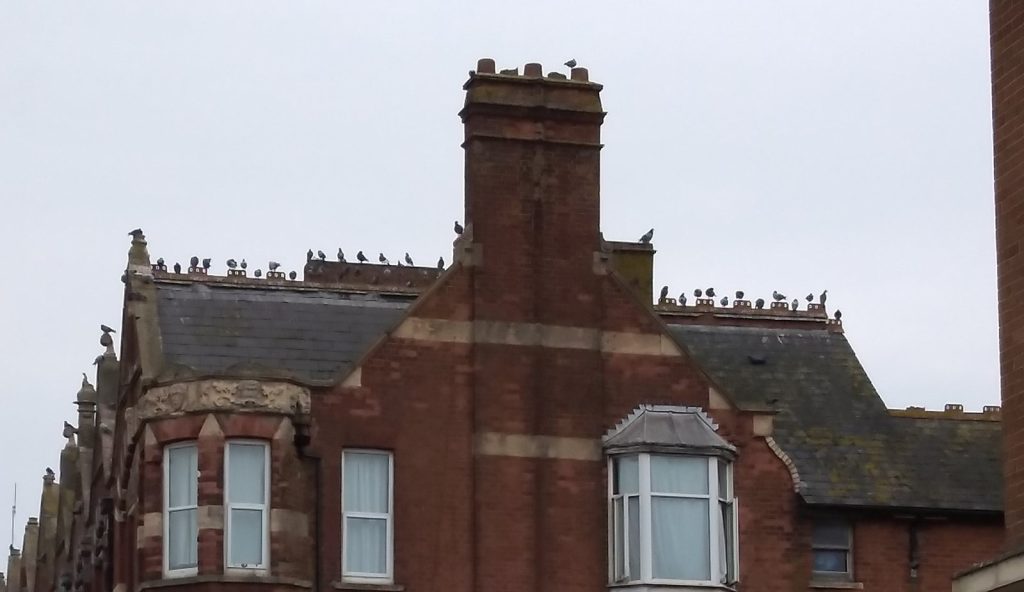
To keep pigeons off a roof, first check that no nest is in use. Then close the gaps they nest in, such as eaves, broken tiles, open chimneys and the space under solar panels. Finally, take away the places they sit with spikes, tensioned wire or a steep slope on ridges, parapets and chimney stacks.
Where pigeons sit and nest on a roof
A roof gives feral pigeons what a sea cliff gave their wild ancestors: height, a clear view and dry ledges. The RSPCA (opens in new tab) lists rooftops and chimneys among the high places pigeons choose to roost and nest. Our page on where pigeons build their nests covers their nest sites in more detail.
It helps to sort the problem into two kinds, because the fixes differ. Birds that only sit on the ridge, a parapet or a chimney stack are using a perch, and that calls for anti-perching measures. Birds that disappear under solar panels, into the eaves or down a flue are nesting or roosting inside, and that calls for closing the space once it is empty.
| Part of the roof | What the birds do there | What works | What to avoid |
|---|---|---|---|
| Ridge, parapet, dormer top | Sit, preen and watch | Continuous spikes, tensioned wire or a slope | Short strips with bare gaps |
| Chimney stack and pots | Sit and watch; may fall into an open flue | A mesh-sided cap or cowl; spikes or a wire frame round the pots | Loose mesh laid over the flue |
| Under solar panels | Nest and roost | A mesh guard clipped round the array | Drilling the panel frames |
| Eaves, soffits, tiles, vents | Get into the roof space to nest | Repair, then mesh or a vent cover | Sealing before checking it is empty |
| Flat roof and gutters | Drink and rest | Good drainage; wire frames on busy areas | Leaving standing water |
Check for a nest first
Look before you block anything. In England, Scotland and Wales the Wildlife and Countryside Act 1981 (opens in new tab) makes it an offence to take, damage or destroy the nest of any wild bird while it is in use or being built. The RSPB (opens in new tab) says you must let the chicks leave before you remove a nest or block the way in, and it notes that pigeons can nest in any month.
Other birds use roofs too. House sparrows and starlings often get in between the tiles and the gutter, and swifts use gaps under torn felt or rotten soffits, so a hole with birds going in and out is not always a pigeon’s. Bats roost in roofs as well and have their own legal protection. If you are not sure what is in there, wait and watch, or ask a wildlife specialist.
In the United States, feral pigeons are not covered by the Migratory Bird Treaty Act because they are not a native species (US Fish and Wildlife Service, 2020 (opens in new tab)). Mourning doves, which also nest on houses, are on the protected list (50 CFR 10.13 (opens in new tab)), and state or city rules can apply to either. Elsewhere, check local wildlife law before you touch a nest.
Work safely, or pay someone who can
Most pigeon problems on a house are at the top of the roof, which is the most dangerous place to work. The Health and Safety Executive (opens in new tab) says all roof work is highly dangerous, even if the job only takes a few minutes, and that every roof should be treated as fragile until a competent person has confirmed it is not.
From a properly secured ladder you can usually reach a gutter or an eaves gap on a low house. HSE ladder guidance (opens in new tab) says a leaning ladder should be set at about 75° (one unit out for every four up) and should reach at least 1 m above where you are working. Ridges, chimney stacks and solar arrays need roof ladders, scaffolding or a platform, which for most homeowners means a roofer, a chimney sweep or a bird-control firm.
Ridges, parapets and flat roofs: take away the perch
On a ridge or a parapet the aim is to leave nowhere to stand. Spikes, tensioned wire and slopes all do this. A 2008 study in Basel found that a ledge 4 cm wide was too narrow for a feral pigeon to sit on, and that a smooth slope of 25° stopped them perching, with 35° to 50° needed on rougher materials (Haag-Wackernagel and Geigenfeind, 2008 (opens in new tab)).
Spikes have to cover the whole perch. Gaps between strips, or a deep ledge with room behind the spikes, become new perches. The University of Missouri Extension (opens in new tab) advises cleaning the prongs regularly, because twigs and grass caught in them give birds a base to build on. The University of Arizona extension guide (opens in new tab) warns that badly fitted spikes can even create nest sites, and recommends a professional fitter.
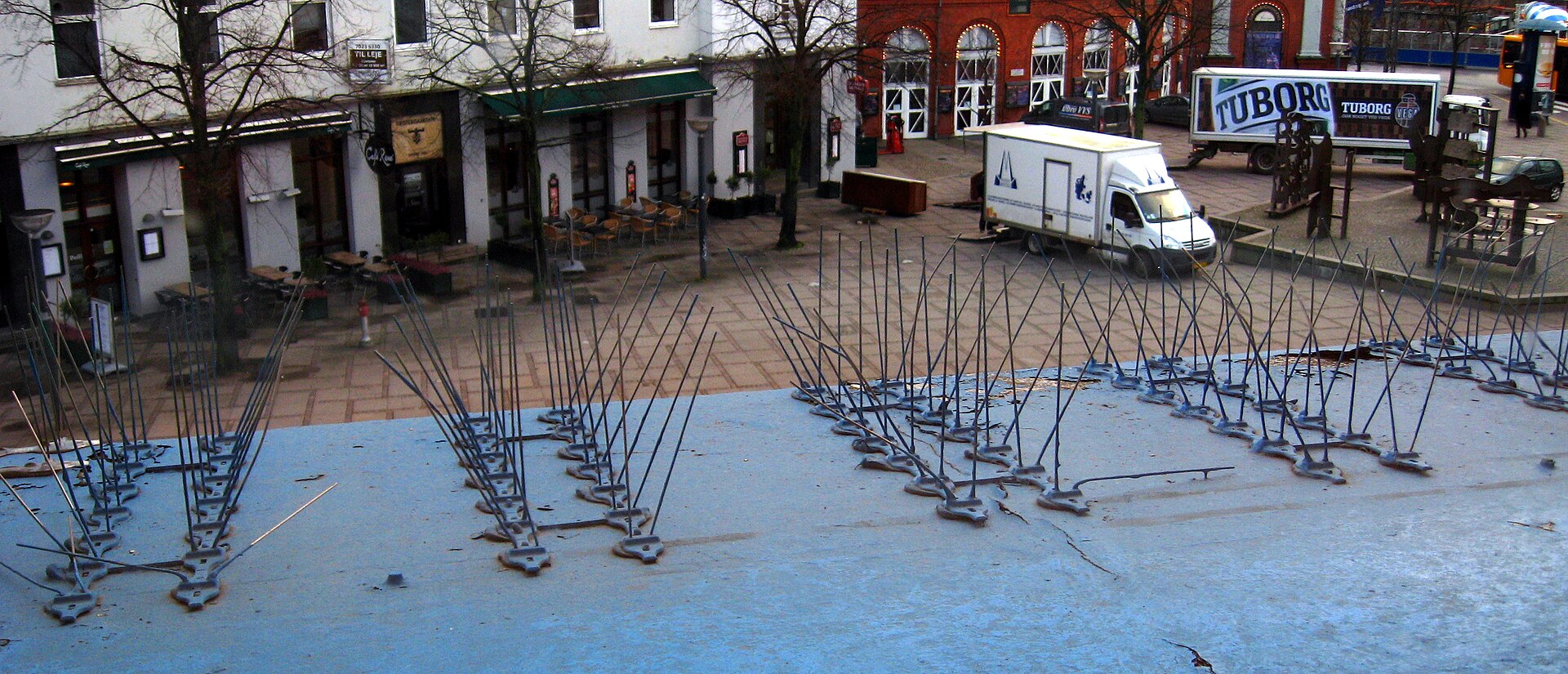
Tensioned wire is less visible than spikes on a long ridge or parapet. On a heavily used ledge, the Missouri guide suggests steel wire or heavy monofilament line stretched at about 5, 13 and 18 cm above the surface.
Flat roofs bring water as well as ledges. Montana’s guidance advises grading roofs so water does not pool, checking that air-conditioning units drain properly and keeping gutters draining. Where pigeons gather on a flat roof or on chimney pots, the RSPCA suggests wire-frame structures, which stop them opening their wings once they land.
As an Amazon Associate, Pigeonpedia earns from qualifying purchases. Amazon links on this page may earn us a small commission, at no extra cost to you.
Some links on this page go to Amazon. If you buy through them we may earn a small commission, at no extra cost to you. As an Amazon Associate I earn from qualifying purchases.
For a ridge, parapet or chimney base
LANNEY Stainless Steel Bird Spikes, 10 strips
- Stainless steel spikes on strips
- Ten strips covering about 10.8 ft
- For ledges, parapets and the base of chimney pots
Our take: Spikes only work when they cover the whole perch with no bare gaps. Clear twigs out of them now and then. Wear gloves when you fit them.
Check price on Amazon (opens in new tab)Chimneys
A chimney stack is a high, sheltered perch, and an open flue can look like a hollow tree. That is dangerous for the bird. The Internet Center for Wildlife Damage Management (opens in new tab) notes that pigeons and starlings that fall down a chimney usually cannot climb back out. Our page on a bird stuck in a chimney covers what to do if a bird is already stuck.
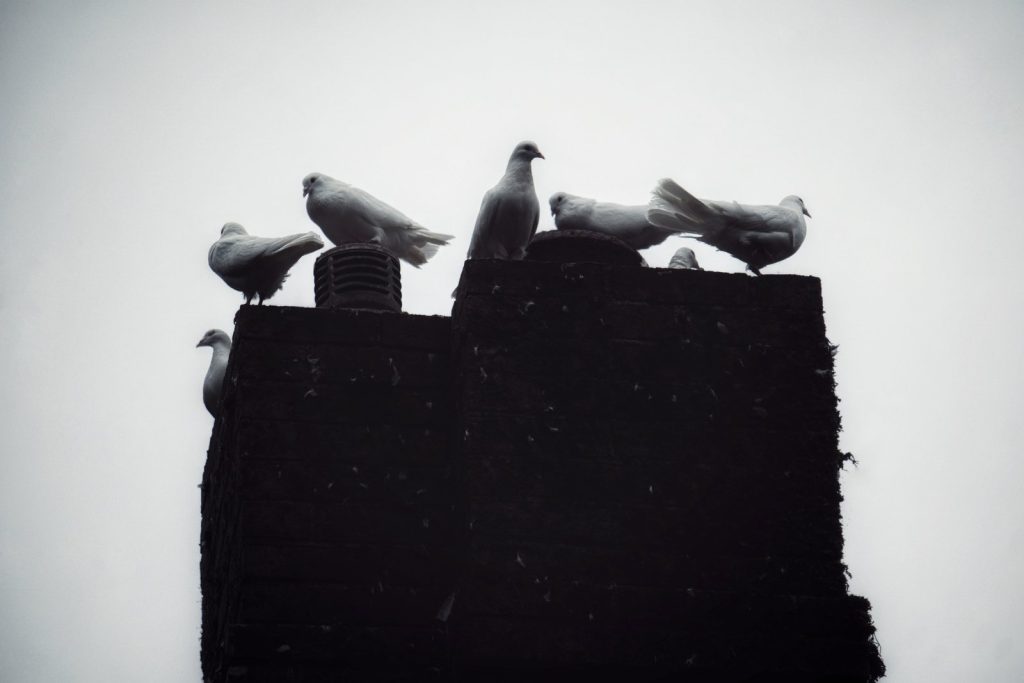
The fix is a proper chimney cap or cowl with mesh sides, which lets smoke and gases out and keeps birds out. The Chimney Safety Institute of America (opens in new tab) recommends one, with a mesh opening of about 10 to 13 mm (3/8 to 1/2 inch) in most of the US. Do not lay loose wire mesh over a flue. It rusts and can collect snow and ice, which can stop gases such as carbon monoxide escaping.
Ask a chimney sweep to fit the cap and to check that it suits the fire or boiler the flue serves. For birds that only sit on the stack, spikes or a wire frame round the base of the pots will do.
Solar panels
The gap under a roof-mounted solar array is dry and sheltered, so pigeons nest and roost there. Historic England (opens in new tab) notes that birds nesting under panels can cause problems with the panels and their cabling, and that the best prevention is a bird guard round the array, ideally fitted when the panels go in.
A guard is a strip of stiff mesh clipped to the panel frames so that it closes the gap down to the roof. It should not be drilled into a panel frame without the maker’s approval, and it must leave airflow and drainage under the panels clear (Energy Stack (opens in new tab)). Ask your installer which fittings they accept before anyone fixes anything, as some fixings can affect the warranty.
If pigeons are already under the panels, check for eggs or squabs first. Clear the nest material and fit the guard once the young have left. Because panels sit high on the roof, this is usually a job for the installer or a bird-control contractor.
For solar panels
Maporch Solar Panel Bird Guard, 6 in × 120 ft roll
- PVC-coated galvanised steel mesh with 1/2-inch (about 13 mm) holes
- 120 ft of mesh with 80 fastener clips, scissors and gloves
- Cuts and bends by hand round corners
Our take: A guard like this closes the gap under the panels. Check with your installer first, and fit it only when nothing is nesting underneath. On a high or steep roof, pay a fitter.
Check price on Amazon (opens in new tab)Gaps into the roof space
Pigeons get into lofts through broken or slipped tiles, gaps at the eaves and soffits, and open vents. The Basel tests give the sizes to aim for: feral pigeons could not get through a slot 4 cm wide or 5 cm high, or a square hole of 6 × 6 cm. Anything larger needs closing, and Montana’s guidance suggests 6 mm (1/4 inch) wire mesh, sold as hardware cloth, over openings.
Repair the tile or soffit itself where you can, because mesh over a rotten board is only a patch. Seal a gap only when you are sure the space is empty. The RSPB suggests doing this kind of work in winter, when fewer birds are nesting, though pigeons can still be breeding then.
What does not last on a roof
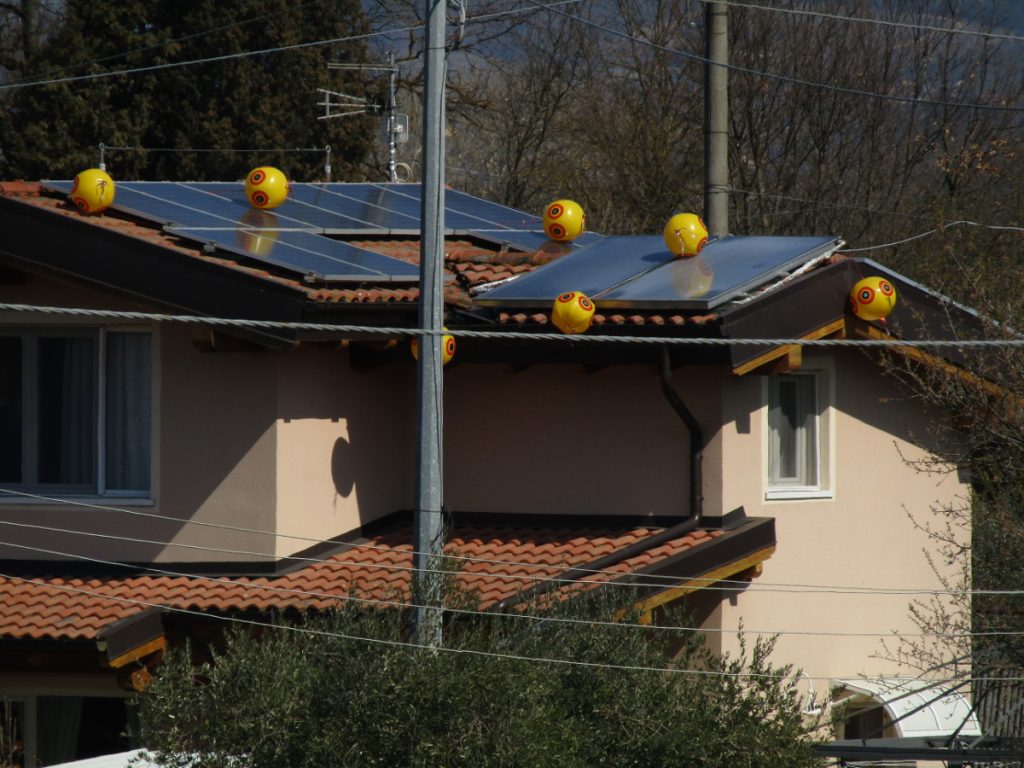
Plastic owls, hawk kites, reflective tape and spinning gadgets are sold for roofs because they are easy to put up. Pigeons learn that they are harmless. In tests of 11 deterrent systems at the University of Basel, ultrasound and a repellent smell had no effect, and pigeons that wanted a site got past every system (Haag-Wackernagel, 2000 (opens in new tab)).
Sticky gels collect dirt quickly on a roof and can trap small birds, which the SPCA in New Zealand (opens in new tab) has recorded. Electric shock tracks rely on pain and in the Basel tests did no better than harmless systems. Poison, glue traps and shooting are not roof methods; our page on whether it is legal to shoot pigeons explains the law.
If the birds keep coming back, look for the food. A neighbour who feeds pigeons, or spilled seed under a bird table, keeps them close whatever is on the roof. See our pages on a neighbour’s pigeons and the general guide to keeping pigeons away. Our guide to pigeon deterrents compares the fittings, and the balcony guide uses the same steps for a balcony.
Cleaning up
Clear old nest material and droppings before you fit spikes or a slope with adhesive, or the fixings will not hold. Wear gloves and avoid raising dust. Our guide on how to clean pigeon poop covers the safe method, surface by surface.
Frequently asked questions
How do I get rid of pigeons on my roof?
Check for an active nest, then close gaps into the roof, fit a guard round any solar panels, and cover ridges, parapets and chimney stacks with spikes, tensioned wire or a slope. Remove any food nearby. Decoys and ultrasonic devices do not last.
Do roof spikes hurt pigeons?
Properly fitted spikes stop pigeons landing without injuring them, and the RSPCA counts them among the more humane options. They must cover the whole perch and be kept clear of nest material.
How do I stop pigeons nesting under solar panels?
Fit a mesh guard round the edge of the array so the gap under the panels is closed. Check first that no nest is in use, clear old material, and use clips that do not need holes drilled in the panel frames. Ask your installer before fitting.
Can I remove a pigeon nest from my roof?
Not while it is in use or being built, unless a licence applies. In Great Britain that is an offence under the Wildlife and Countryside Act 1981. Wait until the young have left, then remove the nest and close the gap.
Can a pigeon get stuck in a chimney?
Yes. A pigeon that falls down an open flue usually cannot fly back out. A chimney cap or cowl with mesh sides, fitted by a sweep, keeps birds out.
Will a fake owl keep pigeons off my roof?
Not for long. Pigeons get used to decoys that never move, and in a published Basel test birds that wanted a site got past every deterrent. Use one only as a short pause before you fit spikes, wire or mesh.
Sources
The advice on this page comes from the sources below.
- RSPB. What to do if birds are nesting in your roof or eaves. (opens in new tab)
- RSPB. What does the Wildlife and Countryside Act 1981 do? (opens in new tab)
- RSPCA. Pigeons nesting in gardens and balconies: what to do. (opens in new tab)
- US Fish and Wildlife Service (2020). List of bird species to which the Migratory Bird Treaty Act does not apply. Federal Register, 16 April 2020. (opens in new tab)
- Electronic Code of Federal Regulations. 50 CFR 10.13: list of birds protected by the Migratory Bird Treaty Act. (opens in new tab)
- Montana Department of Agriculture (rev. 2025). Management of pigeons. (opens in new tab)
- Health and Safety Executive. Roof work. (opens in new tab)
- Health and Safety Executive. Safe use of ladders and stepladders. (opens in new tab)
- Haag-Wackernagel, D. and Geigenfeind, I. (2008). Protecting buildings against feral pigeons. European Journal of Wildlife Research 54: 715–721. (opens in new tab)
- Haag-Wackernagel, D. (2000). Behavioural responses of the feral pigeon (Columbidae) to deterring systems. Folia Zoologica 49(2): 101–114. (opens in new tab)
- University of Missouri Extension. Controlling nuisance pigeons (G9448). (opens in new tab)
- University of Arizona Cooperative Extension. Managing pigeons (AZ2001). (opens in new tab)
- Internet Center for Wildlife Damage Management. Chimney cap. (opens in new tab)
- Chimney Safety Institute of America (2014). Animal in your chimney or clothes dryer exhaust vent? (opens in new tab)
- Historic England. Considerations when planning a PV installation. (opens in new tab)
- Energy Stack. Bird protection mesh. (opens in new tab)
- SPCA New Zealand. Bird gel repellents. (opens in new tab)
Last updated 24 November 2026 · Problems