
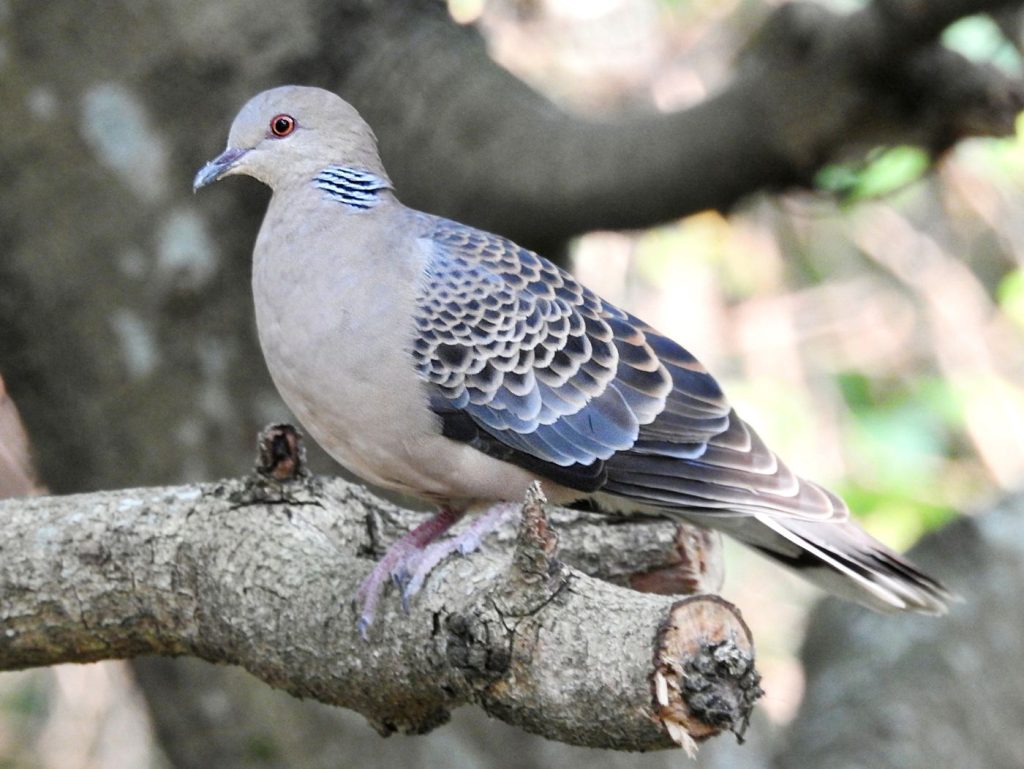
The oriental turtle dove (Streptopelia orientalis), also called the rufous turtle dove, is a large, stocky dove of Asia. It has a pinkish-brown head and breast, a patch of black and blue-grey stripes on each side of the neck, and wings covered in dark feathers with rusty edges that give a scaly look.
It breeds from Siberia and Central Asia to Japan and south to the Himalayas, and many northern birds winter in southern Asia. The IUCN Red List classes the species as Least Concern. In Japan, where it is called kijibato, it is a common bird of farmland, parks and gardens.
Oriental turtle dove at a glance
| Feature | Oriental turtle dove |
|---|---|
| Scientific name | Streptopelia orientalis (Latham, 1790) |
| Other names | Rufous turtle dove; kijibato in Japanese |
| Range | Siberia and Central Asia east to Japan and south to the Himalayas, India and Southeast Asia |
| Habitat | Open woodland, farmland, parks and gardens, from towns up to the subalpine zone |
| Length | 33–35 cm |
| Weight | 165–274 g |
| Eggs | Usually 2, white |
| Incubation | 14–16 days (Japan) |
| IUCN Red List | Least Concern (last assessed 2024), population decreasing |
Length and weight come from the standard reference work Handbook of the Birds of the World (del Hoyo and colleagues, 1997), as quoted by the Japan Bird Research Association (opens in new tab). The Red List status is from BirdLife International (opens in new tab).
How to identify an oriental turtle dove
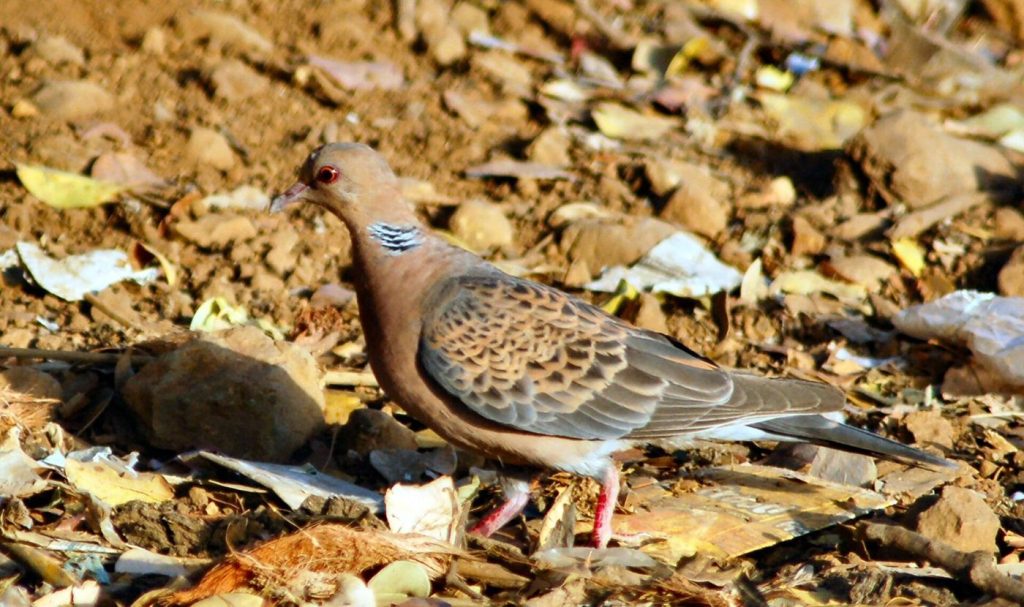
The Japan Bird Research Association describes the plumage as purplish ash-brown from the head down to the chest and belly. Look for these features:
- A patch of black and blue-grey stripes on each side of the neck
- Dark brown wing coverts edged with reddish brown, which makes the wing look scaly
- A black tail with a light grey tip and edges
- A charcoal-grey bill and purplish-red legs
- An orange eye
Males and females look alike. The northern subspecies have a grey-tipped or white-tipped tail, and the southern Indian form is more reddish. The subspecies are listed further down the page.
Oriental turtle dove or a similar dove?
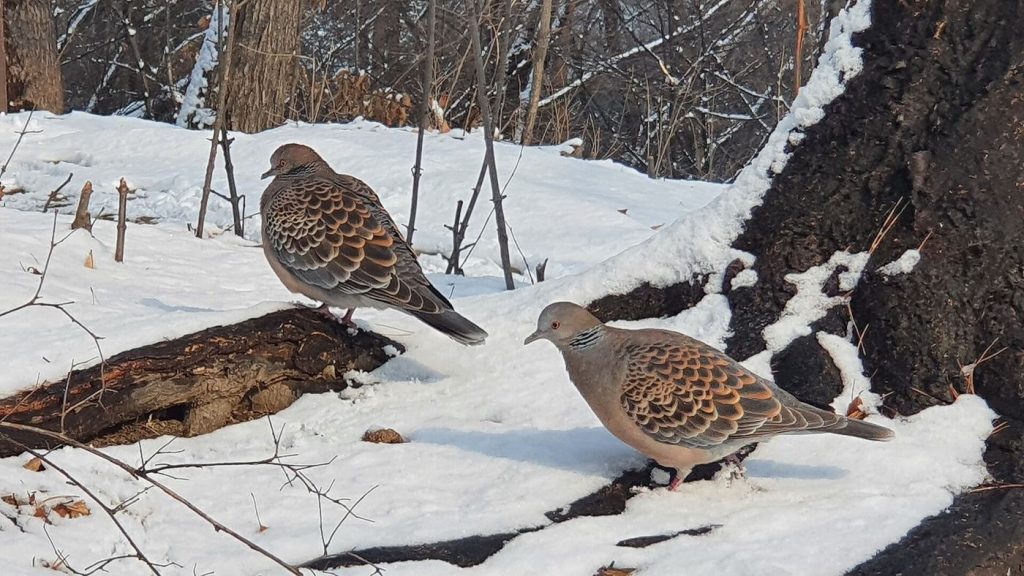
At the western edge of its range, the main look-alike is the European turtle dove (Streptopelia turtur), which has the same striped neck patch and a wedge-shaped tail. The oriental turtle dove is a little larger, with a less pink breast and browner wing feathers that have darker centres. Its flight is more relaxed and direct. The two were once treated as a single species, and some European turtle doves at the eastern end of their range look very much like oriental ones.
Two other Asian doves are easy to separate:
- The spotted dove has a collar of white spots on a black patch, rather than stripes.
- The Eurasian collared dove is paler and sandy, with a thin black half-collar and no scaly wing pattern.
Its relatives in Africa, such as the red-eyed dove and the African collared dove, belong to the same genus but live on another continent.
What does an oriental turtle dove sound like?
Most birdwatchers know it by its voice. The Japan Bird Research Association writes the usual song as a continuous, low “dedep, poh-poh”. The English-language reference sources give it as a four-syllable “her-her-oo-oo”, and the calls differ somewhat between regions.
The Japan Bird Research Association adds that a displaying male gives a “coo” while bowing with his throat swollen, and that a threatened bird may give a sharp “punn!”. For the sounds other pigeons and doves make, see what sound a pigeon makes.
Subspecies
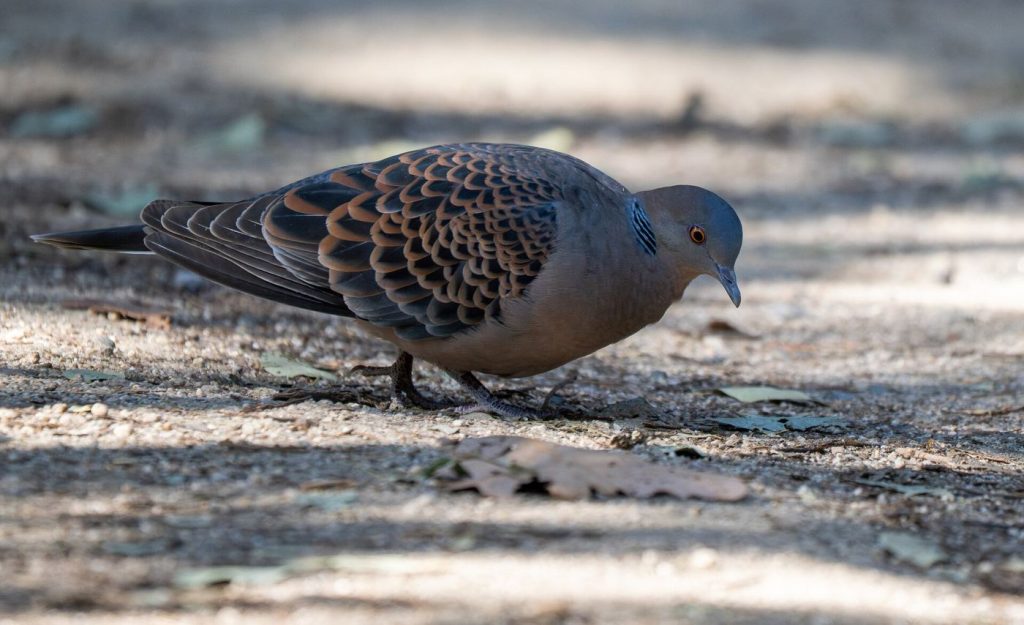
Birds of the World lists six subspecies. They differ mostly in plumage tone and the tail pattern, and some of the ranges grade into each other.
| Subspecies | Range |
|---|---|
| S. o. meena | Western Siberia and Central Asia, south to Afghanistan, Kashmir and central Nepal; winters mainly in India |
| S. o. orientalis | Central Siberia to Sakhalin, the Kuril Islands, Japan and Korea, and south through much of China to northern Vietnam; winters in southern and eastern Asia |
| S. o. stimpsoni | Ryukyu Islands, from Amami-Oshima south to the Senkaku Islands |
| S. o. orii | Taiwan |
| S. o. erythrocephala | Peninsular India, mainly central India and the Western and northern Eastern Ghats |
| S. o. agricola | North-east India, east to Myanmar, and south-central China (western Yunnan and Hainan) |
In the southern Indian form, erythrocephala, the head is reddish brown with no grey on the forehead or crown.
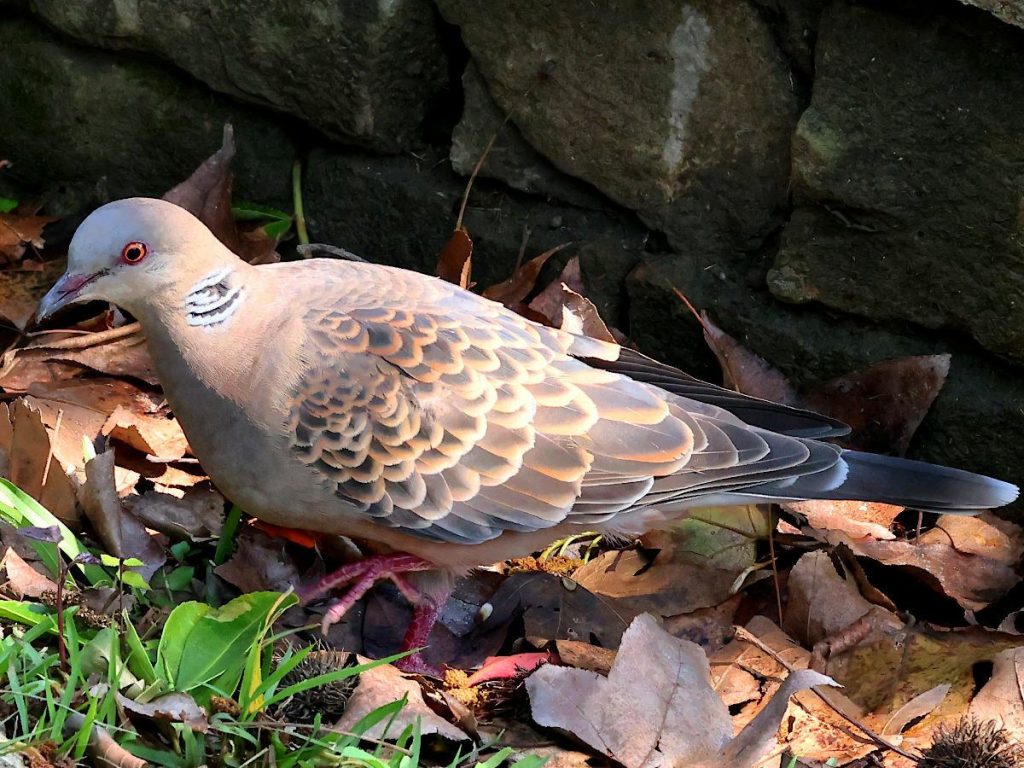
The two migratory northern forms are orientalis, a bird of the Siberian taiga, and meena, which lives in the open woodland of Central Asia. In the wintering grounds, meena tends to show a white tail tip like the European turtle dove, and orientalis a grey one. Wikipedia notes that the difference is not consistent, because both forms can show either.
Size
Japanese measurements, taken from museum and field references, show how little the two sexes differ. Males are slightly larger in wing and tail length.
Wing and tail length of oriental turtle doves
Range of measurements in millimetres, males and females. Each bar runs from the smallest value to the largest, and the lighter part is the spread.
Where oriental turtle doves live
BirdLife International estimates the breeding and resident range at about 31.9 million km², and lists the species as native and breeding in 22 countries and territories (counting Russia once). They run from Afghanistan, Pakistan, India and Bangladesh through Nepal, Myanmar and Thailand to China, Korea and Japan, and north to Mongolia and Russia.
The map shows records from every season, so it includes birds that spend the winter in India and Southeast Asia.
Birds in the middle and low latitudes stay all year, while those that breed far north fly south for winter. BirdLife classes the species overall as a full migrant, with a non-breeding range of about 16.5 million km². Wintering birds go to India, southern Japan and other parts of southern and eastern Asia. In Japan the nominate subspecies is a year-round resident except in Hokkaido and the far north of Honshu, where it is a summer visitor.
Habitat
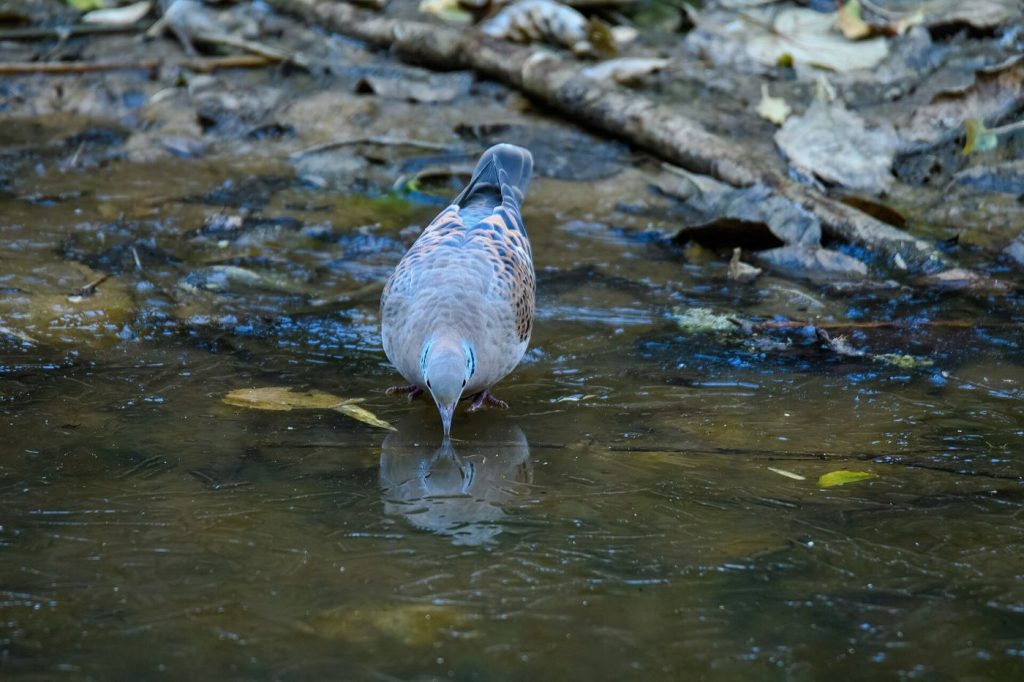
The species lives in well-wooded but fairly open country. In Japan it is seen most often on farmland and in the coppices around it, and it occurs from the subalpine zone to city centres. Its Japanese folk name, yamabato, means “mountain dove”, and suggests that it once lived mainly in lowland woods. Today it is also common in suburban and urban areas. BirdLife lists boreal forest, shrubland, gardens, arable land, flooded farmland and towns among the habitats it uses.
Vagrants
A few birds turn up far outside the range. BirdLife records the species as a vagrant in 22 countries and territories, including the United Kingdom, France, Germany, Norway, Egypt, Canada and the USA. Wikipedia says the subspecies orientalis is a rarity in western Alaska and British Columbia. In Britain, a record tends to attract a crowd of birdwatchers.
What oriental turtle doves eat
The staple food is plant seeds and grain, picked up from the ground. The Japan Bird Research Association says that near farmland, crops make up a large part of what is found in the stomachs of the birds. The crops are mainly soybeans from sowing until the seedlings come up, and wheat at harvest. Wikipedia adds hemp, sunflower, millet and amaranth seeds, and says the species also eats snails and slugs. Japanese researchers have studied this crop damage. For the diet of town pigeons, see what pigeons eat.
Breeding
Oriental turtle doves are monogamous, and both partners share the work. The breeding season is long. In some parts of Japan the birds breed all year, and the peak differs by region: late May to June in Hokkaido and Iwate, and August to September in Kyoto. Ibaraki and Aichi have two peaks. The Japan Bird Research Association links the long season to crop milk, the nutritious food that both parents make in the crop, so the breeding season does not have to match the time when food is plentiful.
In display, the male flaps his wings noisily and shoots upward, then glides down with his tail spread (Wikipedia).
The nest is a flimsy plate of twigs, usually built in a tree about 3 m above the ground, though nests have been found anywhere from ground level to 10 m. In Japan it takes about four days to build. The clutch is usually two small white eggs.
From nest to fledging in Japan
In Japan, the male sits on the eggs by day and the female from evening until the next morning. Both parents feed the chicks on crop milk at first, then add grass seeds and grain. For more on clutch sizes, see how many eggs a pigeon lays. The chicks leave the nest when they weigh about 60% of an adult.
Several broods and many failures
A pair can raise more than one brood in a season. One recorded pair tried to nest eight times in a year, and another pair succeeded four times. Even so, the share of nests that fledge young is only 20–40%, according to the Japanese studies the association cites. Nest predators include large-billed crows, carrion crows, azure-winged magpies, cats and Japanese rat snakes. A pair that reused a nest where a brood had failed within the previous 60 days tended to fail again.
An experiment with the number of chicks showed why two is the usual clutch. Broods of three produced more fledglings than broods of two, but the chicks weighed less when they left the nest, the smallest one stayed longer, and the longer nesting period cuts the number of attempts a pair can make in a year.
Population and conservation
BirdLife International last assessed the oriental turtle dove in 2024 as Least Concern. Nobody has counted the world population, but the species is described as generally common. BirdLife’s national estimates for breeding pairs in China, Taiwan, Korea, Japan and Russia are each between 10,000 and 100,000.
The population is thought to be decreasing, but not quickly enough to approach the thresholds for a threatened category. Tree cover in the species’ range has fallen by about 10.9% over three generations (about 14 years, at a generation length of 4.7 years). BirdLife therefore suspects, as a precaution, that the population has declined by between 1% and 19%. BirdLife also lists use as human food and as a pet at subsistence and national scale, and the species appears in two of the seven wildlife trade datasets it checked. For pigeons and doves that are at risk, see are pigeons endangered.
Seeing an oriental turtle dove
In Japan, Korea and eastern China the easiest places to find one are parks, shrines and farm edges, where the birds often feed on the ground and let people come fairly close. Listen first, because the cooing carries. In India, the northern birds mainly arrive in winter. Watch from a distance and don’t disturb nests.
For other wild pigeons and doves, see the types of pigeon guide. The difference between a dove and a pigeon is mostly a matter of naming.
Frequently asked questions
What is the difference between an oriental turtle dove and a rufous turtle dove?
Nothing. They are two names for Streptopelia orientalis. British sources often say “rufous turtle dove”, and the standard international English name is “oriental turtle dove”.
Where does the oriental turtle dove live?
From central Siberia and Central Asia across to Japan, and south to the Himalayas, India, Myanmar, southern China and Vietnam. Northern birds migrate south for winter, and birds in the south stay put.
How big is an oriental turtle dove?
It is 33–35 cm long and weighs 165–274 g. The wing is about 19 to 20 cm long in males.
What does an oriental turtle dove sound like?
A low, repeated cooing. In Japan it is written “dedep, poh-poh”, and European references write four syllables, “her-her-oo-oo”. It differs from the purring song of the European turtle dove.
Is the oriental turtle dove the same as the European turtle dove?
No. The European turtle dove (Streptopelia turtur) is a separate species. It is a little smaller and has more pink on the breast and orange-brown wing feathers. They were once treated as one species, and birds at the eastern edge of the European turtle dove’s range can look similar.
Is the oriental turtle dove endangered?
No. It is listed as Least Concern. BirdLife suspects a slow decline linked to loss of tree cover, but the species is still common across most of its range.