
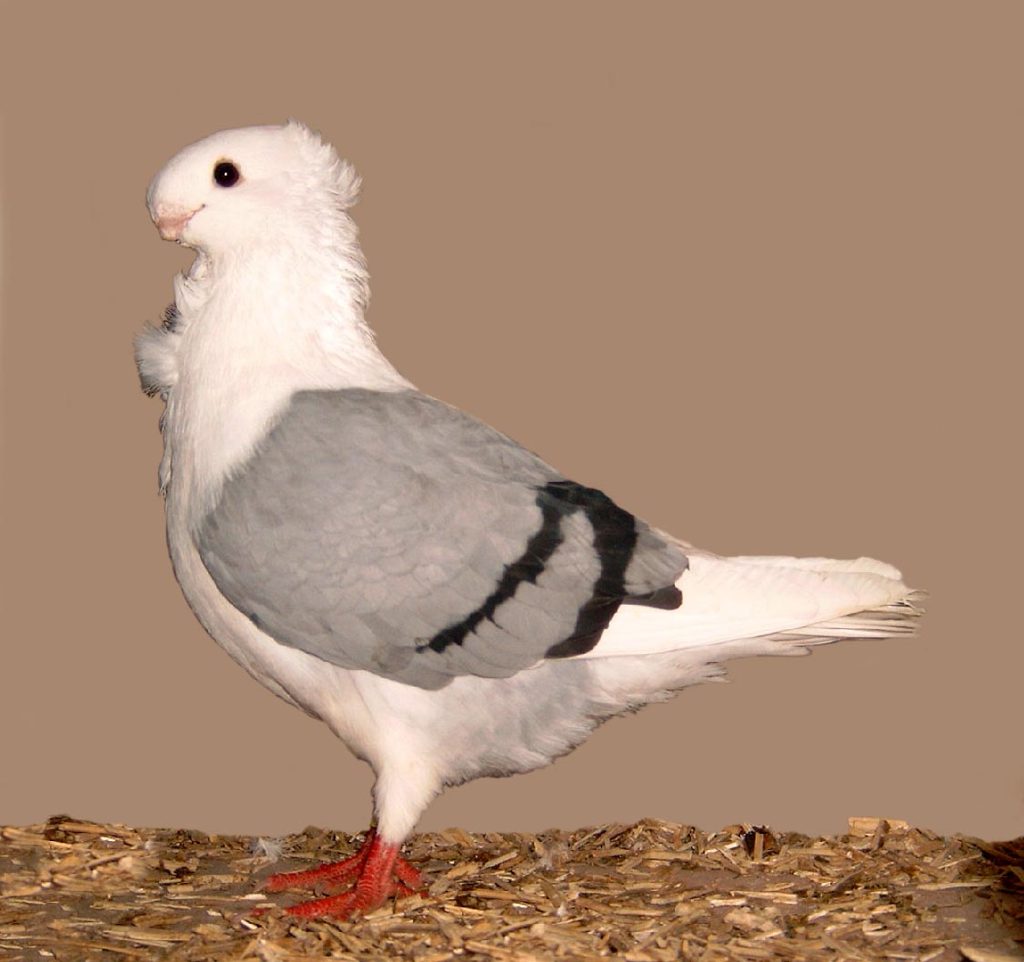
The Turbit is a medium-sized fancy pigeon with a short, thick beak, a pointed crest at the back of the head and a frill of feathers down the breast. The classic bird is white with coloured wing shields. It belongs to the owl and frill group of breeds and is kept mainly for showing.

| Turbit pigeon | Facts |
|---|---|
| Breed group | Owl and frill pigeons |
| Main use | Exhibition (show) pigeon |
| Body | Medium-sized and compact, with a very full breast |
| Head and beak | Large head; short, thick beak set well up the face |
| Crest and frill | Pointed peak crest joined to a mane; frill on the breast |
| Eyes | Dark (“bull”) eyes with fine white ceres |
| Markings | White, with coloured wing shields and ten white flight feathers on each wing |
| First English description | John Moore, 1735 |
What a Turbit pigeon looks like
The National Pigeon Association (NPA) standard asks for a medium-sized, compact bird with a very full breast, a broad back and short wings resting on a short tail. It should stand upright and carry itself well. The head is large for the body, with a high forehead.
Judges look hardest at the beak and how it is set. Both halves should be short and thick, placed so high on the face that the profile runs in one smooth curve from the beak, over the forehead and back to the tip of the crest.
The crest should end in a fine point well above the head and flow down into a mane at the back of the neck. On the breast, the frill parts both ways and runs from the throat well down the chest. The eyes are large and dark with fine white ceres, and the legs are bright red; feathers on the feet or legs disqualify a bird.
Colours and markings
The NPA lists black, dun, blue, silver, red, yellow, mealy and cream, plus a few rarer colours. Blues, silvers, mealies and creams should show even, distinct wing bars. Whatever the colour, it is limited to the wing shields, and the rest of the bird is white.
Getting the marking clean is hard. Robert Fulton wrote in 1876 that most Turbits carried too much colour low on the breast and around the thighs, a fault fanciers called “foul-thighed”. A perfect bird, he said, looks pure white underneath when both wings are lifted.
History of the Turbit
John Moore described the Turbit in his Columbarium of 1735, as Columba fimbriata. He could not explain the English name, but noted that the Dutch called it “cort-beke”, or short beak. He called the breast frill the “purle” and wrote that the more of it a bird had, the more it was admired.
Moore also said that Turbits flown from a young age could be very good flyers, and he had seen one flock that climbed almost as high as Tumblers. By 1876 Fulton counted the Turbit among the high-class show pigeons. He thought it came from the East and was closely related to the owl pigeons, though he could not say which came first.
Some links on this page go to Amazon. If you buy through them we may earn a small commission, at no extra cost to you. As an Amazon Associate I earn from qualifying purchases.
The breed was popular enough in Victorian Britain to get a book of its own, The Turbit Pigeon (1894) by the Rev. Lumley, illustrated by J. W. Ludlow. A reprint of The Turbit Pigeon (opens in new tab) is sold on Amazon, and the 1894 original can be read free through HathiTrust (opens in new tab).
The Turbit Pigeon by Rev. F.W. Lumley
Check price on Amazon (opens in new tab)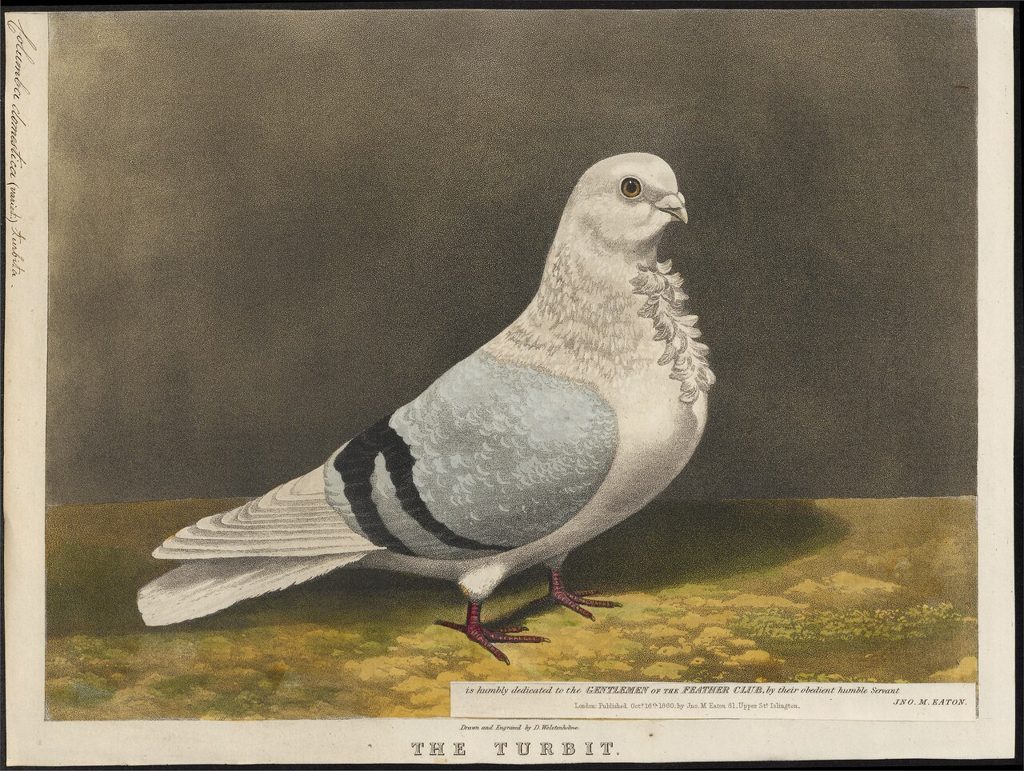
Related breeds
Fulton wrote that the owl pigeon and the Turbit differ in little except crest and colour, so a plain white Turbit could just as well be called a crested owl. Today the NPA places the Turbit in its owl and frill group, alongside breeds such as the African Owl and the Oriental Frill.
Turbits have also been used to make newer breeds. The NPA standard says the Antwerp Smerle was developed in England in the 1920s from the Belgian Exhibition Smerle crossed with other breeds, and that the Turbit had the most influence. The Old Dutch Turbit and the Turbiteen are separate breeds with their own standards.
Keeping and breeding Turbits
Fulton found ordinary Turbits hardy and good breeders that raised their own young. The trouble came with the best show birds. He believed the very full gullet that judges liked left a narrower throat inside, so the parents struggled to bring up crop milk and food for their squabs.
His advice was to put eggs from top pairs under “nurses”, other pairs that would hatch and rear them, and he named plainer Turbits as the best birds for the job. He also blamed the strain of feeding for mouth canker in some young birds; today we know canker is caused by a parasite.
Otherwise Turbits need what any fancy pigeon needs: a clean, dry loft, fresh water and a good seed mix (see what pigeons eat). If you are new to keeping pigeons, start with our guide to pigeons as pets.
Showing a Turbit
Most Turbits today are bred for pigeon shows. Under the NPA standard, a bird with no frill, no crest or any feathering on its feet or legs is disqualified, and so is any bird that has been trimmed, plucked or coloured. Removing a few small feathers and trimming the beak and toenails is allowed.
Questions about the Turbit pigeon
Is a Turbit an owl pigeon?
Not quite. It is closely related to the owl pigeons and shares their short beak and frill, but it has a pointed crest. The NPA puts both in its owl and frill group.
What colour are a Turbit’s eyes?
Dark, which fanciers call “bull” eyes, whatever the feather colour. The cere around the eye should be fine and white.
Can Turbits fly?
Yes. John Moore wrote in 1735 that Turbits flown from a young age could be very good flyers, and he had seen a flock that climbed almost as high as Tumblers.
Why do some breeders use nurse pigeons for Turbits?
Robert Fulton reported in 1876 that top show birds with very full gullets often struggled to feed their young, so breeders put the eggs under plainer pairs.
Where does the name Turbit come from?
Nobody knows. Moore could not explain it in 1735, and Fulton called his own idea, that the wing marking looked like a turbot fish, doubtful.
Sources
This guide is based on:
- National Pigeon Association: Book of Standards (Turbit and Antwerp Smerle) (opens in new tab)
- John Moore, Columbarium, or the Pigeon-House (1735; 1874 reprint), Internet Archive (opens in new tab)
- Robert Fulton, The Illustrated Book of Pigeons (1876), Internet Archive (opens in new tab)
- The Turbit Pigeon (1894), HathiTrust Digital Library (opens in new tab)
Last updated 17 November 2026 · Fancy breeds, Types