
If you live in Britain, the bird cooing from your chimney pot at six in the morning is almost certainly a wood pigeon. It is the UK’s largest and most common pigeon, with around 5.2 million breeding pairs (opens in new tab), and it has moved from woods and farmland into gardens, parks and city streets.
This guide covers how to tell a wood pigeon from the three birds it is most often mixed up with, what its song sounds like, what it eats (including your cabbages), how it raises its young, how long it lives and where it goes in autumn. Every figure comes from the RSPB, the BTO, BirdLife International or published research, and the sources are listed at the end.
| Fact | Wood pigeon (Columba palumbus) |
|---|---|
| Adult weight | about 507 g on average (BTO ringing data) |
| Wing length | about 252 mm |
| UK population | 5.2 million breeding pairs (2016 estimate) |
| UK trend | up 152% between 1967 and 2024 |
| Conservation status | Amber in the UK; Least Concern worldwide |
| Eggs | usually 2 (1 to 3) |
| Incubation | about 17 days |
| Time in the nest | 33 to 34 days |
| Typical lifespan | 3 years for a bird that reaches breeding age |
| Oldest known | 19 years, 8 months and 16 days |
How to identify a wood pigeon
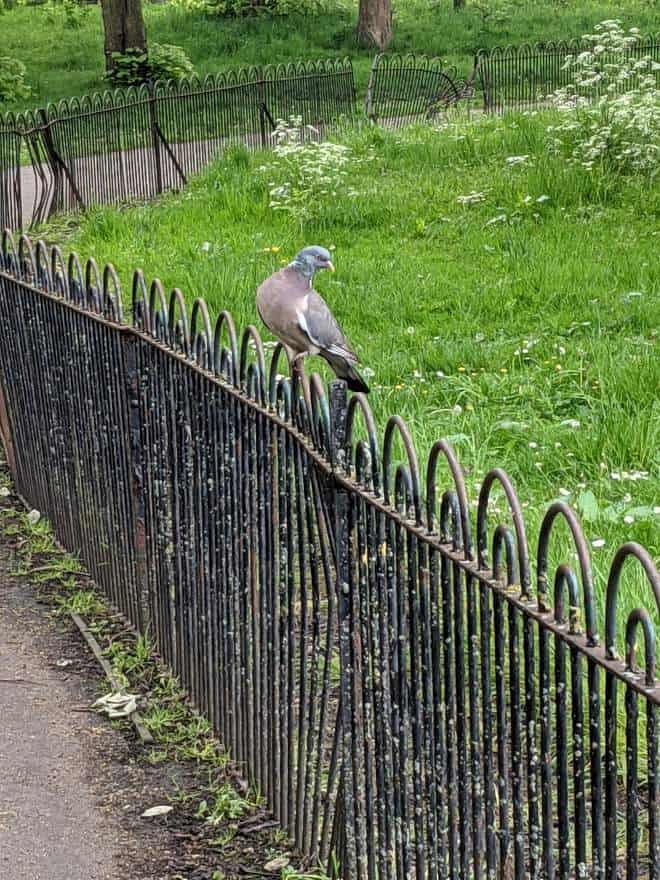
An adult wood pigeon is a big, round-chested grey pigeon with a pinkish breast and a white patch on each side of the neck. Above the white patch sits a small patch of glossy turquoise. The eye is bright pale yellow and stands out against the grey face, and the bill is red and yellow.
The best single clue is the wing. A wood pigeon has a broad white band across the bend of each wing. In flight it is obvious from a long way off, and the BTO (opens in new tab) calls it diagnostic. On a perched bird it is harder to see but still visible as a white line on the folded wing.
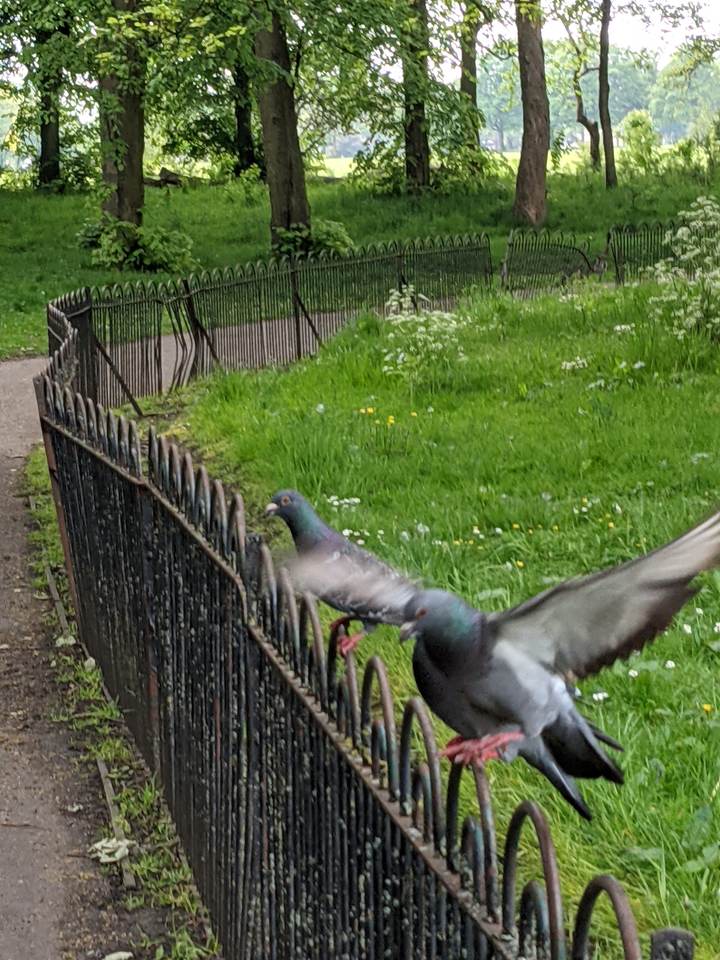
Young birds are the tricky ones. A juvenile wood pigeon has no white neck patch at all. It looks plainer and slightly browner than an adult, often with pale buff edges to the wing feathers, and its eye can look dark from a distance. The white wing band is still there, so check the wing before deciding it must be a stock dove.
Wood pigeon, stock dove, feral pigeon or collared dove?
These four are the pigeons you are most likely to see in a British garden or park. The table pulls together the field marks used by the BTO (opens in new tab), the RSPB (opens in new tab) and the RSPCA (opens in new tab).
| Wood pigeon | Stock dove | Feral pigeon | Collared dove | |
|---|---|---|---|---|
| Scientific name | Columba palumbus | Columba oenas | Columba livia | Streptopelia decaocto |
| Average adult weight (BTO) | 507 g | 326 g | between the collared dove and the wood pigeon | 205 g |
| Neck | white patch with a little green above it (adults only) | glossy green patch, no white | glossy green and purple sheen | thin black half-collar edged with white |
| Wings | broad white band | two short black bars on the inner wing, dark edges in flight | two broad black bars in wild-type birds; plumage varies a lot | plain, with darker grey outer wing |
| Eye | pale yellow | dark | not a reliable clue | deep red |
| Body colour | grey, pinkish breast | blue-grey, pinkish breast | anything from white to black, brown or chequered | pale pinkish beige-grey |
| Song | five notes, “take two cows, Taffy” | a drawn-out low “oooh” | a soft “crrooo” | three notes, “coo-COO-cuk” |
| Where | almost everywhere, including towns | farmland, parks and woods; rarely in towns | towns and cities | gardens, villages and towns |
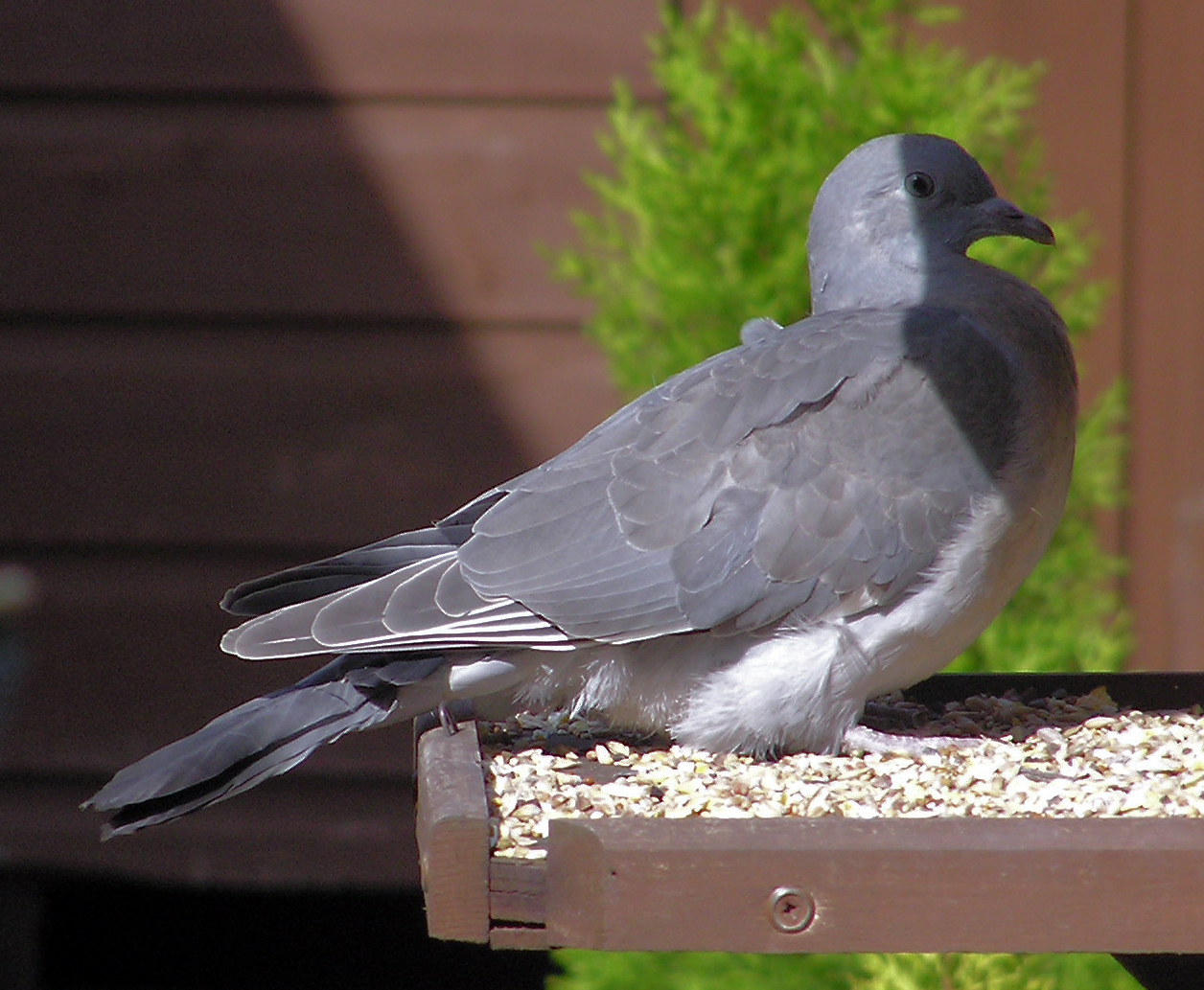
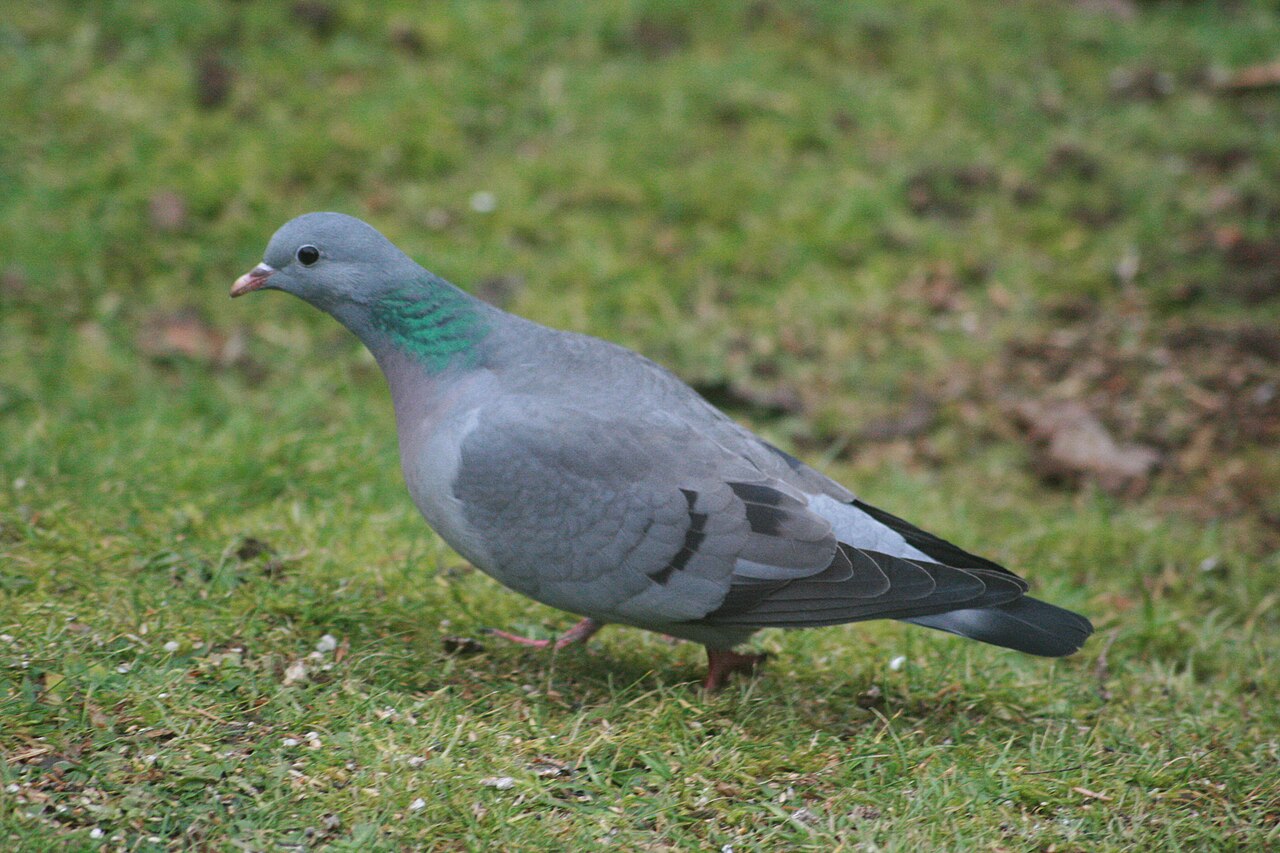
The stock dove causes the most confusion. It is smaller and neater than a wood pigeon, has no white anywhere, and has a dark eye. The RSPB (opens in new tab) points out that the lack of white on the neck is the easiest way to separate the two. Stock doves nest in holes in old trees, which is where the name comes from: stocc is Old English for a stump.
Feral pigeons are descendants of the rock dove, and many of them look nothing like their wild ancestors. If you see a pigeon with a ring on its leg, it is a kept bird. The RSPCA explains that rings starting with GB usually mean a racing pigeon and NPA means a show pigeon.
Wood pigeon or not? A quick ID helper
Answer as many questions as you can about the bird in front of you. The helper weighs the clues above and tells you which of the four species fits best. It works on adult features, so read the note on young birds if your pigeon has no neck patch.
What does a wood pigeon sound like?
The song is a soft, slightly husky five-note phrase, often repeated several times in a row. The BTO writes it as “Oooh oooh ooh ooooh ooh” and suggests the rhyme “take two cows, Taffy” to remember it. Bird Aware Solent (opens in new tab) offers “my toe bleeds, Betty” as another. It is delivered from a high perch, often a roof or chimney pot, and you hear it most on spring mornings.
The collared dove is easy to mix up by ear. Its phrase has three notes with the stress in the middle, “coo-COO-cuk”, and the RSPB says its cooing can seem to go on forever. A stock dove gives a low, drawn-out “oooh” that the BTO likens to blowing across the top of a jam jar.
The other sound to listen for is the wings. The RSPB (opens in new tab) notes the loud clatter a wood pigeon makes when it takes off. In spring, males also perform display flights over their territory: the BTO describes a steep climb, one or two claps of the wings in mid-air, and a long glide down with the tail spread.
What do wood pigeons eat?
Wood pigeons are mainly plant eaters. BirdLife International (opens in new tab) lists green leaves, buds, flowers, seeds, berries and grain, with the occasional invertebrate. They feed on the ground and in trees, and they are surprisingly agile for their size. The BTO notes that they will hang upside down from a branch to reach berries or buds, and that they can suck up water without tipping the head back, as most birds have to.
What sets them apart from most seed-eating birds is that they can live through the winter on green leaves. The BTO (opens in new tab) links their rise to the spread of oilseed rape and winter-sown cereals, which give them food in the hungriest months. Fieldwork in Cambridgeshire found that the area of oilseed rape set the size of the local wintering population.
Crops and gardens
That appetite is why farmers treat them as a pest. In a survey of 52 oilseed rape fields in central and southern England, Inglis and colleagues (1989) (opens in new tab) found wood pigeon damage in 48 of them, and badly grazed patches yielded about 9% less. A review for AHDB (opens in new tab) in 2014 found growers reporting losses of 10 to 40% on brassicas, salads and rape, although nobody had a current national estimate.
On a vegetable plot the answer is the same as on a farm. Netting or covering crops is one of the non-lethal methods Natural England expects people to try before any control, alongside scaring devices and growing vulnerable crops away from woodland.
If wood pigeons empty your bird table, the BTO suggests a feeder guard that only lets small birds through, hanging feeders with short perches, and avoiding seed mixes with a high cereal grain content. The RSPCA also advises against putting out seed or nuts between May and October, as this can increase the risk of disease spreading.
Breeding, nests and eggs
Wood pigeons can nest in any month. BTO nest records show first clutches laid anywhere between 22 February and 20 August, with an average date of 30 April. Most pairs raise one or two broods a year.
The nest is a simple platform of twigs lined with finer twigs, grass and leaves. BirdLife (opens in new tab) gives a usual height of 1.5 to 2.5 metres, in trees, on building ledges, or occasionally in thick vegetation or under a hedge.
The clutch is usually two eggs, about 41 by 29 mm and 19 g each. Both parents take turns to sit, and the eggs hatch after about 17 days. The young then stay in the nest for 33 to 34 days. That is longer than stock doves (28 to 29 days) or collared doves (17 to 19 days), going by BTO nest records.
Like all pigeons, wood pigeons feed their chicks on crop milk, a rich fluid made by the lining of the crop in both parents. A study of nestlings near Newmarket by Murton, Isaacson and Westwood (1963) (opens in new tab) found that squabs got crop milk only for the first three days, after which the parents mixed in more and more real food, mainly cereal grain. Chicks reared early in the summer, before the grain harvest, grew more slowly and many died in the nest, apparently from lack of food.
Baby wood pigeons
A baby wood pigeon in the nest is called a squab. Newly hatched chicks have pinkish skin and a covering of fine yellow down, then grow quills and feathers over the next few weeks. By the time they leave they look like plain, slightly scruffy adults without the white neck patch, which is why so few people think they have ever seen a baby pigeon.
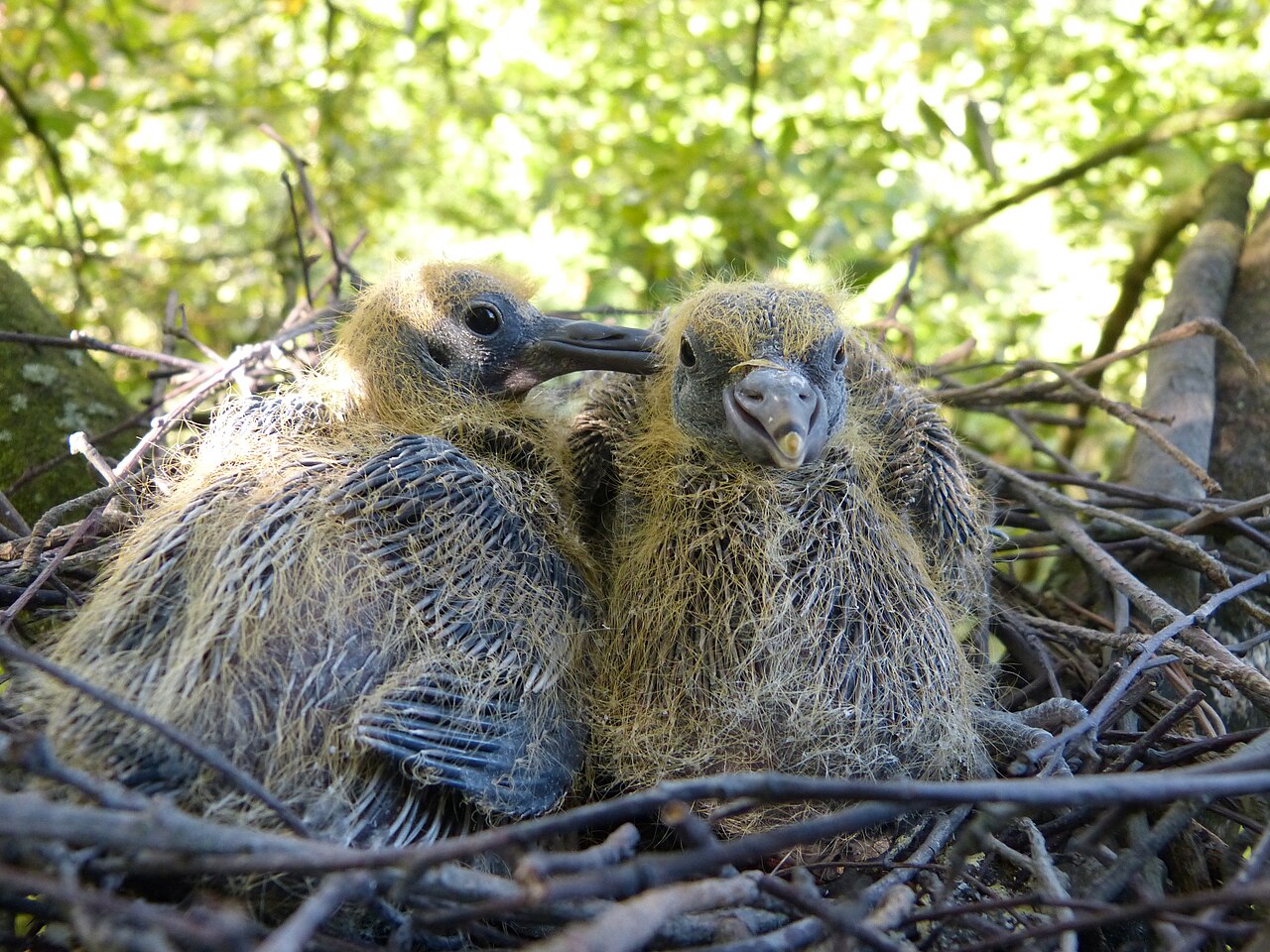
Baby wood pigeon timeline
| Age | What happens | Source |
|---|---|---|
| Day 0 | First egg laid | BTO |
| Day 1 to 2 | Second egg laid, 24 to 48 hours after the first | RSPCA (pigeons in general) |
| About day 17 from laying | Eggs hatch after roughly 17 days of incubation by both parents | BTO |
| Days 1 to 3 after hatching | Fed on crop milk only | Murton et al. (1963) |
| From day 4 | Grain and seeds mixed in with the crop milk, in growing amounts | Murton et al. (1963) |
| First week | Pink skin with yellow down | RSPCA (pigeons in general) |
| Weeks 1 to 3 | Feathers grow in | RSPCA (pigeons in general) |
| Days 33 to 34 after hatching | Young leave the nest | BTO |
| After fledging | Browner than adults, no white neck patch, white wing band present | BTO |
If you want to put an age on a squab from a photo, our pigeon age chart shows the stages week by week.
Found a baby wood pigeon on the ground?
Most young wood pigeons found on lawns and pavements are fledglings that have left the nest on purpose. The RSPCA’s advice (opens in new tab) is to keep pets away, leave a feathered fledgling where it is and watch from a distance, because the parents are usually nearby. If it is in immediate danger, move it a few metres to a sheltered spot.
A chick with no feathers or only a few is a nestling and will not survive long on the ground. The RSPCA suggests putting it back in the nest, or in a makeshift nest such as a basket fixed to the nearest tree. Only take a baby bird in if it is sick or injured, if you know the parents are dead, or if you have watched for more than two hours and they have not come back. Our page on what to do with an injured pigeon explains how to box it up and who to call.
How long do wood pigeons live?
For a wood pigeon that survives to breed, typical life expectancy is about three years. BTO ringing data (opens in new tab) put adult survival from one year to the next at about 61%, and only about 52% of juveniles make it through their first year.
Some do much better. According to the BTO’s 2024 ringing report (opens in new tab), the oldest known wood pigeon in Britain and Ireland lived for at least 19 years, 8 months and 16 days, more than six times the average.
The RSPCA lists predators such as peregrines and cats, disease, traffic and cruelty among the things that shorten pigeon lives.
Population and trends
Wood pigeons have done very well over the past 50 years. The BTO’s survey data show the UK breeding population rising by 152% between 1967 and 2024. The increase levelled off around 2010, and the Breeding Bird Survey now shows a very shallow decline in England over the most recent five years. The species breeds in 91% of the 10-km squares in the UK.
The same pattern shows up across Europe. National surveys record increases in France, Spain and Portugal, and BirdLife describes the European population as increasing.
Wood pigeons are on the UK Amber list of Birds of Conservation Concern. Globally they are listed as Least Concern, and BirdLife International (opens in new tab) estimates 20.5 to 29 million pairs in Europe and 51 to 73 million mature birds worldwide.
Behaviour, flocks and migration
The RSPB (opens in new tab) describes wood pigeons as shy in the countryside but tame and approachable in towns. The BTO suggests that being persecuted on farmland may be part of the reason, and its Garden BirdWatch survey finds them in a greater share of suburban gardens than rural ones.
Outside the breeding season they gather in flocks to feed on fields. In late October and November the BTO (opens in new tab) records huge flocks, sometimes tens of thousands of birds, flying high and south on clear, calm days. Nobody is sure where they are going, but many thousands arrive in Spain and Portugal at this time. The RSPB says the passage is easiest to see in south-west England and south Wales.
British wood pigeons are mostly resident, but winter numbers are boosted by birds from the continent. BirdLife (opens in new tab) describes the species as mainly migratory in northern and eastern Europe and resident or partly migratory elsewhere. In Spain, SEO/BirdLife (opens in new tab) says millions of birds from central and northern Europe join the resident population each winter.
Where wood pigeons live
The wood pigeon breeds across Europe, from Iceland, Ireland and Portugal to Russia, and east through Turkey, Iran and Central Asia to Pakistan, northern India and Nepal. It also lives in Morocco, Algeria and Tunisia. The Madeira subspecies died out in the early 20th century, and the Azores birds form a subspecies of their own, C. p. azorica.
The map shades every country where BirdLife International records the wood pigeon as a native bird, by season. Shading is by whole country, so in very large countries such as Russia, China and India the birds only occupy part of the area.
Within Britain and Ireland, the BTO finds wood pigeons in almost every 10-km square except the high mountains of Scotland and some bare northern and western islands. They are commonest in the arable lowlands of eastern Britain and Ireland.
Do not confuse the common wood pigeon with the Andaman wood pigeon. That is a separate species found only on the Andaman and Nicobar Islands in the Bay of Bengal, and BirdLife lists it as Near Threatened.
Wood pigeon health and disease
The disease you are most likely to see in a garden is trichomonosis, also called canker. Garden Wildlife Health (opens in new tab) lists wood pigeons, feral pigeons and collared doves among the species affected. The parasite attacks the throat, so sick birds struggle to swallow, drool, bring food back up and become thin. In pigeons a swollen neck can sometimes be seen from a distance. It spreads through shared food and water, so cleaning feeders and bird baths helps.
Our guides to canker in pigeons and the signs of a sick pigeon go into more detail. While bird flu restrictions are in place, the RSPCA asks people not to handle sick or dead birds, and to wash their hands thoroughly if they have to.
Are wood pigeons protected?
Yes, in the sense that all wild birds in England and Wales, their nests and their eggs are protected under the Wildlife and Countryside Act 1981. But wood pigeons can be controlled. In England, general licence GL42 (opens in new tab) lets an authorised person kill wood pigeons to prevent serious damage to crops, fruit, vegetables or livestock food, provided they have first made reasonable efforts with non-lethal methods such as scaring, netting and crop management.
The rules are different in Scotland, Wales and Northern Ireland and they change from year to year. Our article on whether wood pigeons are protected explains the licences in each country.
Wood pigeon FAQ
Is a wood pigeon the same as a normal pigeon?
No. The “normal” town pigeon is the feral pigeon, a descendant of the domesticated rock dove (Columba livia). The wood pigeon (Columba palumbus) is a separate wild species. It is bigger, has white neck patches and white wing bands, and was never domesticated.
How can I tell a wood pigeon from a stock dove?
Look for white. Adult wood pigeons have a white patch on the neck and a white band across the wing. Stock doves have no white at all, a dark eye and two short black bars on the wing. Young wood pigeons lack the neck patch but still show the white wing band.
How long do wood pigeons live?
Typically about three years once they reach breeding age, according to BTO ringing data. The oldest known British wood pigeon lived at least 19 years, 8 months and 16 days.
When do wood pigeons breed?
They can nest in any month. In Britain first clutches are laid between late February and late August, with an average date of 30 April, and pairs raise one or two broods a year.
How long do baby wood pigeons stay in the nest?
About 33 to 34 days after hatching. The eggs take about 17 days to hatch, so a nesting attempt lasts around seven weeks from laying to fledging.
How many wood pigeons are there in the UK?
About 5.2 million breeding pairs, according to the 2016 estimate used by the BTO and RSPB. Numbers rise in winter when birds arrive from the continent.
Do wood pigeons mate for life?
The RSPCA describes pigeons in general as pairing for life, and wood pigeon pairs share incubation and feeding of the young. Male wood pigeons also hold breeding territories, which they advertise with song and display flights.
Sources
- BTO BirdFacts: Woodpigeon (opens in new tab), Stock Dove (opens in new tab) and Collared Dove (opens in new tab). Population, trends, breeding, survival and biometrics.
- BTO Garden BirdWatch: Pigeon identification (opens in new tab) and Woodpigeon factsheet (opens in new tab).
- BTO Ringing Scheme: Longevity records for Britain and Ireland, 2024 (opens in new tab).
- Bird Aware Solent: Woodpigeon or street pigeon? (opens in new tab)
- RSPB: Woodpigeon (opens in new tab), Stock Dove (opens in new tab) and Collared Dove (opens in new tab).
- RSPCA: Pigeons in the UK (opens in new tab) and Found a baby bird out of a nest (opens in new tab).
- BirdLife International (2025): Common Woodpigeon species factsheet (opens in new tab) and Andaman Woodpigeon factsheet (opens in new tab).
- Murton, R.K., Isaacson, A.J. and Westwood, N.J. (1963). The food and growth of nestling wood-pigeons in relation to the breeding season (opens in new tab). Proceedings of the Zoological Society of London 141: 747–781.
- Inglis, I.R., Thearle, R.J.P. and Isaacson, A.J. (1989). Woodpigeon (Columba palumbus) damage to oilseed rape (opens in new tab). Crop Protection 8: 299–309.
- AHDB (2014). FV 426: A review of the costs of woodpigeon damage to brassicas, salad crops and oilseed rape (opens in new tab).
- Natural England / Defra: GL42 general licence, 2026 (opens in new tab).
- Garden Wildlife Health: Trichomonosis in garden birds (opens in new tab).
- Vigie-Nature / MNHN: Oiseaux communs, bilan STOC 2001–2019 (opens in new tab). SEO/BirdLife: Paloma torcaz (opens in new tab) and SACRE results (opens in new tab).
- Map country boundaries: Natural Earth (opens in new tab) (public domain). Base map © OpenStreetMap contributors.
Last updated 31 October 2026 · Types