
The common wood pigeon does not live wild in the USA. In the UK, wood pigeons are protected like other wild birds, but they can be controlled as pests under certain conditions.
This article mainly covers the UK. Laws differ between England, Scotland, Wales and Northern Ireland, and change over time.

What Does Protected Mean?
In the USA, wild birds are protected by the Migratory Bird Treaty Act of 1918 (opens in new tab), which covers native migratory birds but not feral pigeons.
Feral pigeons are not native to the USA, so the federal law does not cover them. If you are in the USA, check your state’s rules, as native pigeons such as the band-tailed pigeon are protected.
In the UK, it is more complicated.
In the UK, all wild birds, including wood pigeons, are protected under the 1981 Wildlife and Countryside Act (opens in new tab).

The Act makes it illegal to kill, injure or take wild birds, or to damage their nests in use or their eggs, unless an exception or licence applies. The Department for Environment, Food and Rural Affairs (DEFRA) and Natural England look after these rules in England.
However, in the UK, wood pigeons are treated as pest species because they can seriously damage crops.
This means that they can be controlled under general licences, which set out who may act, for what purpose and under what conditions (in England, for example, GL42 (opens in new tab)).
Wood pigeons live wild in Ireland but not in North America, Australia or New Zealand. In Ireland, they are protected under the Wildlife Acts and may only be controlled under the annual ministerial declarations published by the National Parks and Wildlife Service. Elsewhere, the rules for feral pigeons and native species vary by country, so check with your local wildlife agency.
Control can take several forms, including shooting them.
Farmers and people they authorise may shoot pigeons under a general licence to prevent serious damage, but this does not mean anyone can, for example, shoot pigeons on their roof.
Let’s look at the main issues in more detail.
The following information applies to the UK.
If you are in the USA and have concerns about any of the issues raised here, contact your state wildlife agency.
Moving Or Destroying A Wood Pigeon’s Nests
If the wood pigeon is in an unsafe area during the nesting season, or you find that they have become a problem in your garden, you still cannot move or destroy the nest or eggs (opens in new tab) in the UK.
If you think the birds are in danger, ask a local vet, the RSPCA or a local wildlife rescue for advice (the RSPCA covers England and Wales; in the US, Animal Help Now (opens in new tab) lists wildlife rehabilitators by ZIP code, and elsewhere a local vet or wildlife rescue can help).

Moving or destroying an active nest or its eggs without a licence is an offence.
If you are found guilty, you can be fined and may even face up to six months in prison.
Once the nest is no longer in use or being built, you may remove it, but keep in mind that some birds reuse a nest more than once in a season.
In the USA, several native birds will reuse another bird’s nest, so if you destroy one, you may be destroying the new nest of a protected bird.
Clearing Out Nest boxes
If you keep nest boxes in your garden, you will probably end up cleaning them out at some point.
You will need to do this after breeding season as the nest will no longer be in use.

At this point, you will also be able to remove the unhatched eggs from the nest.
Between 1 September and 31 January each year, you can legally remove unhatched eggs while cleaning out a nest box.
You must throw the eggs away, because it is illegal to keep the eggs of wild birds.
Accidentally Breaking a Nest While Gardening
If you break a nest that is empty or still being built, do not try to put it back in the tree, because it will be less stable and more likely to be blown down.
If a nest with young in it gets damaged, you can look up how to safely re-nest baby birds (opens in new tab) online, or contact a local wildlife rescue.
Some vets may recommend putting a wild bird to sleep if it is unlikely to recover. If you want the bird to have a chance, ask whether a local wildlife rescue can assess it.
The RSPB does not rescue birds itself, but its website has advice, and the RSPCA can suggest a pigeon-friendly rescue center that is able to care for them.
What If You Capture a Protected Bird?
If you find an injured wood pigeon, take it to a vet or a wildlife rescue so that it can be assessed. Many vets will look at injured wildlife without charging the finder.
If the injuries are too serious, the vet may put the bird to sleep humanely.
Practices vary, so ask when you call.
If you plan on keeping the bird in captivity because it can no longer look after itself, then you may need to get a licence (opens in new tab).
If the bird is sick and a vet agrees to treat it, ask the vet or a local wildlife rescue for advice on what to do next.
Are wood pigeons vermin?
“Vermin” is an everyday word, not a legal category. In law, wood pigeons are wild birds like any other, but in England they can be controlled under general licence GL42 (opens in new tab) to prevent serious damage to crops, and Scotland, Wales and Northern Ireland have similar licences.
Farmers treat them as a pest because winter flocks graze oilseed rape, and they also eat peas, brassicas and cereals. The large areas of oilseed rape grown since the 1970s are thought to have helped their numbers grow.
In Ireland, wood pigeons are protected under the Wildlife Acts (opens in new tab) and can only be controlled under the yearly declarations published by the National Parks and Wildlife Service.
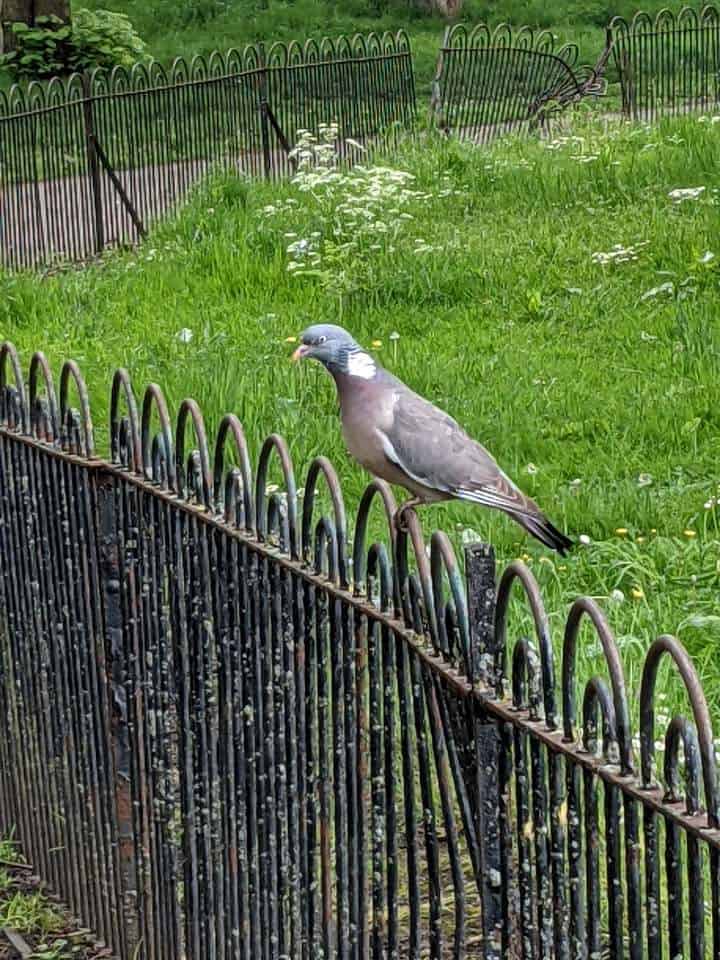
The phrase “rats with wings” came from New York, where wood pigeons don’t live, and was aimed at feral pigeons. The two are easy to tell apart. A wood pigeon is bigger, with a white patch on each side of its neck and a white bar across each wing in flight. Feral pigeons have no white on the neck and come in many colours.
Are Wood Pigeons Going Extinct?
No. Wood pigeons are common. It was the passenger pigeon of North America that was killed to extinction in the early 1900s.
Many bird species have been hunted to extinction.
Others have died out after people brought new animals into their habitat.
For example, settlers on Mauritius brought pigs, macaques and rats, which ate dodo eggs and competed with the birds for food.
The dodo had probably died out by the late 1600s (opens in new tab).
Can I Keep a Wood Pigeon as a Pet?
Wild wood pigeons do not cope well with cages or confinement. Hand-reared birds can become very tame, but rescues usually aim to release them.
If you are caring for a wood pigeon that has become used to people, get advice from a wildlife rescue before releasing it.
A bird that has been hand-reared without learning to find food may struggle in the wild.
Until it is ready, it relies on you for food, care and protection from predators.
The real question is whether you should keep a wood pigeon as a pet rather than whether you can.
Is it Legal to Keep a Wild Pigeon as a Pet?
In the UK, it is illegal to take a healthy wild bird from the wild to keep. You may care for an injured bird until it is fit to release, and a wildlife rescue can advise if a bird can never be released.
If you take one from the wild, it may also have young that depend on it.
Wood pigeons live in pairs, and pairs often stay together.
So taking one from the wild can also separate it from its mate.
Healthy wild animals are best left alone.
Is it Legal to Feed Wood Pigeons?
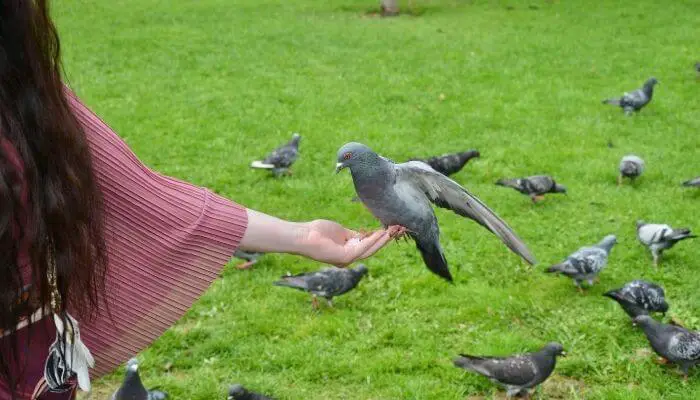
It is legal to feed pigeons in your own garden, but some people choose not to, because large numbers of pigeons can leave a lot of droppings on roofs and cars.
Under the Environmental Protection Act (1990) (opens in new tab) dropping food in the street can count as littering, and some councils have fined people for feeding pigeons in public places.

Fixed penalties vary between councils, and councils can also use Community Protection Notices against people who repeatedly feed pigeons in public places.
In practice, enforcement differs a lot from place to place.
Some councils, including Manchester, have been reported to fine people who feed birds (opens in new tab) in public places, so check your council’s rules.
Please note, this article is for information and educational purposes only. There are comments about legal issues which are correct at the time of writing but as situations and laws change, it is best to seek qualified legal advice for your specific issue or question.
Last updated 31 October 2026 · Facts