
No, pigeons cannot swim. They have no webbed feet and their feathers are not waterproofed like a duck’s, so a pigeon that lands in deep water soon becomes soaked, heavy and cold, and it can drown. Pigeons do like water in small amounts. They drink often and bathe in puddles, bird baths and rain.
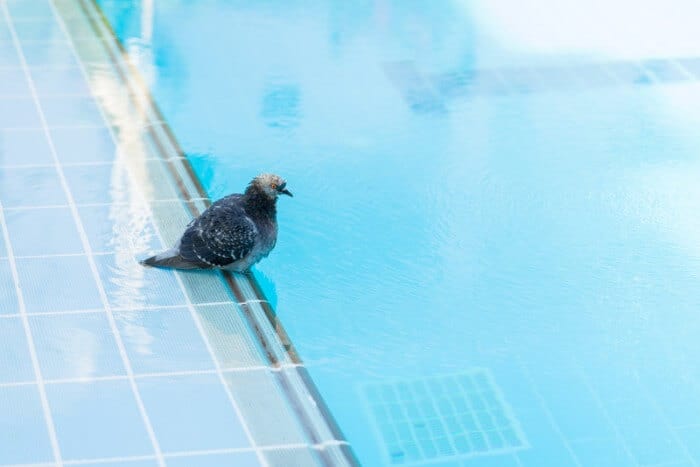
Why pigeons cannot swim
Ducks, geese and gulls have webbed feet that push against the water like paddles. A pigeon has four slender, separate toes made for walking and gripping perches, so its feet give almost no push in water (see pigeon anatomy).
Feathers matter as well. Water birds keep their plumage in condition with oil from the preen gland at the base of the tail. Pigeons have a small preen gland and also grow powder down, which breaks into a fine dust that they spread through their feathers as they groom (see how pigeons preen). The ornithologist Derek Goodwin thought this powder did most of the work that oil does in other birds, but a University of Utah experiment (opens in new tab) found that rock doves whose glands were removed had more worn and damaged feathers after a few months. Neither gives a pigeon the water-repellent coat of a duck.
A soaked pigeon is also heavier and has nothing firm to push off from, so a bird that lands in a pond or pool often cannot fly out again until it reaches the edge.
What happens if a pigeon falls in water
At first a pigeon floats, because birds are light for their size and air is trapped in the plumage. It may beat its wings to move towards the side. As water soaks in, the feathers stop insulating and the bird tires and chills. Pigeons and other birds drown in garden ponds, water butts and steep-sided containers they cannot climb out of. Oregon State University’s 4-H pigeon guide also warns that pigeons crowding into a small bath pan can end up on top of each other, and the birds underneath may drown (Oregon State University (opens in new tab)).
How to help a pigeon in water
- Lift it out with a net, a towel or your hands from the edge. Do not go into deep or fast-moving water yourself.
- Wrap it loosely in a dry towel and gently pat off the water. Do not use a hot hairdryer.
- Put it in a ventilated cardboard box lined with a towel, in a warm, quiet room, and leave it to dry.
- Once it is dry, a healthy adult that stands well and tries to fly can be released where it was found, in daylight.
- If it is weak, still shivering when dry, injured or very young, contact a vet or wildlife rescue. The RSPCA advises taking a hurt pigeon to a local vet in a ventilated box (RSPCA (opens in new tab)).
Wet birds lose heat quickly. Keep the box warm but not hot, and see how cold is too cold for pigeons for the signs of a pigeon that is too cold. Our guide to what to do if you find an injured pigeon covers what to do next.
Do pigeons like water?
Yes, in the right amount. Pigeons bathe often. In shallow water a pigeon wades in, fluffs out its feathers and beats its half-open wings to splash itself, then moves somewhere sunny to dry and preen. In rain it often leans over on one side and lifts a wing so that the rain falls on the underside. Goodwin described both habits in Pigeons and Doves of the World.
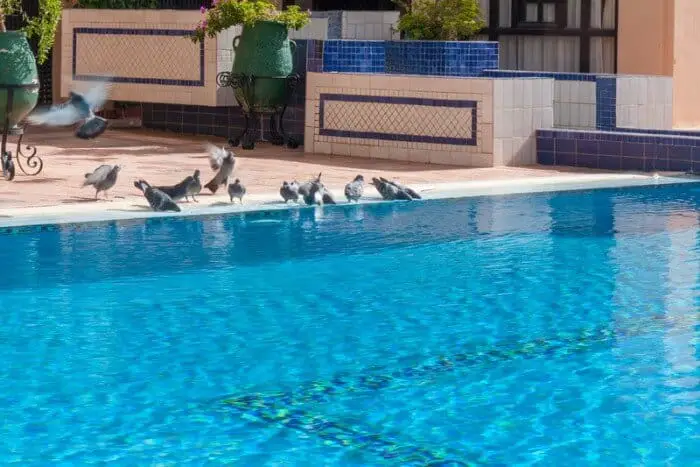
For pet and loft pigeons, Oregon State University suggests a shallow bath pan with 5 to 7.5 cm (2 to 3 inches) of water, big enough for several birds, offered once or twice a week for about two hours. Take it away afterwards so the birds do not drink the dirty water (Oregon State University (opens in new tab)). If a pigeon needs washing by hand, see how to bathe a pigeon.
How pigeons drink
Pigeons drink in an unusual way. Most birds scoop up a little water and tip their head back to swallow. A pigeon keeps its bill in the water and sucks up a continuous draught, using its tongue and throat as a two-stage pump (Zweers 1982 (opens in new tab)). That lets it drink from a puddle or the edge of a pool without wading in. More on how much water pigeons need is in what pigeons drink.
Keeping water safe for birds
- Give garden ponds a gently sloping side or a ramp of stones so that a bird or animal that falls in can climb out. The RSPB recommends shallow, sloping edges for wildlife ponds (RSPB (opens in new tab)).
- Fit secure lids on water butts, tanks and buckets.
- Keep bird baths shallow and refill them with clean water often.
- In a loft, use a wide, shallow bath pan and remove it after use.
Pigeons and water: FAQs
Can pigeons swim?
No. Pigeons have no webbed feet and their feathers are not waterproof like a duck’s. They float for a short time but soon become waterlogged.
Do pigeons like water?
Yes. They drink often and like to bathe in shallow water and in rain, but they keep out of water too deep to stand in.
Can a pigeon drown?
Yes. A pigeon that falls into a pond, pool, water butt or deep container can drown if it cannot reach an edge it can climb out from.
How deep should a pigeon bath be?
About 5 to 7.5 cm (2 to 3 inches), in a pan wide enough for several birds, according to Oregon State University’s 4-H pigeon guide.
Why is a pigeon sitting in water?
Usually it is bathing or cooling down. A pigeon that sits in water for a long time without moving may be unwell and should be checked.
Sources
References used for this page:
- Moyer, B.R., Rock, A.N. and Clayton, D.H. (2003). Experimental test of the importance of preen oil in Rock Doves (Columba livia). The Auk 120(2): 490-496. (opens in new tab)
- Zweers, G.A. (1982). Drinking of the pigeon (Columba livia L.). Behaviour 80: 274-317. (opens in new tab)
- Oregon State University Extension: 4-H Pigeon and Dove Project (4-H 154). (opens in new tab)
- RSPCA: Injured pigeon, what to do and how to help. (opens in new tab)
- RSPB: How to make a wildlife pond. (opens in new tab)
- Goodwin, D. (1983). Pigeons and Doves of the World, 3rd edition. British Museum (Natural History) and Cornell University Press.
Last updated 11 November 2026 · Behavior