
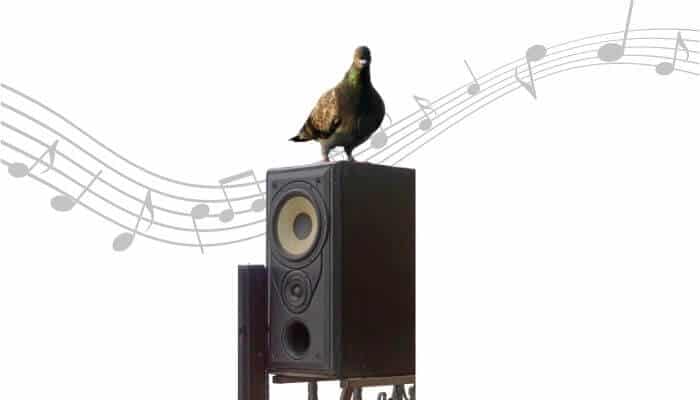
There is no good evidence that pigeons enjoy music. In laboratory tests, pigeons learned to tell Bach from Stravinsky and a fast tempo from a slow one, so they do hear differences in music. When they could choose what to hear, though, they showed no clear preference for music over noise. Head bobbing is a walking reflex, not dancing.
Can pigeons tell music apart?
Yes. In 1984 Debra Porter and Allen Neuringer trained pigeons to peck one disc while organ music by Bach played and another disc during Stravinsky’s The Rite of Spring (Porter and Neuringer 1984 (opens in new tab)). The birds learned the task and then sorted pieces they had never heard: they grouped Buxtehude and Scarlatti with Bach, and Elliott Carter and Walter Piston with Stravinsky. They did not group Vivaldi with Bach, which Java sparrows later did in a similar test (Watanabe 2009 (opens in new tab)).
Rhythm is harder for them. At Tufts University, four pigeons readily learned to tell a fast piano tempo from a slow one. They needed long training to separate two drum metres, and after 40 sessions they still could not tell rhythmic from arrhythmic sound patterns (Hagmann and Cook 2010 (opens in new tab)). The authors concluded that pigeons can time regular sounds but have a limited grasp of rhythmic grouping.
Do pigeons prefer music?
Telling music apart is not the same as liking it. Shigeru Watanabe’s group at Keio University let four pigeons choose, by pecking keys, between Bach and Stravinsky, Bach and noise, or Stravinsky and noise (Watanabe 2009 (opens in new tab)). The birds showed no strong preference in any pairing. One leaned slightly towards Bach and another towards Stravinsky, which cancels out. In an earlier study, hens did not peck more when pecking played music.
Java sparrows, which are songbirds, did prefer some music in the same research programme. Watanabe notes that a liking for music has so far been found only in humans and songbirds, and that a two-choice test may miss weak effects. Pigeons coo, but they are not songbirds (see the sounds pigeons make). Pigeons notice music, then, but nothing so far shows that they enjoy it.
Is a head-bobbing pigeon dancing?
No. Pigeons bob their heads whenever they walk, with or without music. Filming walking pigeons shows that the head is thrust forward and then held almost perfectly still in space while the body catches up, which keeps the image on the retina steady (Troje and Frost 2000 (opens in new tab)). More on this in why pigeons bob their heads.
A study of online videos of animals moving to music found convincing beat-keeping only in species that imitate sounds, mostly parrots (Schachner and colleagues 2009 (opens in new tab)). A pigeon by a speaker that bobs, coos or shuffles is walking, displaying or reacting to the sound as a disturbance.
Music and noise around a loft
Some keepers leave a radio playing in the loft. The usual reason is to get birds used to voices and sudden sounds so they startle less, not because the birds enjoy it. No study has tested whether this helps pigeons, so treat it as a keeper’s habit rather than proven care. If you do it, keep the volume moderate and avoid sudden loud noise near nesting birds. Music is not a proven way to scare pigeons off a balcony either; see how to keep pigeons away for methods that work better.
Pigeons do react strongly to some sounds. The whistle of wings from a flock taking off in alarm can make other birds flee, and in one Australian pigeon species that whistle is a proven alarm signal (see why pigeons make noise when they fly).
Pigeons and music FAQs
Do pigeons like music?
There is no evidence that they enjoy it. Pigeons can learn to tell pieces of music apart, but choice tests found no clear preference for music over noise.
Can pigeons tell Bach from Stravinsky?
Yes. In a 1984 study pigeons learned the difference and applied it to other Baroque and modern composers they had not heard before.
Do pigeons dance to music?
There is no good evidence that they do. Head bobbing is how pigeons keep their vision steady while walking.
What kind of music do pigeons like?
No kind of music has been shown to be preferred. Claims about jazz, classical or dance music come from anecdotes, not tests.
Should I play music for my pet pigeon?
There is no evidence that it helps. If you do, keep the volume moderate and avoid sudden loud noise near nesting birds.
Do pigeons sing?
Not in the songbird sense. Pigeons coo, and males coo more during courtship and when defending a nest.
Sources
Studies used for this page:
- Porter, D. and Neuringer, A. 1984. Music discriminations by pigeons. Journal of Experimental Psychology: Animal Behavior Processes 10: 138-148 (opens in new tab)
- Hagmann, C. E. and Cook, R. G. 2010. Testing meter, rhythm, and tempo discriminations in pigeons. Behavioural Processes 85: 99-110 (opens in new tab)
- Watanabe, S. 2009. How animals perceive music? Comparative study of discriminative and reinforcing properties of music for infrahuman animals. Keio University CARLS series 2: 5-16 (opens in new tab)
- Troje, N. F. and Frost, B. J. 2000. Head-bobbing in pigeons: how stable is the hold phase? Journal of Experimental Biology 203: 935-940 (opens in new tab)
- Schachner, A. et al. 2009. Spontaneous motor entrainment to music in multiple vocal mimicking species. Current Biology 19: 831-836 (opens in new tab)
Last updated 9 November 2026 · Behavior