
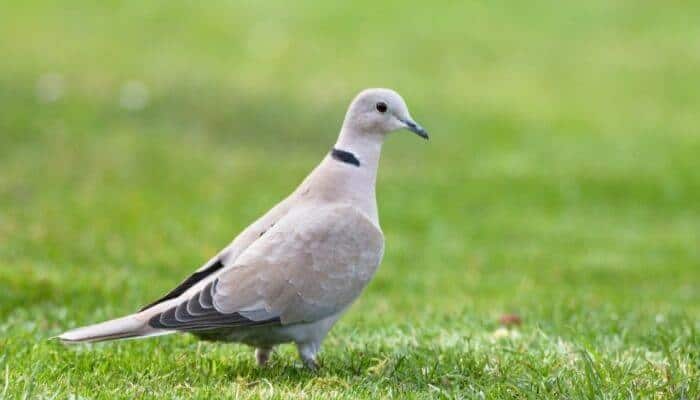
The Eurasian collared dove – scientific name, Streptopelia decaocto – is native to Europe and Asia.
Though the European and Asian continents are where the bird was originally found and developed, it is now found around the world including places like Japan and many different islands across the Caribbean.
When it comes to conservation status, the Eurasian collared dove is listed as being of ‘Least Concern’ on the IUCN Red List (opens in new tab).
This is largely thanks to the bird’s vast global range and presence, along with a healthy increasing population trend.
Eurasian Collared Dove Origins and Distribution
The Eurasian collared dove’s name is the clue to its origin. It is thought that the dove was originally native to the Bay of Bengal area (modern-day India, Bangladesh, Sri Lanka and Myanmar).
By the 1600s, it had found its way (either through introduction or natural migration) to Turkey and the Balkans (South-eastern Europe).
Evidence also shows the dove could be found as far east as China.
At this point in the story, there seems to be a difference of opinion.
Some older accounts suggest it was already widespread in Europe by 1900, but this is not well supported.
Most sources describe a rapid spread across Europe in the few decades after the 1930s.
History records that the bird reached Germany in 1945 and Great Britain in 1952, first breeding there in 1956.
In 1955, Britain recorded just four birds but by 1970, this had increased to 20,000 pairs.
The bird can now be found all over Europe from as far north as the Norwegian Arctic circle to as far south as Morocco and the Canary Islands and as far east as the Ural Mountains in Russia.
The Eurasian Collared Dove was introduced into Japan and also has a large population in North America.
The origin of the arrival in the USA begins in 1974 when some doves escaped captivity in The Bahamas and bred.
They spread to Florida and from there, they spread north-westwards arriving in the Pacific Northwest in 1999.
Records show (opens in new tab) the dove in Alabama in 1991, Texas 1995, South Dakota 1996, Montana 1997, Minnesota 1998, Iowa 1999 and Oregon in 1999.
They have since been seen in California, Colorado, Missouri and Tennessee, and in much lower numbers in the North-eastern states.
They are also spread throughout the Caribbean, Canada and Mexico.
Estimates put the UK population at roughly 800,000 to 1 million breeding pairs.
They inhabit almost every state in the USA so the numbers can only be guessed at.
The Invasive Species Compendium (opens in new tab) notes that global numbers are hard to estimate, and Europe alone is thought to hold several million breeding pairs.
The Eurasian collared dove is one of the most successful modern colonizing species of birds ever.
They Are An Invasive Species
An invasive species (opens in new tab) is any plant or creature that has migrated or been introduced to an environment where it has a negative impact.
They damage the existing ecosystem, upsetting the balance. It might be that an invasive animal dominates the food chain pushing out lesser species or a plant grows so expansive as to limit growth areas for other plants.
Commonly known invasive species are the cane toad in Australia and Japanese knotweed in the UK.
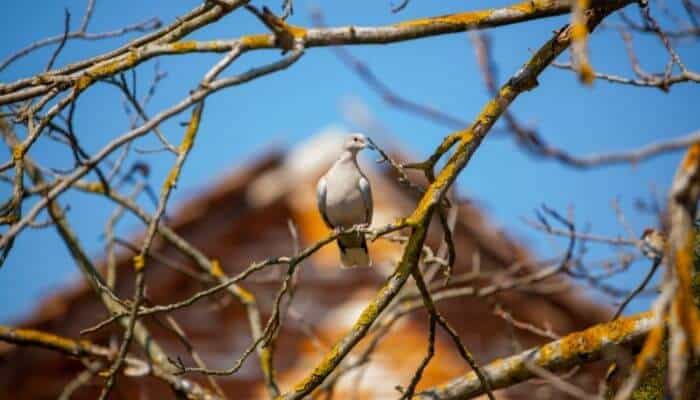
In the USA, the Eurasian collared dove as a non-native bird is classed as an invasive species (opens in new tab).
There is fear that this species will displace native species of doves as well as other species of game birds.
As an invasive species, it is perfectly legal to hunt the Eurasian collared dove in the USA (subject to set hunting seasons and state laws).
In the UK it can be controlled in some situations under general licences, and in parts of Pakistan it is regarded as a crop pest.
In the UK it can be killed legally only under the conditions set out under the Wildlife and Countryside Act.
Eurasian Collared Dove Habitat
The Eurasian collared dove lives and thrives in both urban and rural areas but they appear to prefer spaces with plenty of roosting spots.
They will roost in trees, buildings and barns and on overhead wires and poles.
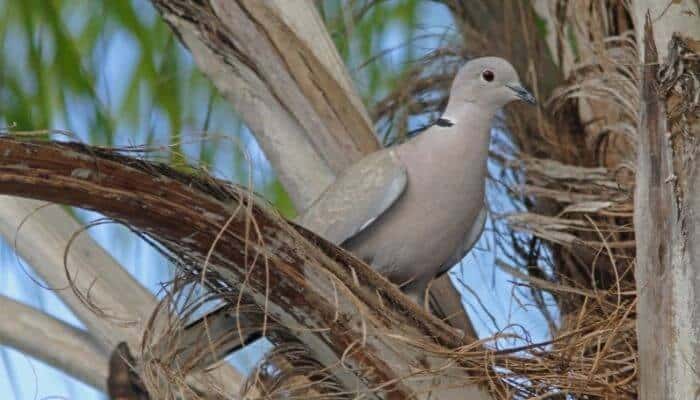
They will commonly avoid wide-open spaces (such as agricultural land) where there are few roosting spots and also heavily wooded areas.
Combine roosting spots with food availability and you have the ideal habitat for this dove.
Grain stores and areas where livestock are kept are popular places for Eurasian collared doves in the countryside.
Nesting sites are typically in trees and shrubs close to human habitation as well as buildings and other constructions.
Appearance Of The Eurasian Collared Dove
This breed is a medium-sized bird of stocky build.
It grows to 30-33 cm (12-13 ins) long and weighs around 200g (7 oz).
The Eurasian collared dove has a plump body standing on short legs with a small head on a short neck and long tail.
The breed is larger than a Mourning Dove, but slimmer than a Rock Pigeon and has a longer tail than a Rock Pigeon. However, it is often confused with the Mourning dove.
The wings of a Eurasian collared dove are broad and slightly rounded, and the tail is also broad with a tip that is squared off and appears white from underneath.
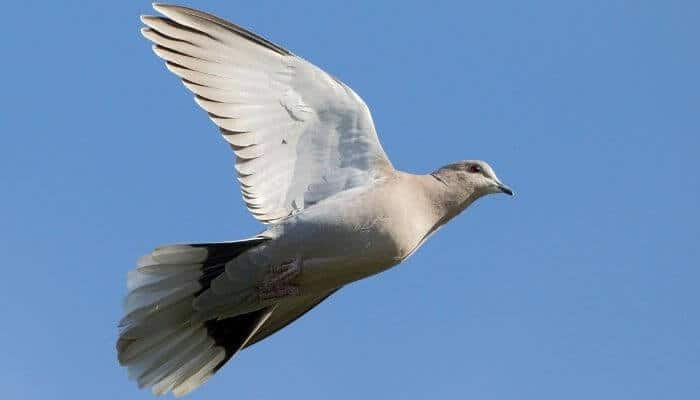
In flight, you will notice that its wingtips are of a darker color than the rest of the wing.
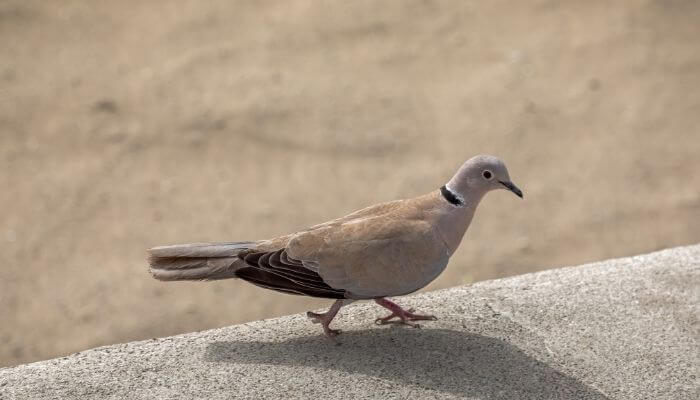
The color of a Eurasian collared dove runs somewhere from chalky light brown and grey buff with an almost pink tinge (not quite as pink as the pink-necked green pigeon though!).
Legs and feet are dark red/mauve, and bills are black and slender.
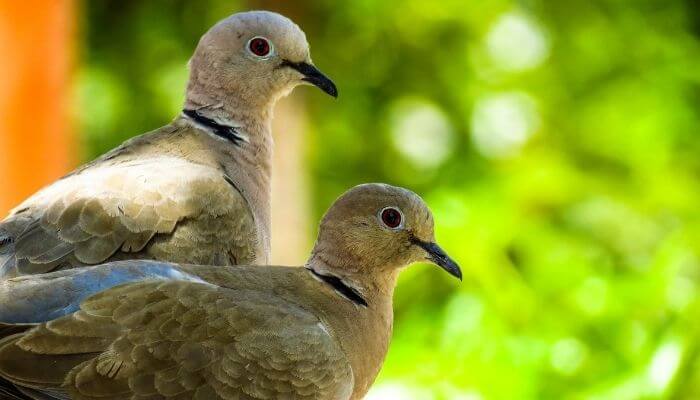
A tell-tale characteristic is the narrow black crescent banded in white that can be found around the nape of the neck – hence its name.
It is this collar that distinguishes it from the other types of doves and pigeons of similar general appearance.
Character
A typical behavior for a Eurasian collared dove is to perch on something high like a telephone pole, wire or large tree and produce repeated and incessant three-syllable coos.
They do this individually and as a community.
Sometimes on landing, they will let out a harsher sound, something described as a hah-hah screeching noise.
Characteristics of their flight patterns include short bursts of clipped wingbeats, as well as impressive-looking looping glides.
When walking, a Eurasian collared dove tends to bob its head and flick its tail in a rhythmic fashion.
In terms of the relationship between humans and Eurasian collared doves, you will find that these birds are not shy at all.
Whilst some species can be very wary of human presence and interaction, even the wildest collared dove will often be happy to get close to human habitats in order to feed.
Generally a placid bird, the Eurasian collared dove will get quite aggressive when defending food sources.
Eurasian Collared Dove Diet
The diet of a Eurasian collared dove is very common for a bird of its size and typical of the whole Columbidae family.
Depending on its location, of course, you can expect a collared dove to regularly consume:
- Seeds
- Cereal grain
- Millet
- Sunflower seeds
- Milo
- Wheat
- Corn
- Berries
- The green vegetation of plants
- Very small invertebrates on occasion, though this is not usually the preferred choice for a Eurasian collared dove.
Mating And Breeding A Eurasian Collared Dove
Eurasian collared doves typically like to breed somewhere that is close to human habitation, because these are the locations where scraps of food and nesting resources are going to be most abundant.
Most nests are found fairly close to inhabited buildings.
Females lay two white eggs that are then incubated for between 14 and 18 days.
There is no specific mating season, with breeding occurring at most times throughout the year, although eggs in the colder winter months in north-eastern Europe are much rarer.
On average, a dove couple will produce between three and four broods per year.
The mating display for this species consists of the male performing a ritual flight that involves fast, almost vertical climbs followed by long glides and circular tumbles.
The display is meant to impress the female.
Taking Care of Eurasian Collared Doves
Basic and effective care of a Eurasian collared dove in a domesticated environment is quite easy.
A large cage, with each dove needing about 2 square feet of space at a bare minimum. The larger the cage, the better, and always place it in an area of your home where there are no vents or open windows. Draughts can put the health of doves at risk.
If you want to keep a few, you will need to buy or build a pigeon coop.
If you want something decorative for your garden and want to attract doves, buy or build your own dovecote using our free dovecote plans.
Place food and water at the bottom of the cage because this is where doves feel most comfortable hydrating and refueling.
Food and water should be refreshed daily.
Feed them a nice mixture of seeds, grains and fruits to maintain the best balance of vitamins and nutrients. A small amount of bird grit will also help to aid good digestion.
Whatever you choose to house them in, they will prefer several perches.
Doves like to take a regular bath so a daily misting with a spray bottle is much appreciated.
If you keep your doves indoors, make sure that you allow the doves to fly around the house for a period of time every single day.
They need good exercise in order to stay healthy.
Generally, they have little desire to ‘escape’, and those that are allowed to fly outside don’t tend to stray too far.
Cages and coops should be completely cleaned out at least once a week.
Other Interesting Facts
There are multiple different collective noun terms that can be used for the Eurasian collared dove, these include:
- Bevy
- Cote
- Dole
- Dule
- Flight
Scientists have pinpointed the Eurasian collared dove as being one of the two species that are argued to be the wild ancestor of the domestic Barbary Dove.
In the scientific name, Streptopelia means collar dove and decaocto is Greek for eighteen.
This comes from a Greek legend about an overworked servant girl paid just 18 coins a year, whom the gods turned into a dove so she could escape her hardship.
In folklore, it is said that the dove’s three-note call still repeats “deca-octo”, the girl’s complaint about her wages.
One of the concerns of the spread of the Eurasian collared dove is that it carries the Trichomonas gallinae (opens in new tab) parasite.
Although not the only bird to be a carrier, it is the sheer numbers of this bird that gives the cause for concern.
Last updated 24 October 2026 · Types