
The Modena is a short, stocky Italian exhibition pigeon, usually shown today in the English type. Britain’s National Modena Club says that type was fixed in the early nineteenth century by breeders led by W.F. Holmes. Birds are shown as Gazzi, with a white body and coloured head, wings and tail, or as Schietti, which are self-coloured.

Shape and carriage
The British club says the principal feature of the English Modena is that it is a bird of curves. It should be medium in size and as short as possible, with a broad, round, prominent chest, a short back, and a short, stocky body. Style comes before size: a medium bird that lacks type sits below a rather larger bird of more cobby build.
Carriage should be proud and erect, with the head held high and a little back, and the tail tilted up. The flights rest on the tail and should never be carried below it; the wing tips just meet. Legs are straight, unfeathered and bright red. Eyes are red or orange. A pearl eye is undesirable.
The German standard describes the same short, rounded outline, and lists a wide range of colours in Gazzi, Schietti and Magnani.
| Feature | English Modena (National Modena Club) |
|---|---|
| Build | Medium, as short as possible; broad chest; short, stocky body |
| Carriage | Proud and erect; head a little back; tail tilted up |
| Wings | Short, tight; tips meet on the tail, never carried below it |
| Legs | Straight, unfeathered, bright red |
| Eyes | Red or orange; a pearl eye is undesirable |
| Main types | Gazzi (pied) and Schietti (self); Magnani also recognised in Europe |
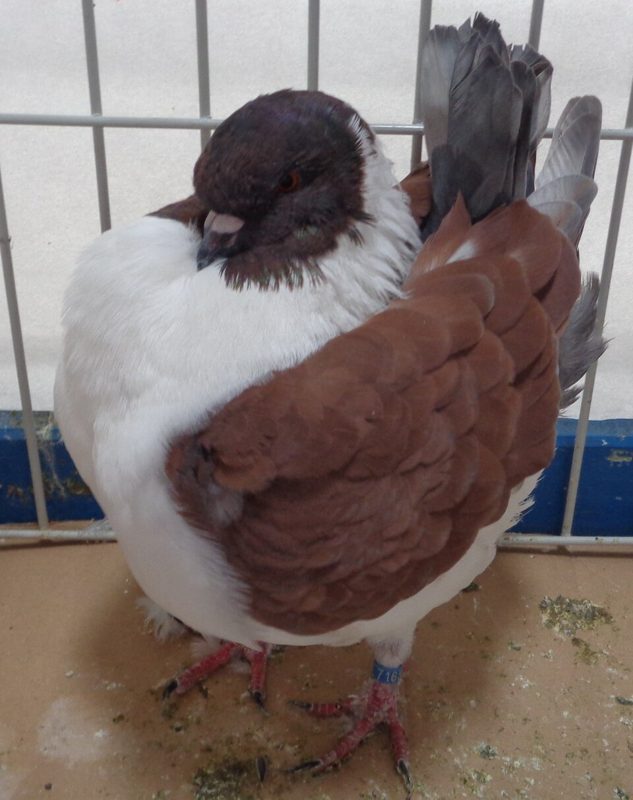
Gazzi, Schietti and Magnani
The British club divides Modenas into Gazzi, or pied, and Schietti, or self-coloured, and also names Magnani, or harlequin. The German standard uses the same three groups.
In a Gazzi, the head, the upper throat, the wings including the flights, and the tail are coloured; the rest of the bird is white. The head colour ends at the back of the skull, and the line runs in an even curve about a finger’s breadth below the eye to the upper throat. The bib should be well rounded. White flights or white tail feathers are a serious fault, except in mottled birds, where the British club allows white flights.
Schietti birds are self-coloured, or show the usual wing pattern of their colour, without a white body. Pigeon Cote notes that, in the United States, Magnani is often treated as a colour class of Gazzi or Schietti rather than as a separate variety.
- Gazzi: white body; coloured head, upper throat, wings, flights and tail.
- Schietti: self-coloured, or with a patterned wing, without Gazzi white.
- Magnani: a third, mixed-colour variety in European lists.
Italy, Germany and the English type
The Modena is a domestic form of the rock pigeon (Columba livia), kept for exhibition among the types of pigeon. The German club standard gives the origin as northern Italy, and says the breed was introduced in Germany at the end of the eighteenth century.
The bird seen in British and many American shows is the English Modena. The National Modena Club of Great Britain, which defines that type, says it was developed in the early nineteenth century by English breeders headed by W.F. Holmes, who then wrote the standard. This page does not repeat unsourced stories about Roman antiquity, or about violent flying contests in the city of Modena.
Keeping Modenas
The standards describe a show bird, not a feeding programme or a lifespan. Daily care is like that of other pigeons kept as pets: a dry loft, grit, clean water and a grain mix.
Clean, unfeathered legs are part of the type, so the perch and floor need to stay dry. Tight feathering and a short tail do not need the extra space of a muffed or fantail breed, but the bird still needs room to stand and stretch.
Modena pigeon questions
What is a Modena pigeon?
A short, stocky Italian exhibition pigeon, usually shown in the English type: a bird of curves, with a broad chest, a short body, and an erect carriage.
What is the difference between Gazzi and Schietti?
A Gazzi has a white body and a coloured head, wings and tail. A Schietti is self-coloured, without that white body pattern.
Is the Modena from the city of Modena?
The name is Italian, and the German club standard gives the origin as northern Italy. The common show type in Britain is the English Modena, fixed there in the early nineteenth century.
What is Magnani?
In European standards it is a third, harlequin or mixed-colour variety. In the United States it is often shown as a colour class of Gazzi or Schietti rather than as a separate variety.
What colour are the eyes?
The British club asks for red or orange eyes. A pearl eye is undesirable, and a broken eye is a fault.
Sources
This page follows these standards and notes:
- National Modena Club of Great Britain, standard for the English Modena (archived copy): origin in early nineteenth-century England under W.F. Holmes, shape, carriage, Gazzi markings, eyes and legs (opens in new tab)
- Sonderverein Deutscher Modeneser, standard in English: origin in northern Italy, introduction in Germany at the end of the eighteenth century, Gazzi, Schietti and Magnani colour lists (opens in new tab)
- Pigeon Cote, The Modena: how Gazzi, Schietti and Magnani are grouped in Europe and in the United States (opens in new tab)
Last updated 13 November 2026 · Types