
Pigeons have green and purple necks because of structural colour, not pigment. Each barbule on a neck feather has a thin keratin layer over a darker core, and light reflected from the top and bottom of that layer interferes. A layer about 595 nm thick looks green, one about 530 nm looks purple, and both shift as the bird moves.

Green and purple neck feathers compared
| Green feathers | Purple feathers | |
|---|---|---|
| Keratin outer layer (average thickness) | About 595 nm | About 530 nm |
| Colour seen straight on | Green | Purple |
| Colour seen at a low angle | Shifts towards purple | Shifts towards green |
| What is underneath | A darker core that works as a weak mirror | The same |
| Part of the feather that shines | The barbules, not the barbs | The barbules, not the barbs |
How thin-film interference works
Light behaves as a wave. When it hits a neck-feather barbule, part of it reflects straight off the outer keratin, and part goes through the keratin and reflects off the darker core underneath. The two reflections leave the feather a fraction of a wavelength apart.
Where the peaks of the two waves line up, that colour is reinforced and looks bright. Where a peak meets a trough, that colour cancels out. Which colours survive depends on the thickness of the keratin layer, so a difference of about 65 nm is enough to turn a feather from green to purple. Soap bubbles and oil films on water shimmer for the same reason.
A team at Fudan University in Shanghai measured neck feathers from domestic pigeons in 2006. They found that green and purple barbules have the same basic build, with an outer keratin layer around an inner core, and that the colour comes from interference in the top keratin layer, while the structure beneath acts as a poor mirror. The barbs themselves, the main branches of the feather, have no iridescent colour. For the parts of a feather, see pigeon anatomy.

Why the colour changes as the pigeon moves
Tilting a thin film changes the distance the light travels inside it, so a different colour is reinforced. In the 2006 study, green barbules turned towards purple as the viewing angle moved from straight on to a low angle, and purple barbules turned towards green.
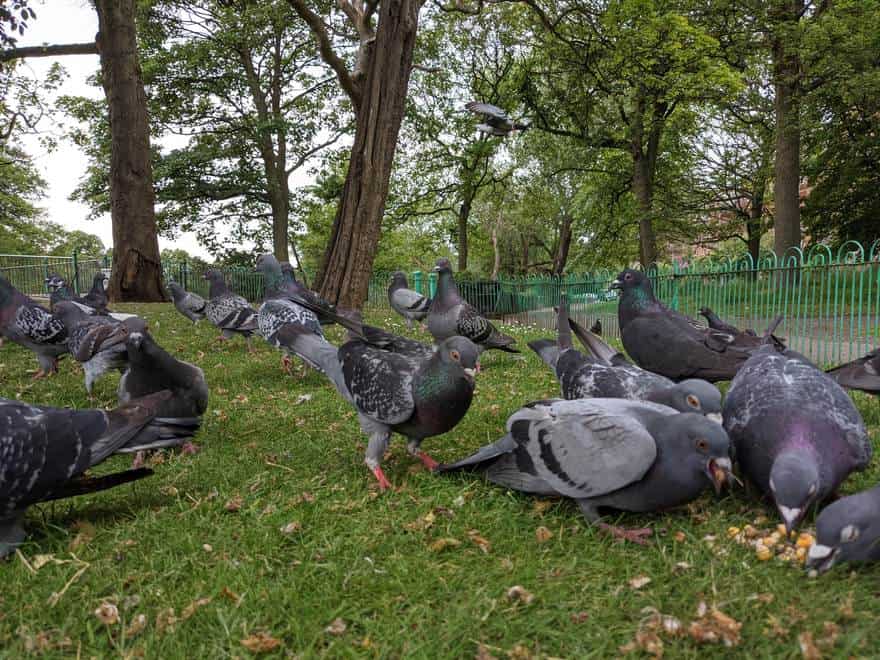
A pigeon’s neck is a curved surface covered in feathers lying at slightly different angles, so you see patches of both colours at once. As the bird turns its head, walks or bows, the patches swap.
Is the colour pigment or structure?
Both play a part. The grey, black or brown of a pigeon’s plumage comes from melanin pigment, which is what pigeon colour genetics is about (see pigeon colour genetics). The green and purple sheen is structural: there is no green or purple pigment in the feather.
The melanin still matters to the sheen. A dark layer under the keratin absorbs stray light, so the reflected colour stands out instead of being washed out. In some show breeds judges count a neck sheen as a fault; the Ice pigeon standard is one example.

Do male and female pigeons both have iridescent necks?
Yes. Both sexes have a green and purple neck, although Animal Diversity Web notes that females tend to show less iridescence than males. That makes neck colour a poor way to sex a pigeon on its own.
Young pigeons have duller necks until their adult feathers come in (see what a baby pigeon looks like). Males show the neck off in courtship: in the bowing display described in Derek Goodwin’s pigeon ethogram, the male raises his neck feathers and inflates his crop while he coos and turns. For more on that display, see why pigeons puff up their chests.
Why some pigeons shine more than others
The state of the feathers matters. In a 2014 experiment, Sarah Leclaire and colleagues changed the number of bacteria on the feathers of captive feral pigeons. Birds with fewer bacteria had feathers in better condition and brighter iridescent necks, and birds with more bacteria spent more effort on preening and preen oil. Preening is how pigeons keep feathers clean and in place (see preening).
Worn or damaged feathers reflect less evenly, so a pigeon with feather rot or in the middle of a moult can look patchy. Lighting matters too: the colour shows best in direct sun and can almost vanish in shade.
Curious how your own pigeon’s neck would score? Rate My Pigeon gives a photo a playful judge’s scorecard, and neck shimmer is one of the categories.
Other iridescent pigeons and birds
Iridescence is common in the pigeon family (see the Columbidae family). Woodpigeons and stock doves have glossy green patches on the neck (see wood pigeon), and the Nicobar pigeon is iridescent almost all over.
Many other birds use structural colour, often with more complex structures than the pigeon’s single film. Peacock feathers, for example, contain a regular lattice of melanin rods, as the same Fudan University group showed in 2003. Starlings, hummingbirds and mallard drakes also owe their sheen to structure rather than pigment.

Frequently asked questions
Why do pigeons have green and purple necks?
Because of thin-film interference. The barbules of the neck feathers have a thin keratin outer layer over a darker core. Light reflecting from both surfaces reinforces green where the layer is about 595 nm thick and purple where it is about 530 nm thick.
Are pigeon neck feathers really green and purple?
The colour you see is real reflected light, but there is no green or purple pigment. Seen from another angle or in shade, the same feather can look grey.
Do female pigeons have shiny necks?
Yes. Both sexes have iridescent neck feathers, though females tend to show slightly less iridescence than males.
Why don’t young pigeons have shiny necks?
Juveniles grow duller feathers with less of the green and purple shine. The full sheen appears once they moult into adult plumage. See what a baby pigeon looks like.
Why are some pigeons shinier than others?
Feather condition makes a difference. A 2014 study found that pigeons with fewer bacteria on their feathers had brighter iridescent necks. Wear, moult, breed colour and lighting also change how much sheen you see.
What other birds have iridescent feathers?
Within the pigeon family, the Nicobar pigeon, woodpigeon and stock dove all have iridescent feathers. Outside it, peacocks, starlings, hummingbirds and mallard drakes are well-known examples.
Sources
We checked each source on 4 November 2026.
- Yin, H. et al. (2006). Iridescence in the neck feathers of domestic pigeons. Physical Review E 74: 051916 (PubMed abstract) (opens in new tab)
- Leclaire, S. et al. (2014). Feather bacterial load affects plumage condition, iridescent color, and investment in preening in pigeons. Behavioral Ecology 25(5): 1192–1198 (opens in new tab)
- Animal Diversity Web: Columba livia (opens in new tab)
- Goodwin, D. Ethogram of the pigeon (Great Lakes Pigeon Rescue) (opens in new tab)
- Zi, J. et al. (2003). Coloration strategies in peacock feathers. PNAS 100(22): 12576–12578 (opens in new tab)
Last updated 4 November 2026 · Facts