

One of the most common questions in the avian world is “are doves and pigeons the same thing?”. Scientifically there is no confusion. Doves and pigeons are technically the same thing but language caused a distinction, creating two definitions.
All pigeons and doves belong to the same family and are classified by their similar appearance of a stout body with small, rounded heads, tapered wings, short legs and cooing calls, though doves are typically smaller in stature.
There is no single scientific feature that separates “doves” from “pigeons”; the difference is mostly one of naming.
Pigeons and doves are not two separate scientific groups: some species called doves are more closely related to some species called pigeons than to other doves.

The general view is that doves are beautiful, soft-looking birds, a symbol of love and peace, while pigeons are somewhat reviled, a feral bird often thought of as vermin found in mainly gray, brown and blue colors.
Doves and pigeons are in the same taxonomic family. There are 344 known species, of which 13 are now extinct.
Before we address the question of whether doves and pigeons are the same thing, lets look at some terminology.
When it comes to Etymology (opens in new tab) (the study of words) the definition of what a dove is has changed over the years. The word “dove” was originally used to describe all pigeons but in English it is now mostly used for smaller species.

However, the distinction is made harder through language as expressions are not consistent and are often used interchangeably.
The English word dove comes from an old Germanic word that may refer to the bird’s diving flight, while the French use pigeon, which is derived from the Latin word pipio, which means “peeping” chick.
Individuals all over the world also have their own linguistic views without scientific or taxonomic knowledge, so what one person may call a dove, another may call a pigeon.
Also Read: Pictures Of Pigeons and Doves: 26 Different Breeds
Characteristics of The Columbidae Family
The taxonomic order that pigeons and doves belong to is known as Columbiformes.
Within this order, there is only one family and that is Columbidae which contains all known species of pigeons and doves.
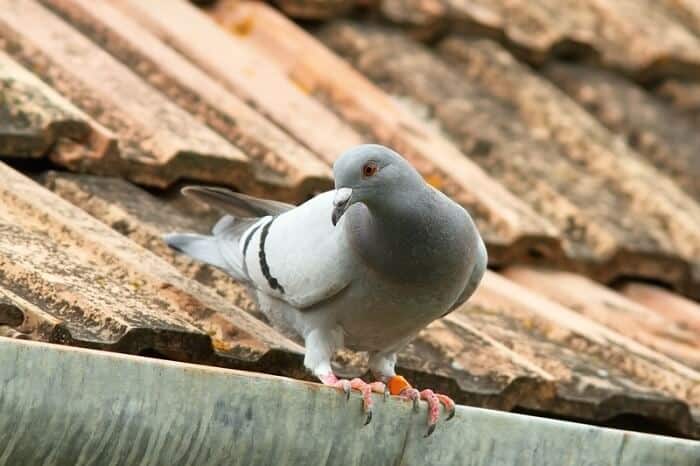
Pigeons and doves share certain features. These features are:
- Short, stout/rounded bodies
- Short, scaly legs
- Small, rounded heads
- Small, slim beaks with a small fleshy patch at the base
- Tapered wings
- Soft, dense feathers
- Crooning or cooing calls
There are of course variations to these rules as there are numerous different breeds within the species of the Columbidae family.
Some have developed different calls and others have developed extravagant feathers in some areas such as the frillbacks and fantails.
Essentially though, they all conform to the basic characteristics.
They are also similar in certain behaviors:
- They eat the same diet – seeds and fruit (see note below)
- All breeds build relatively flimsy nests
- Egg clutches are one or two and both parents take on caring responsibilities
- Both sexes also produce crop milk to feed the young
In terms of diet, there is some distinction in that the various species can be classed as either granivorous or frugivorous.
- Granivorous are seed-eating and typically feed on the ground
- Frugivorous are fruit and mast (opens in new tab) eating and typically feed in trees.
Are Doves and Pigeons the Same Thing?
This is a valid question given that we have just described all the characteristics they share.
In short, yes. Whether two birds can breed depends on how closely related their species are, not on whether they are called doves or pigeons. This also answers the question “can doves and pigeons mate?“
Most pigeon and dove species have a broadly similar number of chromosomes, often around 76 to 80, so chromosome counts do not divide them into two groups.
Closely related species can sometimes produce hybrids, but crosses between distant species are rarely successful.
For example, a domestic pigeon and a Barbary dove may mate in captivity, but hybrid offspring are rare and usually sterile, so continuing the “line” is very unlikely.
There is no reason for doves and pigeons to mate in the wild. There are enough choices within their own species.
Are Doves Pigeons?
From a zoological point of view, doves are pigeons. Science has classified them all as Columbidae and they are the only family in the order Columbiformes, although they include around 350 different species.
Genetically, each species differs from the others, just as in any other bird family.
Are Pigeons Doves?
As said above, all pigeons and doves belong to the same family.
Are Doves White Pigeons?
Based on the answers to “are pigeons doves” or “are doves pigeons”, you could say that many white “doves” are really white pigeons.
However, remember that not all doves are white. White is just one colour form.
Other breeds like the mourning dove, various fruit doves and Eurasian collared dove are all different colors. And generally, release doves are breeds of white pigeons rather than white doves.
Perceived “Differences” Between Doves and Pigeons

Many people perceive them to be different based on a variety of factors. All of these factors are just differences in appearance between Columbidae species.
The perceived differences between doves and pigeons essentially fall into four key areas, some of which have been generalized above:
- Size and appearance
- Diet and predators
- Habitat
- Calls
1. Size and Appearance
The majority of the biological diversity between doves and pigeons is perceived to be in their size and tails.
There is a considerable variation in size across the full range of species, with lengths ranging from 6 to 30 inches (15 to 75 centimeters).
The smallest breed is the New World Ground Dove which measures as little as 5 inches (13 cm) and weighs less than one ounce (22 g). The largest species is the Crowned Pigeon of New Guinea. This is as big as a turkey, weighing between 4 to 9 pounds (2 to 4 kg).
Most species have 10 or 11 primary flight feathers in their wings, which are large in comparison to their overall size.
They have what is known as low wing loading which is what makes them such excellent and in some species, acrobatic fliers. When it comes to tails, however, it is mostly doves that win out.
Although there are breeds of fancy pigeons, such as the American and Indian fantail pigeons, doves generally have the more expressive and bigger tails.
While on the subject of feathers, marked differences can also be seen between the granivorous species and the frugivorous species.
The former tend to have duller plumage while frugivores are more brightly colored. Various species of fruit doves from Fiji and the Indian Ocean are the most brightly colored.
2. Diet and Predators

As mentioned previously, diet enables the classification into either granivores or frugivores.
These diets give rise to some anatomical differences.
In granivores, the gizzards have thicker walls.
Their intestines are also longer than those of the frugivores.
Another morphological adaptation to enable diet is that frugivores can cling to branches and hang upside down to reach fruit.
Although much smaller in number, some species eat food items other than seeds and fruit. Quail doves and ground doves, for example, eat worms and insects.
The Atoll Fruit Dove likes to eat small reptiles as well as insects.
Other species eat insects, moths, slugs and snails including Ruddy Ground Doves, White-Crowned Pigeons, and Orange Fruit Doves.
With regard to predators, pigeons are at the mercy of large birds with better dive velocity, particularly the Peregrine Falcon and other hawks.
This applies to doves too, but the “ground” species are at risk of having their eggs eaten by rats and snakes.
Humans can also be considered one of their predators – particularly for common pigeons.
3. Habitat
Columbidae have adapted to almost all types of environments which is why species are found all over the world including the remotest places of Eastern Polynesia, Réunion Island in the Indian Ocean, and The Azores.
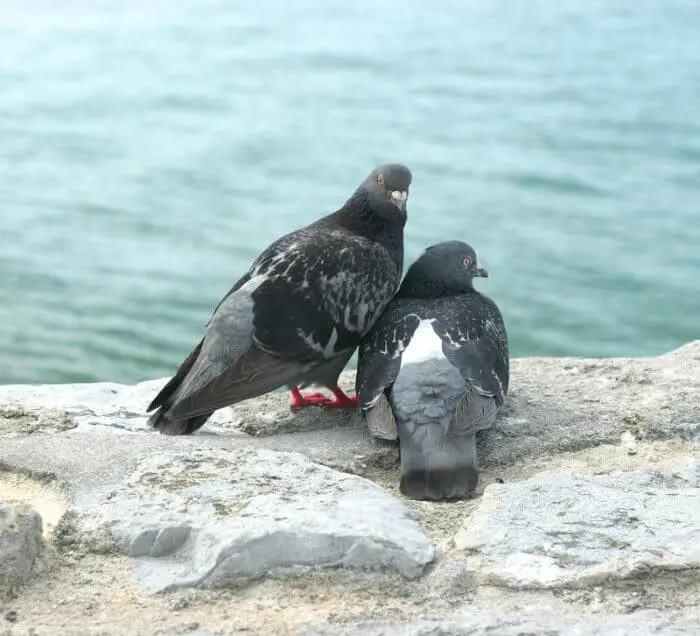
Places where they haven’t been able to establish are the High Arctic, the driest interior of the Sahara Desert, and Antarctica.
There is no distinction in habitats. All Columbidae species can be terrestrial, semi-terrestrial, or arboreal.
They can live in temperate woodlands, tropical forests, on sandy atolls and rocky mountains, in grasslands, savannah, and deserts, and of course, towns and cities.
Although they are found in any habitat, ranges vary among the species. Some have very large ranges.
For example, the Eurasian Collared Dove can be found from China to India and the Middle East, to Europe and Britain. The Eared Dove can be found across the whole of South America.
Other species have more restricted ranges, some being found in just one place.
For example, the Whistling Dove is only found on Kadavu Island in Fiji and The Grenada Dove is only to be found in the country of the same name.
Others are even more restrictive. The Somali Pigeon only lives in a tiny area of Northern Somalia, the Black-Banded Fruit Dove lives only in Arnhem Land in Australia, and Moreno’s Ground Dove is only found In a small area of Northern Argentina.
The Rock Dove – which all domestic and feral pigeons are descended from – has the largest distribution. Its range stretches from Ireland to China.
4. Calls
Doves have long been associated with a melodious cooing but ‘pigeons’ also make this sound (because they’re the same!).
The coo can vary according to different situations. For example, the coo may become something like “oorh” when the bird is alarmed.

Some breeds have developed unique vocalizations that are significantly different from the coo.
Trumpeter pigeons are so called because their call is a rolling, drum-like sound rather than a gentle coo.
Several domesticated breeds of fancy pigeons are called trumpeters.
The Bottom Line
Much like humans, pigeons/doves are very similar in general outward appearance, sharing many of the same characteristics.
Biologically, they all belong to one family, and the names “dove” and “pigeon” do not mark a scientific divide.
Sources:
- Difference between the vocalizations of two sister species of pigeons explained in dynamical terms. (opens in new tab)
- Diversity of feeding habitats and diet composition in the turtle doves Streptopelia turtur to buffer loss and modification of natural habitats during breeding season. (opens in new tab)
- Pigeonetics takes flight: evolution, development, and genetics of intraspecific variation. (opens in new tab)
Last updated 23 October 2026 · Types