
Maybe you’ve never given much thought to pigeons, other than to notice them walking around in your community.

Did you know that many people keep pigeons as pets? That’s right! And there are so many reasons why.
On top of that, there are some really cool facts about pigeons that are sure to make you love them just as much as any bird lover.
Even if you never end up holding a pigeon or keeping one in your home, it’s fun to learn more about these birds that live in your city. Check out these fascinating facts and get ready to love pigeons.

1. They Can Recognize Themselves
Research studies have found a unique pigeon specialty: pigeons can recognize themselves.
Only a handful of animals have shown signs of self-recognition, which makes this a notable finding.
This came from mirror and video tests, in which trained pigeons learned to tell their own image apart from a photo of another pigeon.
One 2008 study found that pigeons could recognize a slightly delayed video of themselves, a self-recognition task (opens in new tab) that many children under about three years old fail.
Not only that, but pigeons are also able to differentiate among humans when looking at photos.
2. Pigeons are Very Fast
Ever heard of pigeon racing? It’s a real thing and that’s because pigeons are very fast when they take to the skies.

The fastest recorded pigeon flight clocks in at 92.5 miles per hour, though the typical racing velocity of a pigeon in flight is around 50 to 60 mph.
3. They Aren’t That Dirty
Many city dwellers claim that pigeons are dirty and spread disease and that we should stay away from them.
This claim is often exaggerated. Pigeons keep themselves clean, and the risk to healthy people is low, although their droppings can carry some diseases, such as psittacosis, so basic hygiene matters.
It’s still best to stay away from wild pigeons, both to avoid disturbing them and as a sensible hygiene precaution.
4. Pigeons are Spiritual to Some Religions
In several religions around the world, pigeons are considered spiritual and people feed and care for them for that reason.
This includes some Muslim, Sikh and Hindu communities. Unless you’re taking part in such a religious ceremony, it’s best not to feed the pigeons in your community, especially with bread, which doesn’t contain the nutrients that they need to stay healthy.

Other religions see the pigeon as a spiritual symbol as well. According to some folk beliefs in India, the soul of a person who has died can return in the form of a bird and watch over their loved ones.
In Christianity, the pigeon (or more specifically the dove) represents the Holy Spirit and is a symbol of peace.
5. They are Incredibly Social
Unlike some other bird species, you will usually see pigeons living in groups, which can range from 20 to 30 birds. That’s because pigeons love to be social and interact.
If you keep pigeons as pets, you’ll likely notice that they like to be around you and will tolerate being held and touched much better than other birds that people commonly keep as pets.
6. Pigeons Mate for Life
In most cases, pigeons mate for life. They’ll choose their mate and continue to produce several broods together over the course of their lifespan.
Once mated, pigeons are also monogamous and will stick with only the mate they’ve chosen.

Pigeons who are mated will build their nests together and will raise their young together.
7. Both Sexes Incubate the Eggs
Unlike with some bird species, both the mother and the father pigeon help to incubate eggs until the babies hatch.
Most of the time, the mother pigeon will sit on the eggs from midafternoon, through the night and to mid-morning.
Then the father pigeon will take over from mid-morning to midafternoon so that the mother pigeon can look for food and take a rest. Once the babies hatch, both parents will care for them.
8. Pigeons Both Feed Their Babies
As mentioned above, both the mother and father pigeon participate in caring for the hatchlings.
Both parents feed the babies and offer a mixture called crop milk.

This is a rich, cheese-like secretion from the lining of the parents’ crop, later mixed with softened seeds, which the parents regurgitate straight into the baby pigeon’s mouth.
In this way, both the parent pigeons play a role in raising the babies.
9. You Might Not Realize You Are Seeing Baby Pigeons
There’s a conspiracy theory that pigeons are drones that spy on us and report back to the government and that’s why you never see a baby pigeon, this is also the theory behind the viral phrase; “the birds work for the Bourgeoisie“.
While these kinds of stories are certainly fun to speculate about, in this case, it’s been entirely debunked.
Unlike other bird species, baby pigeons can remain in the nest for up to six weeks so by the time they fly the coop, they’re already nearly fully grown and look like an adult pigeon.
Look closely, though, and you might see that baby pigeons aren’t red around their eyes yet, like an adult pigeon.
That color comes later, at around sexual maturity, which occurs between seven months and one year of age.
10. Pigeon Guano Was Once Revered
You probably never would have imagined that pigeon poop was once something people sought out, rather than moaned about as it covered the outsides of the buildings where pigeons nest.

However, many centuries ago, pigeon guano was considered quite valuable as a fertilizer and guards were often employed to watch over the pigeon coops to keep people from coming along and stealing the pigeon guano.
11. They Can Help Tell the Weather
Pigeons have much better hearing than humans and can hear very low frequencies that we cannot.
For that reason, they may be able to sense distant storms long before we can hear them.
They might also be able to detect when a volcano may be about to erupt, something that humans can’t do simply by listening.
12. Pigeons Have Been Around for Thousands of Years
Long before books and the internet, ancient peoples were recording the presence of pigeons.
They date back at least as far as 3000 BC as scientists found what they believe are the first recorded images of pigeons in Mesopotamia (which is now Iraq).

The people of ancient Mesopotamia are thought to have been among the first to domesticate the rock pigeon, the ancestor of the pigeons we see in cities and farms today.
13. They Can Be Part of a Large Communication System
With today’s modern methods of communication, such as the smartphone, email and texting, the need to deliver messages in other ways has virtually disappeared.
However, there was a time when pigeons were used as part of the largest communication system in the world. Using pigeons as messengers dates back thousands of years, to ancient Egypt and Persia.
Egypt and Syria had famous pigeon post networks in the Middle Ages, and Egypt’s traditional pigeon towers, used to raise pigeons, are still a common sight today.
Pigeons can carry up to 10% of their body weight and were once used to carry the results of the Olympic Games to those who wanted to know how they turned out. Pigeons were also used extensively during wartime to carry messages back and forth across enemy lines.
The last pigeon post was disbanded in India in 2008, and while pigeons can still be taught to carry messages and return home, it’s not a system that’s used much anymore.
14. Pigeons Have Saved Many Lives
As mentioned above, pigeons were often used during wartime to carry messages around, even in enemy territory. For that reason, they are credited with saving many lives.
Pigeons were released when a boat was sinking to alert help where to find them before everyone drowned.
During WWI, pigeons were used to carry messages back and forth from the trenches, helping save many lives behind enemy lines.
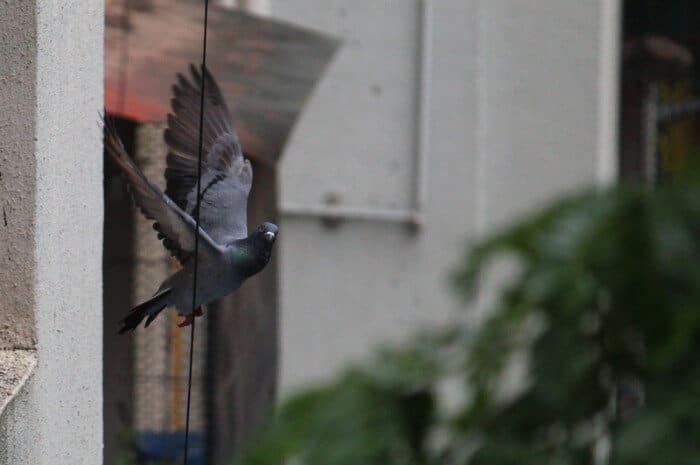
During WWI and II, pigeons were used to fly important communications back and forth across the English Channel.
Pigeons have received many honors from both the French and British governments. Cher Ami, a pigeon serving with the US Army in France, was shot but still delivered its message, flying about 25 miles in around 25 minutes.
Another pigeon named G.I. Joe was credited with alerting British troops that an Italian town they had just captured was about to be bombed by Allied aircraft. With five minutes to spare, the troops were saved, thanks to a pigeon.
15. They Aren’t Really Bobbing Their Heads
When you see pigeons walking, you might think they are bobbing their heads as they go.
But that’s not actually what’s happening. There are movements happening called the thrust and hold.
During the thrusting movement, birds are moving their heads forward so they can see around and the hold movement allows their bodies to catch up with their heads.
Researchers used treadmills to study the pigeons and found that they do this so they can see what’s happening in their environment, which offers protection from predators and allows them to look for food.
The thrust and hold motions happen so quickly that it might appear they are bobbing their heads.
16. Pigeons Have Delivered the Mail
You’ve already read about how pigeons delivered messages during wartime and to let people know the results of a sporting competition.
But pigeons have also been called upon to deliver the mail. This started in 1896 when pigeons were used to carry communications between Auckland and Great Barrier Island in New Zealand.
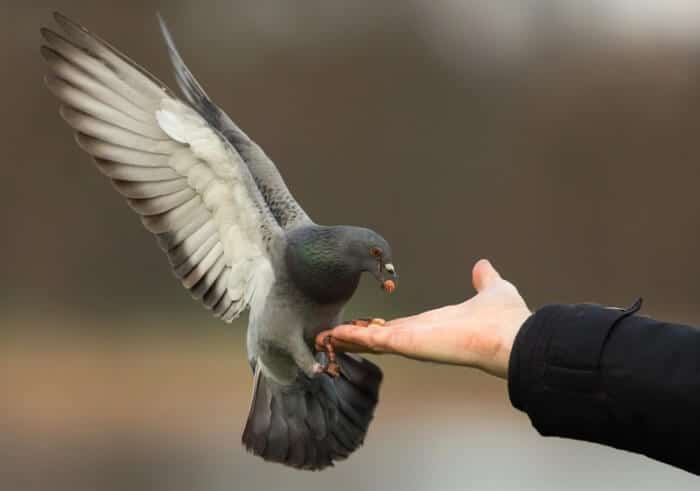
The messaging service was created as a result of a sinking ship that no one knew was in trouble until three days later, resulting in more than 100 deaths.
The pigeons could carry messages back and forth very quickly between the two locations.
17. They Were Used in Finance
When you think about finance, pigeons probably aren’t the first thing that comes to mind.
In the 1800s, the banking Rothschild family is often said to have used trained homing pigeons to carry financial news, and a popular legend claims they learned of Napoleon’s defeat at Waterloo this way, although historians consider that story a myth. Pigeons were, however, genuinely used to send financial news: in 1850 Paul Julius Reuter used them to fly stock prices between Aachen and Brussels, helping to found the Reuters news agency.
18. Pigeons are Excellent Racers
Most people look at pigeons and see pests that take over the city and poop all over the place.
However, others look at pigeons and see money. That’s because pigeons are very fast and can be used in pigeon races, which brings in big money.

Champion racing pigeons can cost a lot…the record for the most expensive pigeon ever sold was almost $1,900,000 in 2020.
19. Celebrity Pigeon Fanciers
Pigeons aren’t only interesting to ornithologists and religious individuals. Many celebrities and famous people have an interest in pigeons as well.
The British Royal Family (opens in new tab) has kept racing pigeons at the Sandringham Estate in Norfolk for more than a century, with Queen Elizabeth II a keen patron of the sport, and Mike Tyson keeps several pigeons as pets.
The inventor Nikola Tesla was famously devoted to the pigeons he fed in New York.
Pablo Picasso loved doves and pigeons so much that he named his daughter Paloma, the Spanish word for dove.
20. Some Pigeons Have Gone Extinct
Passenger pigeons went extinct in North America only at the beginning of the 20th century.

At the time, experts estimate that between three and five billion passenger pigeons had lived in the continent, but they were completely wiped out, mainly by large-scale hunting and habitat loss. The last known passenger pigeon, Martha, died in 1914.
The Revive & Restore Project (opens in new tab) is an attempt to bring back the passenger pigeon.
21. They Can Make Sea Rescues
Because pigeons are so intelligent and have such good eyesight, they have also been trained to help rescue people lost at sea.
They are taught to look for red or yellow life jackets so they can notify rescuers where to go to pick up the person.
In US Coast Guard trials in the 1970s and 1980s (Project Sea Hunt), pigeons spotted targets around 90% of the time, compared with under 40% for human crews, although the program was never put into regular use.
22. Man is a Pigeon’s Main Predator
You might be surprised to learn that humans are the biggest threat to pigeon populations. That’s due to widespread control measures to keep the number of pigeons under control in urban areas.
As you read above, hunting pigeons can also wipe them out. In terms of natural predators, however, the peregrine falcon is the biggest threat to pigeons in the wild.
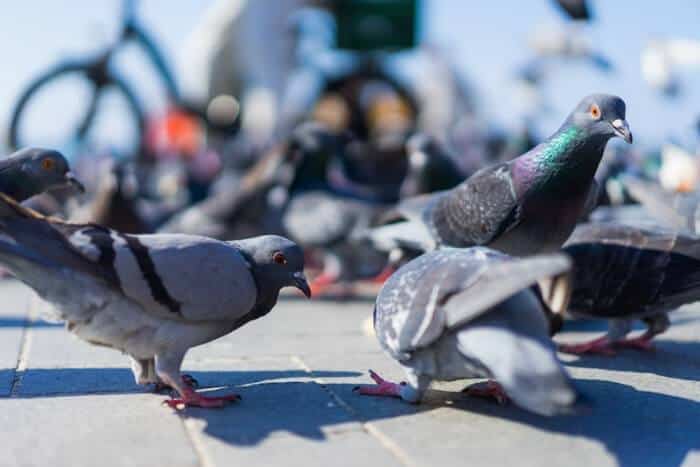
Peregrine falcons can reach well over 200 miles per hour in a hunting dive, far faster than any pigeon, and they are adept at hunting them in cities as well as along rocky coastlines, which experts say provides natural population control.
23. Pigeons are Good at Hiding Their Nests
Unlike other bird species, pigeon nests are not usually built in trees. Instead, they create them on flat rooftops, sheltered areas in urban areas and in rocky areas in rural areas.
For this reason, you’ve probably never seen a pigeon nest.
They are usually built from twigs and sticks and aren’t very sturdy at the beginning.
But, since pigeons use the same nest for many broods of babies, the droppings of the babies and parents tend to build up and harden inside the nest, creating a hard shell that keeps the nest intact for quite some time.
24. They Can Be Very Small or Much Larger
One of the most fascinating things about pigeons is the variation in size, with the small ones weighing just over an ounce and the largest weighing up to around 8 pounds.
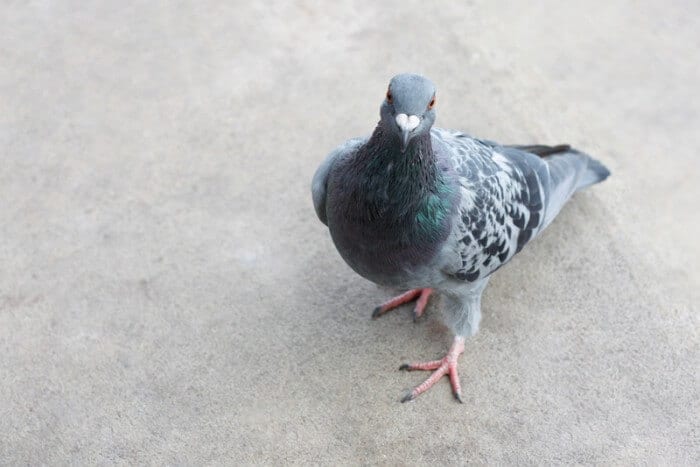
Pigeons also range in length from about 5 inches to around 30 inches. The smaller ones aren’t necessarily babies and size is determined by many factors, genetics being one of the main ones.
25. Pigeons Can Learn the Alphabet
You already know that pigeons are smart animals, but you might not know that they can learn to tell letters apart. In one classic experiment, pigeons learned to distinguish all 26 letters of the English alphabet, and a 2016 study showed they could learn to tell real English words from made-up ones.
This doesn’t mean they can read, but it shows how strong their visual memory is, the same kind of skill that may help them navigate their way home using landmarks.
Did you know any of these pigeon facts?
They are more than just the “pesky” creatures you see in downtown areas. Now that you know so much more about these interesting birds, you might be more tolerant of them when you see them roaming around the city.
Think you know your pigeons? Try our 12-question pigeon quiz.
Last updated 23 October 2026 · Facts